
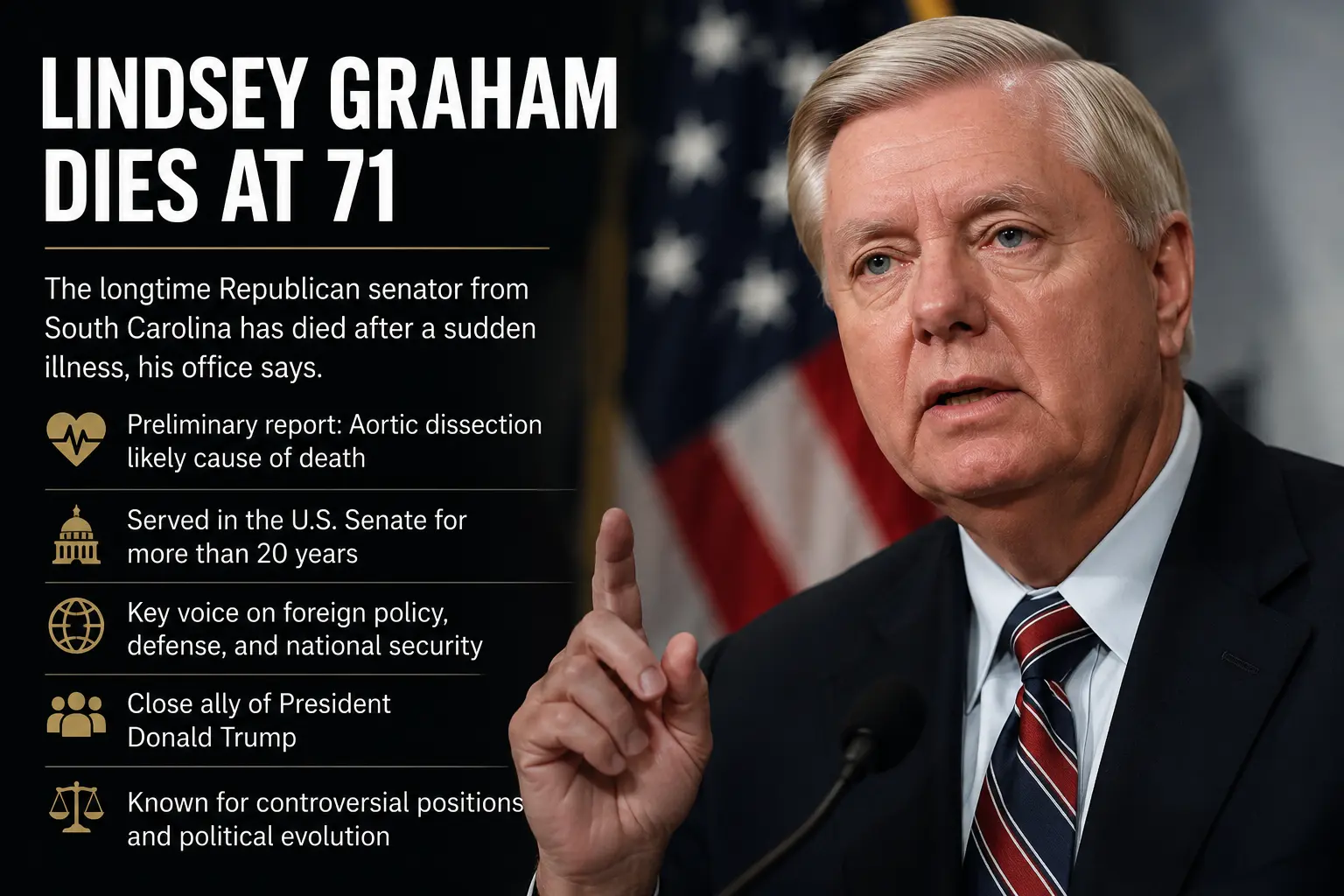
US Senator Lindsey Graham, one of the most influential Republican figures in Washington and a close ally of President Donald Trump, has died at the age of 71, triggering a wave of political reaction and renewed debate over his long and often controversial career.
According to statements reported by major US media, Graham died after what his office described as a brief and sudden illness. A preliminary medical report later indicated that the likely cause of death was an aortic dissection, a serious condition involving a tear in the wall of the body’s main artery. His sudden death came shortly after he had returned from a trip to Ukraine, adding to the attention surrounding the timing of the announcement.
Graham represented South Carolina in the US Senate for more than two decades and became one of the most recognisable Republican voices on foreign policy, national security and judicial matters. He served on several powerful Senate committees and was widely known for his hawkish approach to global affairs.
His death has created immediate political uncertainty in Washington. Graham was not only a senior Republican senator, but also a key figure in budget negotiations, national security debates and legislation related to Russia, Ukraine and defence spending. His death also comes at a sensitive moment for US-Iran talks, as Washington continues to manage tensions involving Tehran, Gulf security and wider regional diplomacy. His absence leaves a significant gap inside the Republican Party at a time when Congress is already dealing with major domestic and foreign policy challenges.
However, Graham’s legacy is far from simple. Supporters saw him as an experienced lawmaker with deep knowledge of defence and foreign affairs. His views were often shaped by a hardline approach to security threats, including debates over sanctions, military pressure and the risk of war with Iran. Critics viewed him as one of the most controversial Republican senators of his generation, especially because of his strong support for US military power, backing for Ukraine against Russia, and firm support for Israel.
His political evolution also drew heavy attention. Graham was once a sharp critic of Donald Trump during the 2016 presidential race, questioning Trump’s fitness for office. But in later years, he became one of Trump’s closest allies in Congress. That shift became one of the defining controversies of his career, with opponents accusing him of political opportunism and supporters arguing that he adapted to the direction of the Republican Party.
Graham was also frequently criticised by progressive groups for his positions on immigration, abortion, gun rights and the judiciary. At the same time, he occasionally worked across party lines, particularly earlier in his career, on issues such as immigration reform and national security.
The political question now turns to who will replace him in the Senate. His death could reshape the balance of influence among Republicans, particularly on foreign policy and defence issues. It may also open a difficult political battle in South Carolina, where Graham had long remained a dominant Republican figure.
For Washington, Lindsey Graham’s death is more than the loss of a senior senator. It marks the end of a political career that reflected many of the tensions inside modern American conservatism: loyalty to party, military intervention abroad, shifting alliances, and the rise of Trump-era Republican politics.