
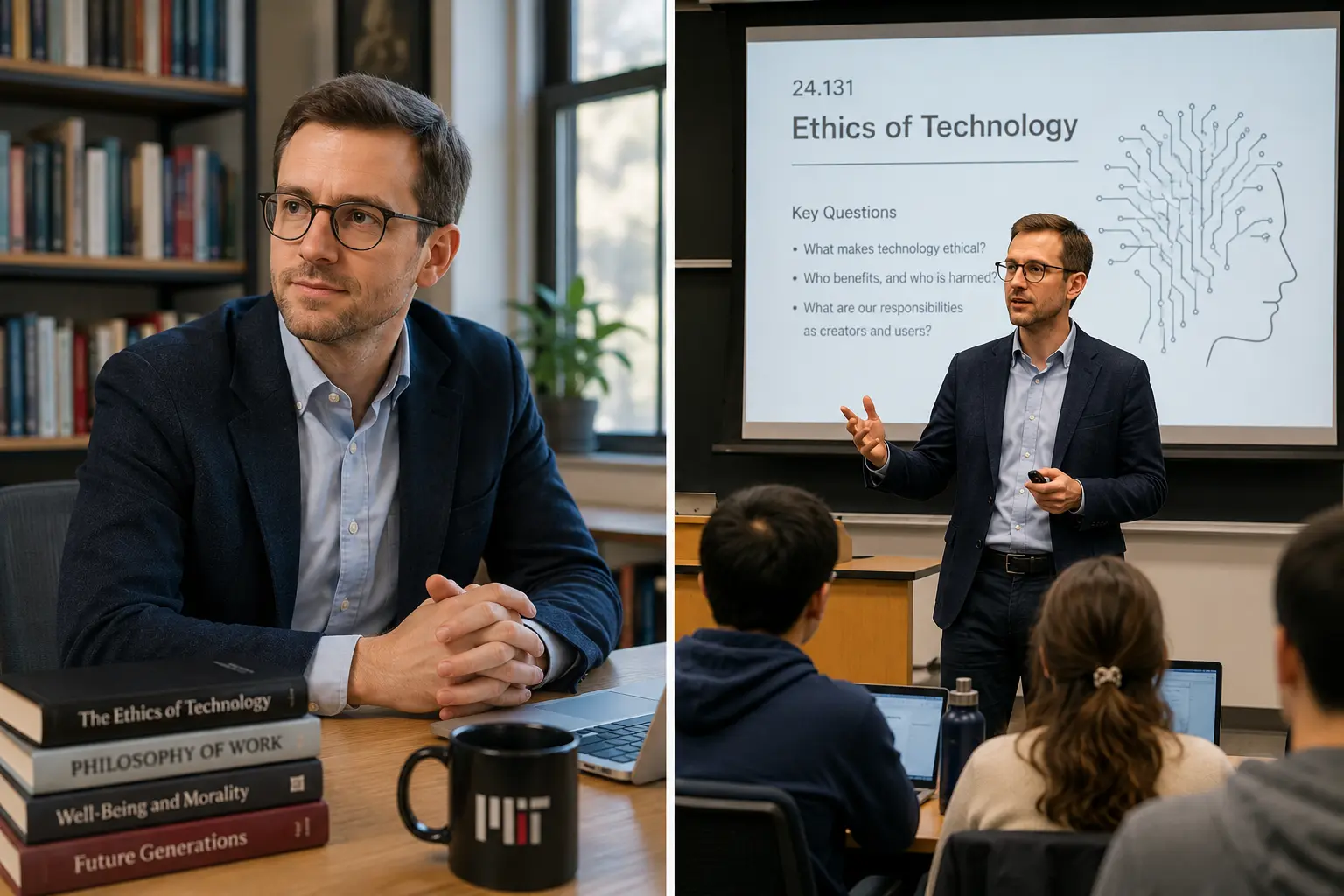
Work is often discussed in terms of income, productivity and efficiency, but MIT philosopher Michal Masny is asking a deeper question: what makes work valuable in the first place? As the NC Ethics of Technology Postdoctoral Fellow in the MIT Department of Philosophy, Masny studies the role work plays in human life and how new computing technologies may reshape people’s well-being, social identity and sense of purpose.
For Masny, work is not valuable only because it provides a paycheck. It can also give people a place to develop skill, contribute to society, receive recognition and build community. That is why he is cautious about futures in which work is dramatically reduced or removed altogether. While shorter working weeks or greater automation may bring real benefits, Masny argues that eliminating work completely would not necessarily improve life for everyone.
Why Work Still Matters
Masny’s research challenges the idea that leisure alone is the goal of human progress. He argues that work can be both necessary and positively valuable, because it gives structure to people’s lives and offers opportunities for achievement, responsibility and connection. A society with less work may be desirable in some ways, but a society with no meaningful work could also lose something important.
This question has become more urgent as artificial intelligence and automation change the nature of jobs. If machines can perform more tasks once done by people, society must decide not only how to distribute income, but also how to preserve the forms of meaning, contribution and recognition that work can provide.
Teaching Ethics Alongside Technology
During his fellowship at MIT, Masny has worked to connect philosophy with computing education. He teaches Ethics of Technology and has also helped students examine the social and ethical consequences of technical projects. His goal is to help future scientists and engineers think more carefully about the outcomes of the technologies they build.
Masny argues that the old division of labor is no longer enough. Traditionally, engineers and scientists created new technologies, while philosophers, lawyers and policymakers evaluated them later. But because modern technologies are developed and deployed so quickly, ethical thinking must happen earlier in the process. Builders of technology need to understand social consequences from the beginning, not after the damage is already visible.
Closing the Wisdom Gap
Masny’s broader teaching philosophy is shaped by a concern that society may become technologically powerful without becoming wise enough to use that power responsibly. He believes students in science and engineering should learn to ask philosophical and legal questions, while students in the humanities should understand enough about technology to engage with its real-world impact.
This approach reflects the purpose of the NC Ethics of Technology Fellowship, which was established in 2021 with support from the NC Cultural Foundation. The program aims to advance research and public discussion around the ethics of technology and artificial intelligence, while making these debates more accessible to the wider community.
Questioning Everything
Masny arrived at MIT in 2024 after completing postdoctoral work at the University of California, Berkeley. Originally from Poland, he earned his doctorate in philosophy from Princeton University after studying at Oxford University and the University of Warwick. His research spans value theory, ethics of technology, political philosophy and questions about the future of humanity.
His interests include human and animal well-being, obligations to future generations, existential risks, the future of work and anti-aging technologies. These topics may seem broad, but they are linked by a common concern: how people should live well in a world shaped by powerful scientific and technological change.
Deepfakes, Ethics and Student Research
At MIT, Masny has also worked with students on ethical questions surrounding deepfakes. As part of the Social and Ethical Responsibilities of Computing Scholars Program, he led a research group focused on the ethical, political and knowledge-related problems created by misleading synthetic media.
Students in the group explored how deepfakes can distort public trust, influence politics and complicate the way people judge truth online. They later presented their findings during the MIT Ethics of Computing Research Symposium, contributing to a wider campus conversation about the responsibilities that come with new computing tools.
A More Engaging Philosophy Classroom
Masny also wants to rethink how philosophy is taught. He believes undergraduate philosophy classes should feel less like passive lectures and more like active events where students are invited into a serious conversation. Instead of treating lectures like audiobooks, he prefers a classroom experience closer to a discussion, interview or live exchange of ideas.
For him, philosophy is useful beyond academic study because it trains people to ask better questions. Better questions can lead to clearer answers, sharper reasoning and a stronger ability to identify hidden problems. That skill is especially important in technology, where the way a question is framed can shape the design and consequences of an entire system.
Final Outlook
Masny will begin teaching at the University of Colorado Boulder in fall 2026, where he plans to continue his research into the value of work and the ethical challenges of emerging technologies. His time at MIT has placed him at the intersection of philosophy, computing and public responsibility, helping students and researchers think more carefully about the human impact of innovation.
As artificial intelligence becomes more powerful, questions about work, meaning and responsibility will only grow more important. Masny’s work suggests that the future of technology should not be measured only by what machines can do, but by how human lives, communities and values are shaped in the process.