
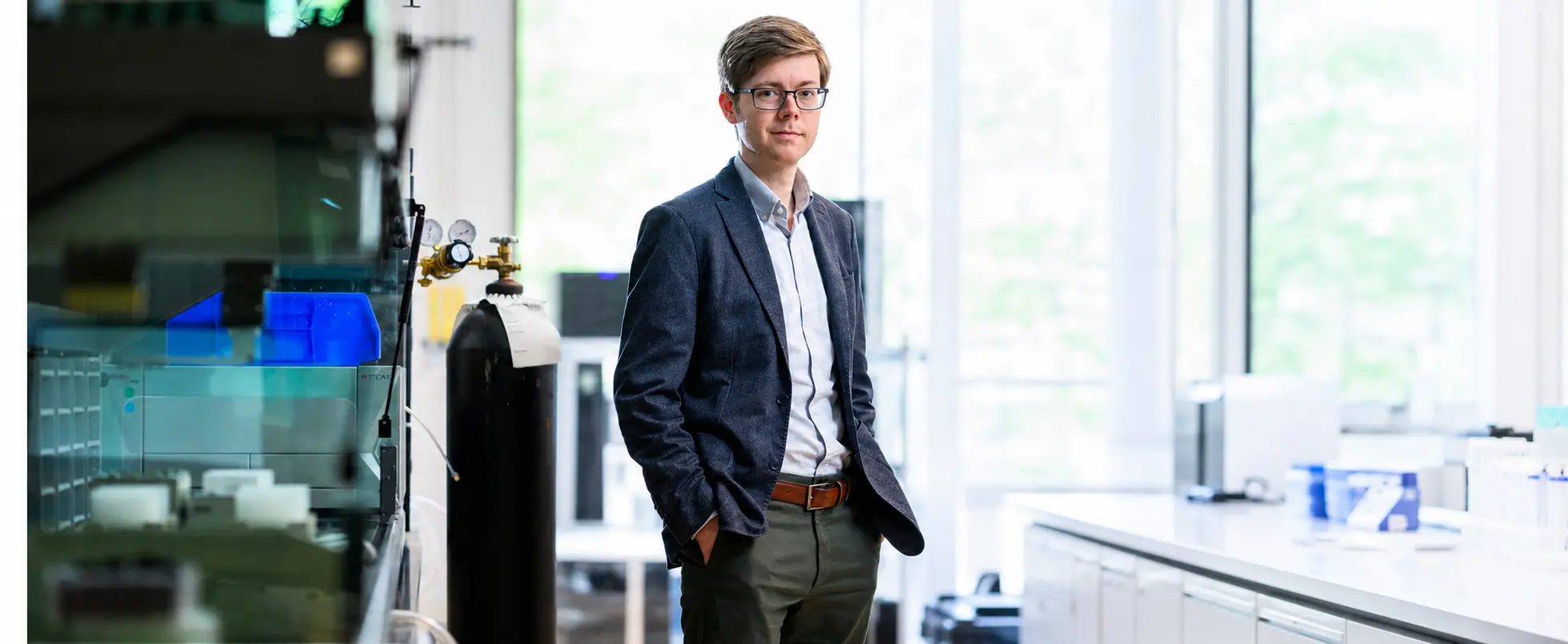
Artificial intelligence is becoming one of the most powerful tools in modern drug discovery, especially in fields where the number of possible solutions is far too large for traditional laboratory testing. In chemistry, that challenge is enormous. Scientists estimate that between 10²⁰ and 10⁶⁰ possible chemical compounds could have potential as small-molecule drugs, making it impossible to test every candidate experimentally.
This is where researchers like MIT Associate Professor Connor Coley are trying to change the process. Coley works at the intersection of chemistry, chemical engineering, computer science and machine learning, developing artificial intelligence models that can analyze huge numbers of possible compounds, design new molecules and predict the reaction pathways needed to make them.
His work focuses mainly on small-molecule drug discovery, where researchers look for chemical compounds that could become future medicines. Instead of relying only on slow laboratory screening, AI models can help scientists identify promising candidates faster and with greater precision.
AI Meets Chemistry
Coley’s research combines machine learning with cheminformatics, a field that uses computational methods to study chemical data. During his doctoral work at MIT, he explored how automated chemical reactions could be optimized and how machine learning could help plan reaction pathways for making new drug molecules.
His early work was also connected to a DARPA-funded program called Make-It, which focused on using machine learning and data science to improve the synthesis of medicines and useful compounds from simple building blocks. This became a key turning point in Coley’s research path, giving him a deeper interest in how models can understand which chemical reactions are possible.
After completing his PhD, Coley accepted a faculty position at MIT at the age of 25. Before starting, he completed a postdoctoral position at the Broad Institute, where he gained more experience in chemical biology and drug discovery. There, he worked on identifying small molecules from massive DNA-encoded libraries that could bind to disease-related mutated proteins.
Giving AI Chemical Intuition
Since returning to MIT in 2020, Coley has built a lab focused on using AI not only to synthesize existing compounds, but also to design new molecules with useful properties and find practical ways to make them.
One of his lab’s models, called ShEPhERD, was trained to evaluate potential drug molecules based on how their three-dimensional shapes may interact with target proteins. This kind of model can help researchers better understand whether a molecule is likely to work as a drug candidate before spending time and resources on laboratory testing.
The goal is not just to make AI generate molecules randomly. Coley’s team wants models to develop something closer to medicinal chemistry intuition. In other words, the model should understand the criteria chemists care about when designing drug-like compounds.
Building Models Based on Chemical Principles
Another major project from Coley’s lab is FlowER, a generative AI model designed to predict the products of chemical reactions. What makes this approach important is that the model was built with fundamental chemical principles in mind.
For example, the researchers included ideas such as conservation of mass and required the model to consider whether the intermediate steps in a reaction pathway were chemically feasible. This matters because expert chemists naturally think about reaction mechanisms, intermediate steps and how molecules transform from reactants into products.
Many machine learning models do not automatically think in that way. Coley’s work aims to make AI systems more grounded in real chemical reasoning, so their predictions become more accurate and useful for scientists.
Why This Matters for Drug Discovery
The importance of this research goes beyond academic chemistry. Drug discovery is expensive, slow and uncertain. Finding the right molecule can take years, and many candidates fail before reaching patients. AI cannot eliminate all of that risk, but it can help researchers search chemical space more intelligently.
By using models that understand molecular shape, protein interactions, reaction feasibility and chemical mechanisms, scientists may be able to identify better candidates earlier, avoid dead ends and design new compounds more efficiently.
Coley’s lab also works on related areas such as laboratory automation, computer-aided structure identification and optimal experimental design. Together, these projects aim to push chemistry toward a future where AI and human scientists work side by side.
Final Thoughts
Connor Coley’s work shows how artificial intelligence can become more than a pattern-recognition tool in science. By building models that understand chemical principles, his research is helping AI move closer to the way expert chemists reason.
For drug discovery, this could be a major step forward. Instead of testing countless compounds one by one, researchers can use AI to narrow the search, design smarter molecules and predict how to make them. As AI becomes more deeply connected with chemistry, the future of medicine may depend not only on laboratory experiments, but also on models that understand the science behind them.