

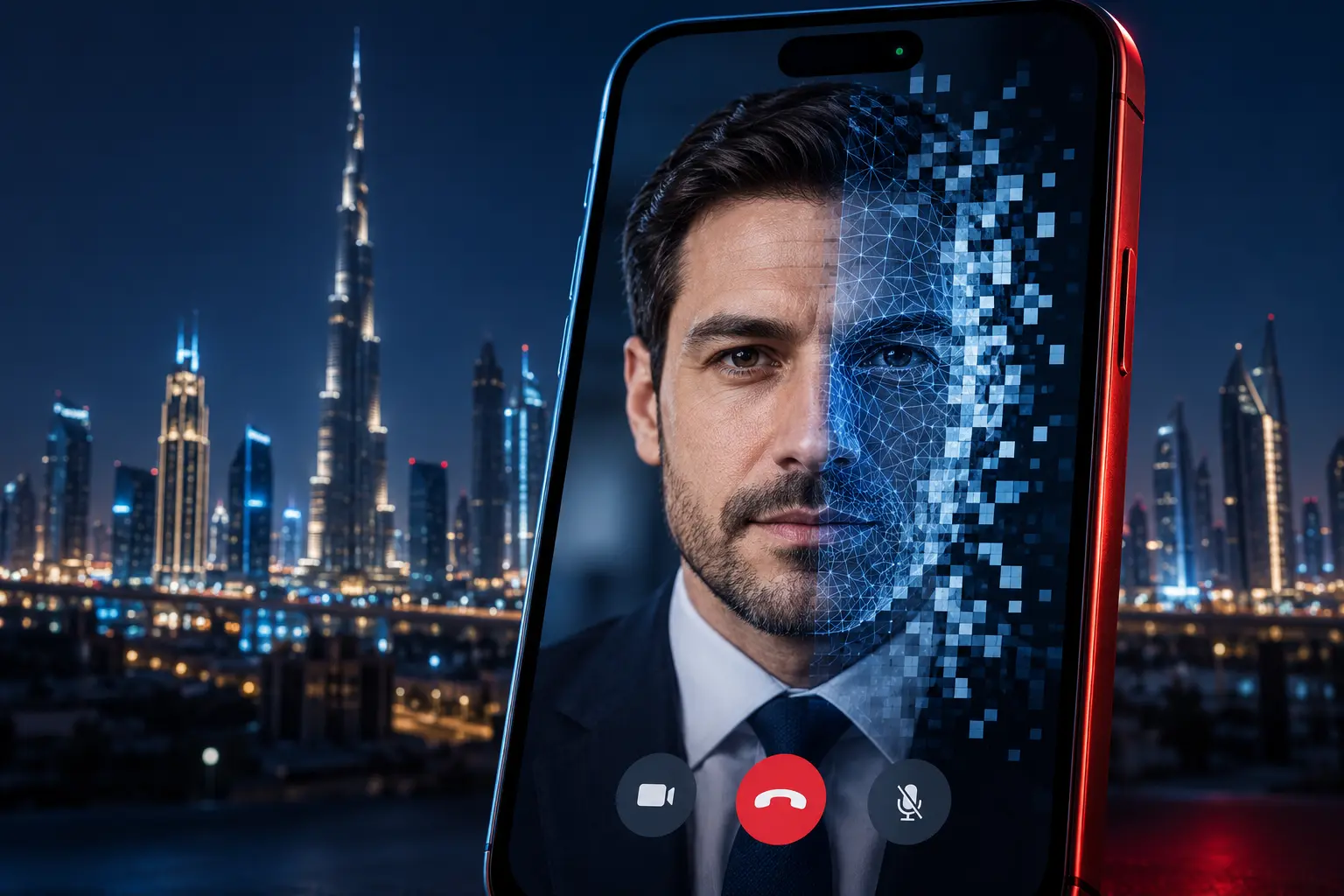
Dubai deepfake scams are becoming a growing concern as artificial intelligence makes it easier to create realistic fake videos, cloned voices, and convincing digital identities. In the UAE, scammers can use AI-generated content to impersonate business executives, family members, government officials, or other trusted people. Knowing how these scams work, and how to spot deepfake video and voice fraud, can help individuals and businesses avoid serious financial and personal losses.
Quick answer: treat any urgent video, call, or voice note that asks for money, passwords, or verification codes as unverified until you confirm it through a second channel you already trust, such as a number you saved yourself or a face-to-face check. If you have already paid, contact your bank immediately and report the case to the police.
Why Deepfake Scams Are Growing in the UAE
The rapid development of generative AI has made deepfake technology more accessible than ever. Creating a convincing fake video or cloned voice no longer necessarily requires advanced technical skills, which makes AI a useful tool for criminals. Deepfakes are also only one part of a broader trend of AI scams targeting UAE businesses, with criminals increasingly using artificial intelligence to make online fraud more convincing.
The UAE’s highly connected digital economy also creates opportunities for sophisticated online scams. Businesses regularly communicate through video calls, messaging platforms, email, and social media, while financial transactions can take place almost instantly. This combination creates the perfect environment for UAE AI scams.
A scammer may use a cloned voice to call an employee and pretend to be a manager requesting an urgent payment. In another scenario, criminals may create a fake video of a company executive or public figure to make a fraudulent request appear legitimate. Deepfake fraud can target both individuals and organisations, which is why digital awareness is becoming an important part of Dubai AI security.

Recent UAE Warnings About Deepfake Scams
UAE authorities have been warning residents about AI-enabled impersonation. In September 2026, the Ministry of Human Resources and Emiratisation (MOHRE) cautioned that scammers were creating fake videos, voice recordings, and images that appear to come from the ministry or its officials, usually with an urgent request to share personal information, click a link, or send money. MOHRE’s advice is not to trust a video or voice message just because it looks or sounds real, and to check any request through the ministry’s official channels.
In October 2025, the UAE Government Empowerment Department made a similar point about impersonation: end suspicious calls, find the official number independently, and call back to verify. It also warned that uploading personal photos to AI editing apps means sharing biometric data, which could later be misused for fake accounts, fraud, or deepfakes. Public photos and voice clips can become source material in the same way, a concern that also surfaced when Meta removed its Muse AI feature from Instagram after privacy and consent criticism.
As more government services become digital and AI-assisted, knowing which channels are genuinely official matters even more. Our guide to agentic AI in UAE government services explains what residents can expect by 2028.
What Is Dubai’s Saraab Deepfake Detection Tool?
As AI-generated fraud grows, authorities are exploring tools that can help people identify manipulated content. Saraab (written SARAAB by its developer) is an AI model built by the Dubai Electronic Security Centre (DESC) to detect deepfake videos. It was unveiled at GISEC Global 2026 in September.
DESC says the model reaches up to 91% accuracy and plans to release it as open source, naming Hugging Face as the platform. The release was still described as upcoming when it was unveiled, so check DESC’s official channels before relying on it.
Deepfake detection systems generally analyse digital media for signs of manipulation, such as facial movements, audio patterns, or image inconsistencies that are difficult for people to notice. However, users should not assume that any AI detection tool can identify every deepfake with 100% accuracy, and DESC’s own figure is below that. AI-generated content continues to evolve, and detection technology has to evolve alongside it. Saraab is also described as a video tool, so it does not replace verification for voice calls or messages. The best approach is to combine technology with basic verification habits.
How to Spot a Fake AI Video or Voice Call
Learning how to spot deepfake video content starts with paying attention to details that look slightly unnatural.
Look for:
- Unusual facial expressions or limited facial movement
- Lips that do not perfectly match the spoken words
- Strange blinking or eye movements
- Unnatural lighting or shadows around the face
- Distorted backgrounds or objects
- Audio that sounds robotic, overly smooth, or inconsistent
- Unusual pauses or changes in voice quality
- A person appearing to speak in a way that does not match their normal behaviour
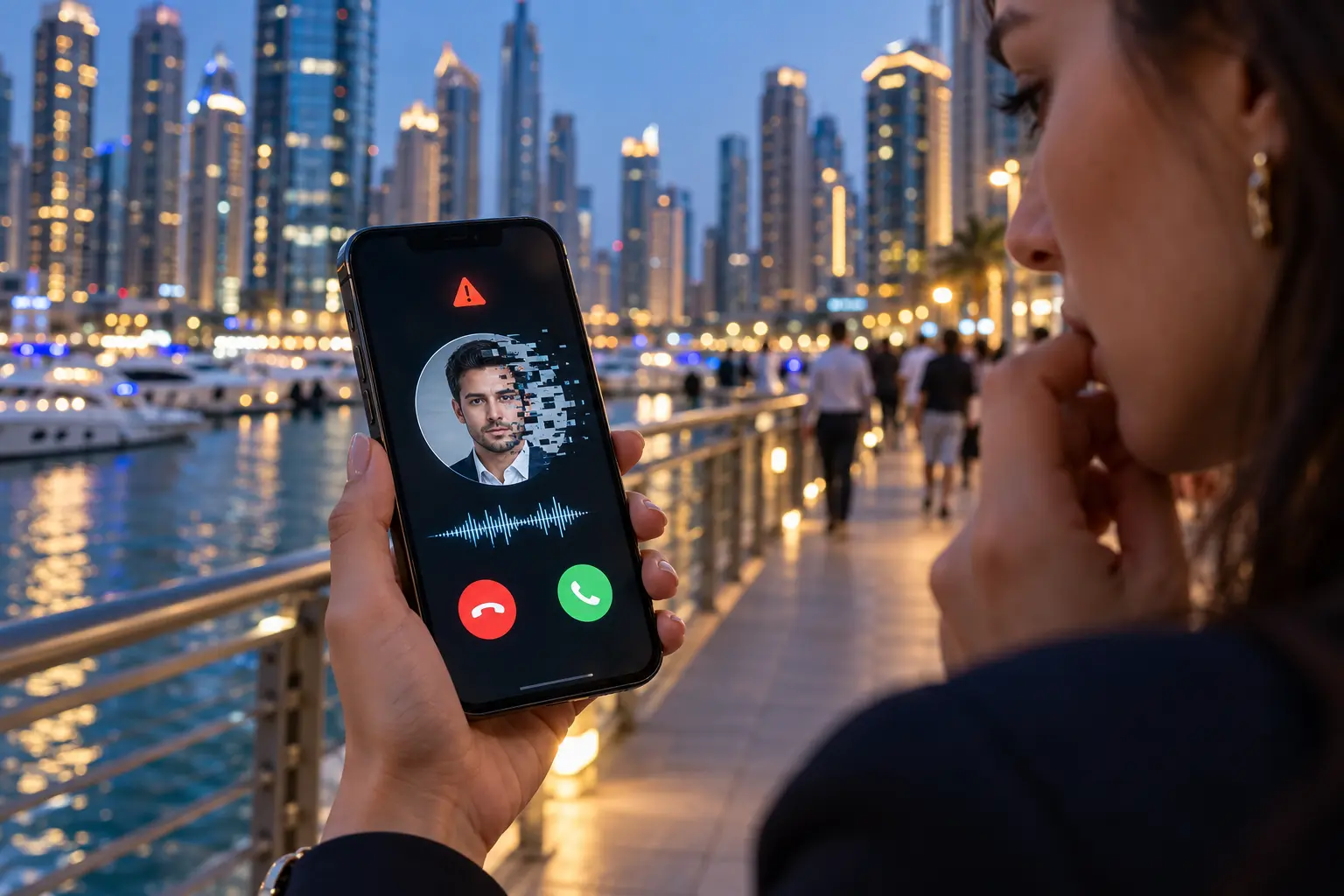
Voice scams can be even harder to identify because people tend to trust familiar voices. In a deepfake voice scam in the UAE, a criminal could clone someone’s voice and use it during a phone call or voice message. The caller may claim to be a family member who urgently needs money or a colleague who needs an immediate payment. If a request involves money, passwords, authentication codes, or sensitive information, do not rely on the voice alone. Verify the person’s identity through another communication channel.
Common Deepfake Scam Warning Signs
Many Dubai deepfake scams rely on urgency and emotional pressure rather than sophisticated technology alone.
Some common warning signs include:
Unexpected urgent requests
Be cautious when someone suddenly asks you to transfer money, share confidential information, or make an important decision immediately.
Requests to keep something secret
Scammers may tell victims not to contact anyone else because the situation is supposedly confidential or urgent.
Unusual communication behaviour
If someone who normally communicates through email suddenly calls from an unfamiliar number or asks you to switch platforms, verify the request independently.
Inconsistent details
Pay attention to names, dates, locations, payment instructions, and other details that do not match what you already know.
Emotional manipulation
Fear, urgency, authority, and excitement are commonly used to reduce the time a victim has to think. A deepfake becomes much more dangerous when it is combined with these traditional social-engineering techniques.
How to Protect Your Family and Business
The best defence against AI-enabled fraud is not simply learning to recognise fake media. It is creating a verification process that works even when the fake looks convincing. For families, consider having a simple rule: never send money based only on a phone call or voice message. You can create a family verification phrase or another private method for confirming someone’s identity during an emergency.
Businesses should have similar procedures. For example:
- Require a second person to approve unusual payments.
- Verify financial requests through an independent communication channel.
- Avoid sharing sensitive information through unverified calls.
- Use multi-factor authentication for important accounts.
- Train employees about AI-generated fraud.
- Establish clear procedures for changing bank details or payment instructions.
- Encourage employees to question unusual requests, even when they appear to come from senior management.
These practices can significantly reduce the impact of UAE AI scams.
What to Do If You Have Been Targeted
If you believe you have been targeted by a deepfake scam, do not panic and do not continue communicating with the suspected scammer. First, stop the transaction or communication if possible. If you have already transferred money, contact your bank or financial institution immediately and explain that you may have been the victim of fraud.
You should also preserve evidence. Save screenshots, phone numbers, emails, messages, recordings, payment information, URLs, and any suspicious videos or images. Do not delete the original evidence, even if the content appears obviously fake. If your account credentials or authentication information may have been exposed, change your passwords and secure the affected accounts as quickly as possible.
How to Report an Online Scam in the UAE
If you encounter a suspected online scam in the UAE, reporting it to the appropriate authorities can help document the incident and potentially prevent further victims. It is also important to understand the wider UAE social media rules, particularly when scams involve social platforms, fake accounts, or manipulated content.
According to the UAE Government portal, cybercrimes can be reported online or at your nearest police station, and 999 is the number to call for help in an emergency.
Reporting channels commonly used in the UAE include the Dubai Police eCrime service on the Dubai Police website, the Ministry of Interior app (through UAE PASS, under Police services and then eCrime services), the My Safe Society app run by the UAE Public Prosecution, and the Abu Dhabi Police Aman service. Check the current service names and steps before you report, as these channels are updated from time to time.
The UAE’s cybercrime law is Federal Decree-Law No. 34 of 2021 on Combatting Rumours and Cybercrimes, in force since 2 January 2022. It covers offences including spreading false information, although the government page does not mention deepfakes by name.
When making a report, provide as much evidence as possible, including:
- The scammer’s phone number or account
- Screenshots of messages
- Emails and usernames
- Transaction details
- Website or social media links
- Copies of suspicious videos or audio
- A timeline explaining what happened
The faster you preserve and report the evidence, the easier it may be for authorities and financial institutions to investigate the incident.
Dubai Deepfake Scams: FAQ
What is a deepfake scam?
A deepfake scam uses AI-generated or AI-altered video, audio, or images to impersonate a real person and pressure the victim into sending money, sharing data, or approving a request.
How can I tell if a video call is a deepfake?
Look for lips that do not match the words, unusual blinking, odd lighting around the face, or a distorted background. Because none of these signs is guaranteed, confirm any financial or sensitive request through another channel before acting.
Can Saraab detect voice deepfakes?
DESC presents Saraab as a model for detecting deepfake videos. For voice calls and messages, rely on verification habits such as calling back on a number you know and agreeing a family verification phrase.
Where do I report a deepfake scam in the UAE?
Report it to the police through the official channels described above, such as the Dubai Police eCrime service or the Ministry of Interior app, and include screenshots, numbers, links, payment details, and a timeline.
What should I do if I have already sent money?
Contact your bank or financial institution immediately, explain that you may have been the victim of fraud, stop communicating with the scammer, and keep all evidence.
Are deepfake scams covered by UAE law?
The UAE’s cybercrime law is Federal Decree-Law No. 34 of 2021 on Combatting Rumours and Cybercrimes. The official government page lists offences such as spreading false information but does not name deepfakes, so report any suspected case to the police and let the authorities advise on your situation.
Final Thoughts on Dubai Deepfake Scams
AI technology is becoming increasingly sophisticated, and Dubai deepfake scams are likely to remain an important cybersecurity concern as criminals find new ways to use synthetic video and cloned voices. Tools such as Saraab may help with identifying manipulated content, but technology alone cannot replace human judgement.
The most effective protection is to slow down, verify unexpected requests independently, use strong account security, and never assume that a familiar face or voice automatically means that the person is genuine. When money, confidential information, or account access is involved, verify first and trust later. For more on how AI is changing everyday life and risk in the UAE, browse our technology guides.