
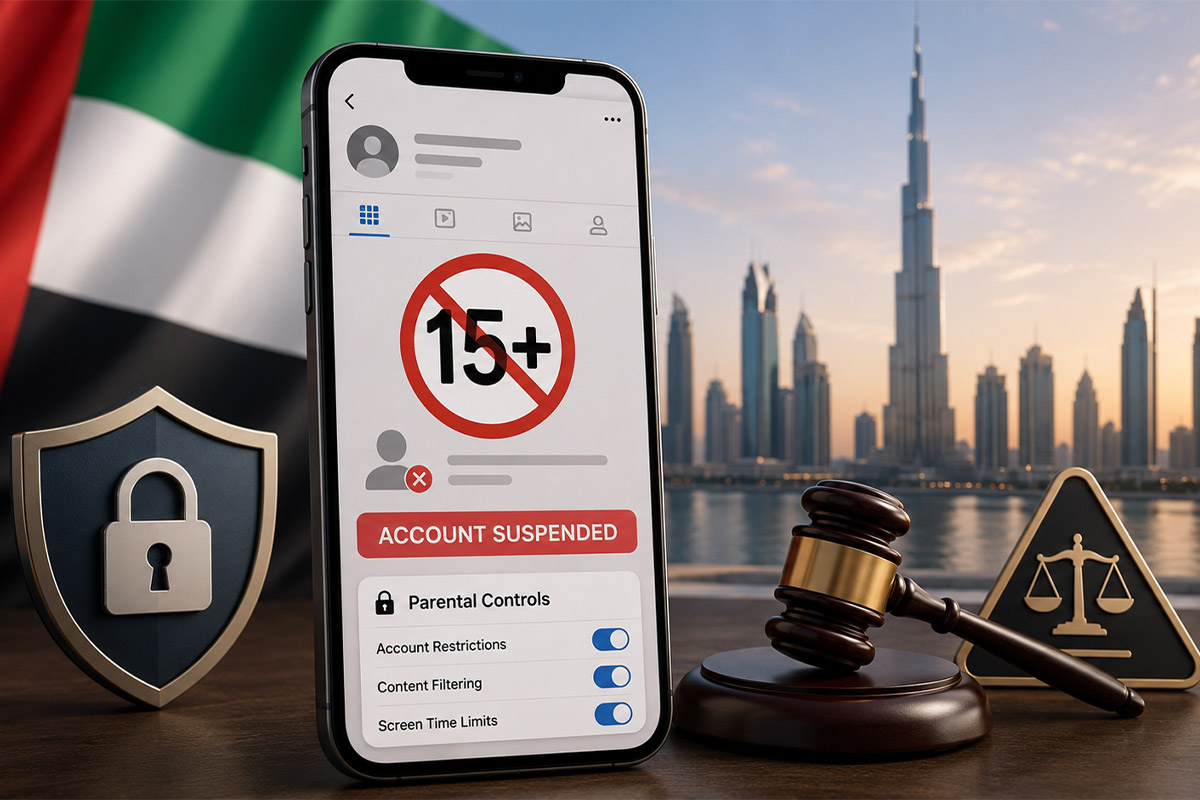
The UAE’s new social media age rule is more than a simple ban on accounts for children under 15. It is a wider digital safety framework that explains how platforms must verify age, protect children’s data, restrict risky features, control advertising and provide tools for parents and caregivers.
Announced under Cabinet Resolution No. 106 of 2026, the new rules apply to social media platforms available in the UAE or directed at users in the country. The law makes clear that children below 15 should not have personal social media accounts, while 15-year-olds will only be allowed access with extra protections built into their accounts.
The resolution also gives regulators the power to warn, penalise, partially block, fully block or close platforms that fail to comply. Social media companies will have 12 months to bring their systems in line with the new requirements.
Which Platforms Are Covered?
The law applies to any platform that allows users to create public or semi-public accounts or profiles.
It also covers services that enable social interaction, allow users to publish or share content, or use algorithms and automated systems to display, rank or recommend posts. This means the rules can apply to free and paid services, regardless of where the company is based or how its platform is technically structured.
If the service is available in the UAE or targets users in the country, it may fall under the new requirements.
What Happens to Accounts Belonging to Children Under 15?
Platforms must detect and suspend or disable personal accounts belonging to children below the age of 15.
The law also says platforms must use reasonable technical and organisational measures to stop users from bypassing the rules. This means simply entering a false date of birth will not be enough, and platforms will be expected to use stronger age-verification methods.
Parental consent will not override the restriction. In other words, parents cannot approve a personal social media account for a child under 15 if the account violates the law.
What About Children Aged 15 to 16?
Children who have turned 15 but are not yet 16 may use social media, but they will not be treated like adult users.
Platforms must apply special protections suited to this age group. These include controls over what content they can view or share, limits on public sharing, restrictions on contact with unknown users and tools that allow access times or daily usage periods to be managed.
The aim is to reduce exposure to harmful content, unsafe interactions and excessive use, while still allowing older minors limited access under safer conditions.
What High-Risk Features Could Be Restricted?
The resolution specifically highlights several features that may create higher risks for children aged 15 to 16.
These include unrestricted private messaging, open live streaming and intensive algorithmic recommendation systems. Platforms may be required to restrict or disable such features for younger users, or provide strong protection tools and safer design measures.
This is especially important because recommendation systems can quickly expose children to unsuitable content, while open messaging and live streaming may increase the risk of contact with strangers.
What Parental Controls Must Platforms Provide?
Social media platforms must provide clear and user-friendly parental control tools.
These tools should allow caregivers to supervise account settings, manage privacy levels and restrict access to certain features. Parents and caregivers may adjust the settings of accounts belonging to children aged 15 to 16, but they cannot use those tools to remove protections required by the law.
This means parental controls are meant to strengthen child safety, not bypass the legal restrictions.
What Responsibilities Do Parents and Caregivers Have?
The law also places duties on parents and caregivers. They must not help a child create or use a personal social media account in violation of the resolution. They must also not provide false or misleading information to help a child get around age-verification systems.
Caregivers are expected to supervise children’s digital activity, protect them from exploitation and online risks, raise awareness of social media dangers and encourage safe and responsible use based on the child’s age and maturity.
How Will Platforms Verify Age?
The resolution lists several possible age-verification methods. These may include verification through a digital government identity, scanning an official identity document, using official documents with biometric matching, or applying AI-based age-estimation technologies.
Platforms may also use approved and licensed age-verification service providers in the UAE, or other mechanisms approved by the Child Digital Safety Council. The message is clear: platforms must move beyond basic self-declared birth dates and adopt more reliable systems.
How Will Children’s Privacy Be Protected?
The law also includes safeguards for children’s data. Platforms must collect and process only the minimum data needed for age verification. They must follow principles such as data minimisation, purpose limitation and secure processing. Biometric data and official documents must not be kept beyond what is necessary to complete the age-check process, unless allowed by applicable laws. This is meant to prevent age verification from becoming a new source of privacy risk for children.
Can Platforms Target Children With Ads?
The resolution restricts how platforms can use children’s data for advertising. Platforms must not target children with directed advertisements based on tracking or behavioural profiling. They also cannot exploit or process children’s personal data for commercial purposes based on their digital activity.
This limits the ability of platforms to build advertising profiles around minors and use their behaviour for commercial targeting.
What Penalties Can Platforms Face?
Platforms that violate the law or fail to meet their obligations may face regulatory action. The resolution refers to warnings, closure, partial blocking, total blocking and other administrative penalties listed under the Child Digital Safety Law.
This gives UAE regulators a wide range of enforcement tools, from formal warnings to restricting or shutting down access to non-compliant platforms.
Who Will Supervise Compliance?
Two main authorities will oversee platform compliance. The National Media Authority will supervise obligations and standards linked to digital and media content involving children. The Telecommunications and Digital Government Regulatory Authority will oversee the technical obligations and standards set out in the resolution.
Both authorities will submit periodic reports to the Child Digital Safety Council, which plays a central role in approving standards and guiding implementation.
How Long Do Platforms Have to Comply?
Social media platforms will be given a 12-month transitional period from the date the resolution enters into force. During this period, the Telecommunications and Digital Government Regulatory Authority may coordinate with platform operators to improve readiness and support implementation of the technical and regulatory requirements. After the transition period ends, platforms are expected to be fully aligned with the new framework.
Final Thoughts
The UAE’s new social media law marks a major shift in how children’s digital safety will be managed. Rather than relying only on parents or simple age declarations, the framework places responsibility on platforms to verify age, suspend underage accounts, limit risky features, protect children’s data and reduce commercial targeting.
For parents, the law also makes supervision and responsible digital guidance part of the wider safety system. For platforms, the message is clear: child safety must be built into the design of social media services, not treated as an optional feature.