
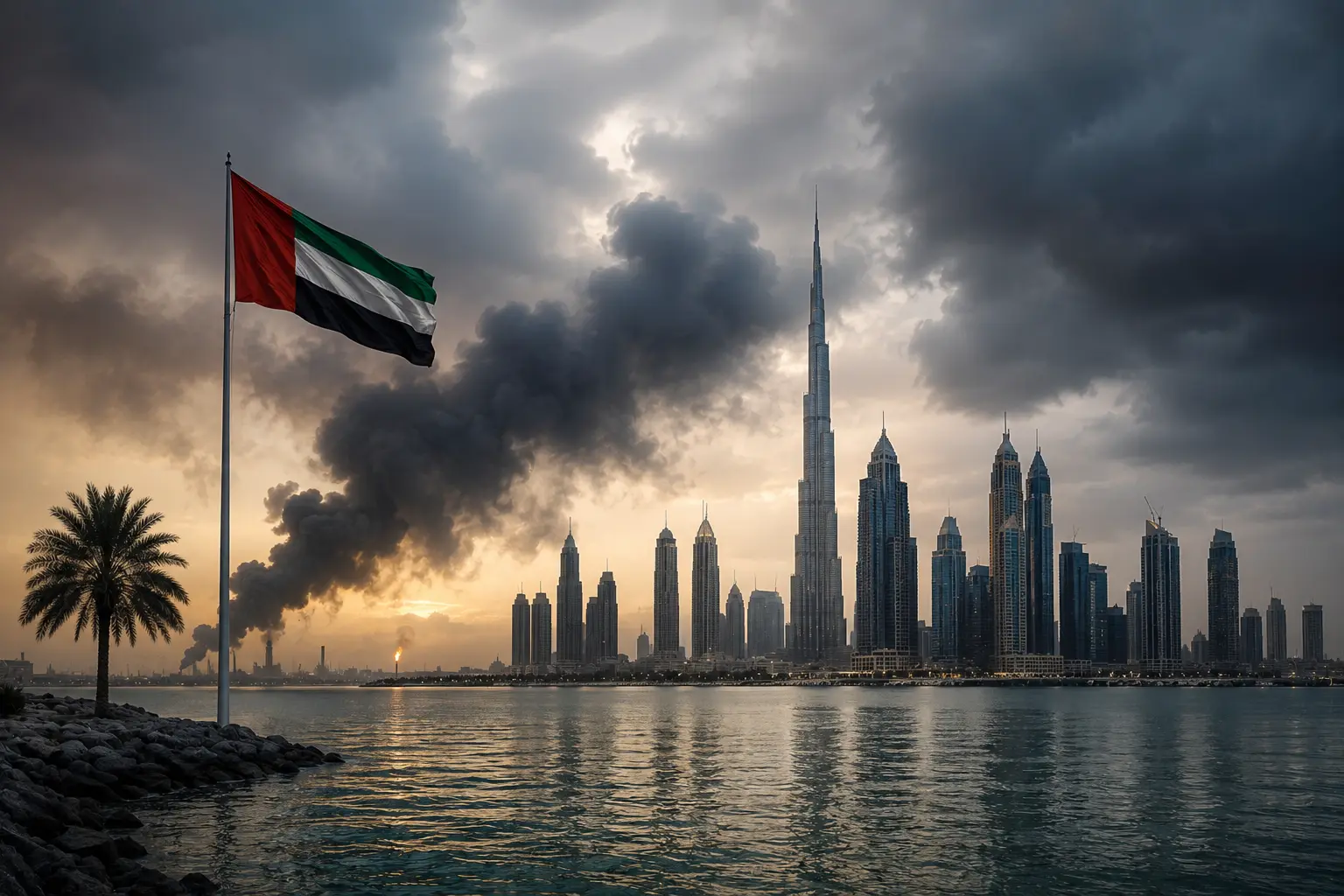
The latest wave of conflict and political unrest across the Middle East has once again placed the UAE economy under international scrutiny. Over the past week, renewed tensions involving Iran, the United States, maritime security in the Gulf and broader regional instability have affected energy markets, investor sentiment and regional stock exchanges. These developments also place renewed focus on UAE and Iran relations, especially because trade, diplomacy and Gulf security are closely connected to the UAE’s economic outlook. For the UAE, the impact is complex: higher oil prices may support government revenues, but risks to trade, aviation, tourism and real estate could test the country’s diversified growth model.
The most immediate impact has been felt in financial markets. Recent pressure on Dubai and Abu Dhabi stock markets shows how quickly regional tensions can affect investor sentiment across the Gulf. Gulf stock markets came under pressure as investors reacted to escalating hostilities and renewed concerns about the Strait of Hormuz, one of the world’s most important energy shipping routes. Gulf stock markets came under pressure as investors reacted to escalating hostilities and renewed concerns about a possible Strait of Hormuz disruption, given the waterway’s importance to global energy shipping. When regional tensions rise, investors often move away from risk-sensitive assets, and that can affect listed banks, real estate developers, logistics companies and consumer-facing businesses in Dubai and Abu Dhabi.
Oil prices are another major channel. Any threat to shipping through the Strait of Hormuz tends to push crude prices higher because the waterway is central to global energy supplies. For Abu Dhabi, which holds the majority of the UAE’s oil reserves, stronger oil prices can support fiscal revenues, sovereign investment capacity and public spending. However, the benefit is not one-dimensional. Higher oil prices can also raise global inflation expectations, increase transport costs and create pressure on interest rates. That matters for Dubai in particular, where growth depends heavily on non-oil sectors such as trade, tourism, aviation, finance and real estate.
Dubai’s economy is especially exposed to the indirect effects of regional instability. The emirate has built its success on being a stable, open and internationally connected business hub in a turbulent region. Its safe-haven reputation has attracted capital, companies, wealthy residents and entrepreneurs from across the Middle East, Russia, South Asia and Europe. In periods of conflict, this status can actually strengthen Dubai’s position if investors see it as safer than neighbouring markets. But if conflict moves closer to Gulf shipping routes or raises concerns about regional security, that same safe-haven image can face pressure.
Trade and logistics are among the most important areas to watch. The UAE is a global re-export hub, and disruptions to shipping routes can increase insurance costs, delay cargo movement and affect supply chains. Even if UAE ports remain operational and secure, uncertainty around nearby maritime routes can make businesses more cautious. This can influence importers, exporters, shipping firms and retailers that rely on predictable delivery schedules.
Tourism and aviation may also feel the pressure. The UAE’s tourism economy depends on international confidence, airline connectivity and a perception of safety. Dubai and Abu Dhabi are not only destinations but also major transit hubs. If regional conflict leads to airspace concerns, route changes or higher fuel costs, airlines may face operational pressure. In the short term, tourism demand can remain resilient, especially from markets that view the UAE as stable. But prolonged unrest could affect travel sentiment and increase costs for airlines, hotels and event organisers.
Real estate is another sensitive sector. Dubai property has often benefited from regional instability because investors move capital into a market they consider secure, liquid and internationally recognised. Dubai’s real estate market has often benefited from regional instability because investors move capital into a market they consider secure, liquid and internationally recognised. However, this advantage depends on confidence. If uncertainty becomes prolonged, some buyers may delay decisions, financing costs may remain elevated, and developers could face more cautious demand. Luxury property may remain more resilient, but the broader market could become more selective.
Banking and finance also face mixed effects. UAE banks are generally well-capitalised and supported by strong regulation, but they are still exposed to interest-rate expectations, corporate credit conditions and investor sentiment. If regional tensions keep energy prices high and global inflation concerns alive, borrowing costs may stay higher for longer. That could affect mortgages, business loans and investment appetite.
Despite these risks, the UAE enters this period with important strengths. It has large financial buffers, globally connected sovereign wealth funds, strong infrastructure and a diversified economic base compared with many energy-dependent economies. The country has also spent years positioning itself as a neutral commercial platform, maintaining business links across different regions while investing heavily in logistics, finance, technology, tourism and renewable energy.
The key question is whether the current unrest remains limited or becomes a prolonged regional crisis. If tensions ease, the UAE economy is likely to absorb the shock relatively well, with oil revenues, safe-haven capital flows and strong domestic demand helping to cushion the impact. If tensions escalate further, the risks become broader: higher shipping costs, weaker market sentiment, delayed investment decisions and pressure on tourism and real estate.
Overall, the UAE economy is not facing a simple negative shock. It is facing a stress test. War and unrest in the Middle East can create risks for trade, travel and investment, but they can also reinforce the UAE’s position as one of the region’s most stable economic centres. The next few weeks will be critical in determining whether this becomes a short-term market reaction or a deeper challenge to the Gulf’s economic outlook.