
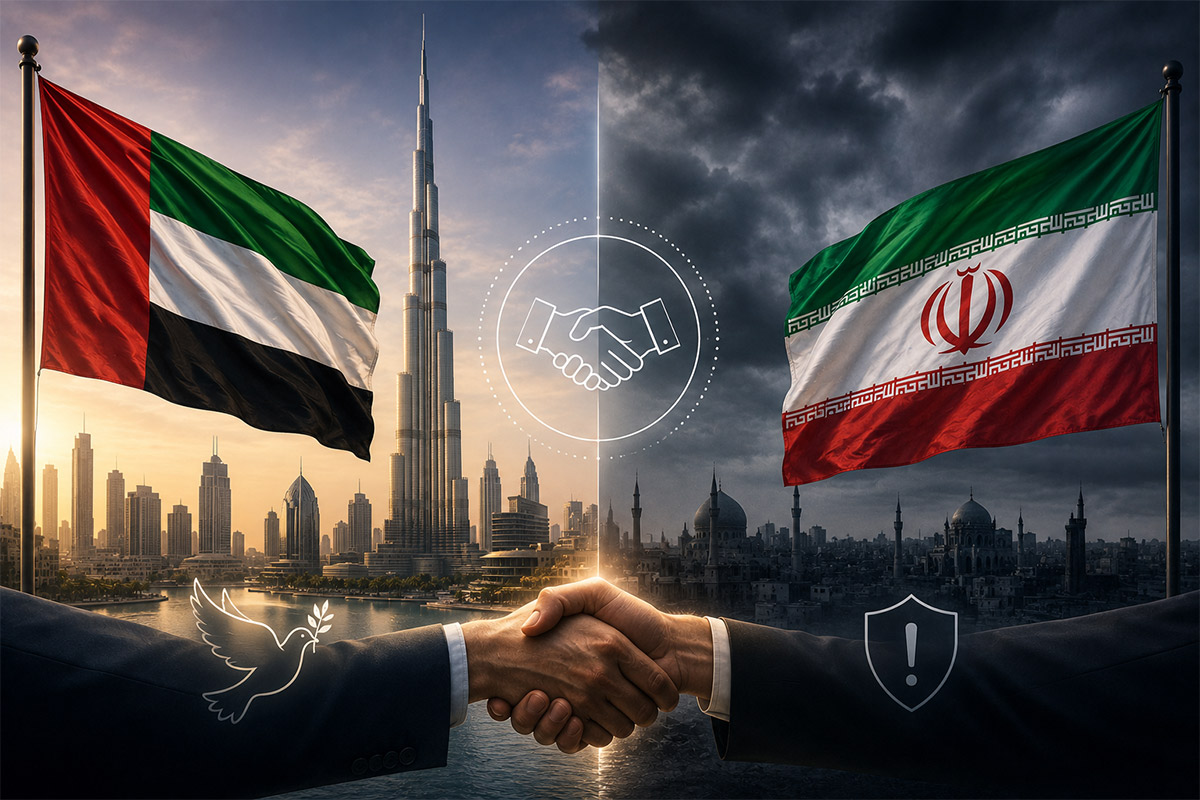
UAE and Iran relations in 2026 are defined by two competing realities: deep economic interdependence and rising regional security tensions. The United Arab Emirates and Iran are close neighbors across the Arabian Gulf, with long-standing commercial links, family networks, shipping routes, and business communities. At the same time, political disagreements, security concerns, sanctions, maritime tensions, and recent regional conflict have placed serious pressure on the relationship.
This makes Iran and UAE relations more complex than a simple “good” or “bad” label. On one hand, the two countries maintain diplomatic channels and have a long history of trade, especially through Dubai. On the other hand, the UAE has strongly condemned recent Iranian attacks and warned that diplomacy is difficult while regional threats continue. In March 2026, the UAE Ministry of Foreign Affairs summoned Iran’s ambassador and issued a formal protest over what it described as Iranian attacks on UAE territory and civilian sites.
For businesses, expats, investors, and travelers, the key question is not only does Iran and UAE have good relations, but how political tension affects trade, banking, logistics, tourism, and daily business activity in Dubai and the wider UAE.
What Are the Current Relations Between UAE and Iran?
Current UAE and Iran relations are cautious, strained, but not fully broken. The two countries maintain diplomatic relations, but the relationship has become more tense in 2026 because of recent regional conflict, accusations, and security concerns. The UAE’s official position combines two priorities: protecting national sovereignty and keeping diplomatic channels open where possible.
The UAE and Iran have a long history of trade and people-to-people links, but recent events have made the political side of the relationship much more difficult. In May 2026, Iran’s foreign minister accused the UAE of involvement in military operations against Iran during a BRICS foreign ministers’ meeting, according to Reuters. The UAE has also said its actions are defensive and aimed at protecting sovereignty and vital infrastructure, according to Reuters reporting.
This means relations between UAE and Iran in 2026 should be understood as a managed relationship rather than a friendly partnership. Trade still matters. Diplomacy still exists. But trust has been damaged by conflict and security concerns.
Does Iran and UAE have good relations in 2026?
The answer depends on which part of the relationship you are looking at. Economically, the relationship remains important. The UAE is one of Iran’s major trade partners, and Dubai has historically been one of Iran’s most important business gateways. The UAE Ministry of Foreign Affairs describes bilateral relations between the neighboring countries as “deeply historic” and notes that the economic relationship is large, although sanctions have reduced bilateral trade.
Politically and strategically, however, the relationship is under serious pressure. The UAE has condemned Iranian attacks, raised sovereignty concerns, and warned that mediation is difficult while attacks continue. Reuters quoted UAE diplomat Lana Nusseibeh saying that Iran must halt attacks before neighbors can mediate, and that restoring relations to the pre-war status quo would be difficult.
So, does Iran and UAE have good relations in 2026? The most accurate answer is: the two countries have active diplomatic and economic relations, but they are strained by regional conflict, security concerns, and political distrust.
Why relations between UAE and Iran remain strategically important
Relations between UAE and Iran matter because geography makes both countries unavoidable neighbors. The UAE sits on the southern side of the Gulf, while Iran controls the northern coastline and has influence near the Strait of Hormuz, one of the world’s most important energy shipping routes.
The UAE also has a major commercial interest in keeping regional trade stable. Dubai’s economy depends on logistics, tourism, aviation, finance, real estate, and re-export activity. Any escalation involving Iran can affect shipping costs, insurance premiums, aviation routes, market sentiment, and investor confidence.
Reuters reported in May 2026 that the UAE’s non-oil private sector grew at its slowest pace since February 2021 in April, as the Iran war weighed on shipping and tourism and hit sales and exports. The UAE PMI fell to 52.1 in April from 52.9 in March, while Dubai’s PMI dropped to 51.6, a 55-month low.
That is why UAE and Iran relations are not only a diplomatic issue. They directly affect businesses, investors, travelers, and regional supply chains.
History of Relations Between UAE and Iran
The history of Iran and UAE relations includes trade, migration, diplomatic engagement, territorial disputes, sanctions, and periods of political tension.
A simplified timeline helps explain the relationship:
| Period | Key Development | Impact on UAE-Iran Relations |
|---|---|---|
| Pre-1971 | Long-standing trade across the Gulf | Merchant families and shipping routes connected southern Iran and the Emirates |
| 1971 | UAE federation established; island dispute intensified | Political disagreement over Abu Musa and Greater and Lesser Tunbs became a long-running issue |
| 1980s–1990s | Dubai grows as trade hub | Iranian traders use Dubai for commerce, logistics, and re-export |
| 2000s | Iran sanctions increase | UAE-Iran trade continues but faces more banking and compliance pressure |
| 2016 | UAE downgrades ties after Saudi-Iran crisis | Diplomatic relationship becomes more limited |
| 2019 | UAE begins re-engagement after Gulf tensions | Security concerns push Abu Dhabi toward dialogue |
| 2022 | UAE ambassador returns to Tehran | Diplomatic ties upgraded after more than six years |
| 2024 | UAE-Iran Joint Economic Committee meets in Abu Dhabi | Both sides discuss trade, tourism, transport, energy, SMEs, and innovation |
| 2026 | Regional conflict increases pressure | Diplomatic tensions rise despite continued economic relevance |
Reuters reported in 2022 that the UAE ambassador returned to Tehran more than six years after the UAE downgraded ties, and noted that Dubai has long been one of Iran’s main links to the outside world.
Economic and diplomatic ties between Iran and the UAE
The economic side of UAE and Iran relations has historically been stronger than the political side. Dubai’s ports, free zones, shipping networks, wholesale markets, and financial services have long supported trade with Iran. Iranian businesses have used the UAE as a regional base for importing goods, managing logistics, and connecting with global suppliers.
In May 2024, the UAE and Iran held the first session of their Joint Economic Committee in Abu Dhabi. The UAE Ministry of Economy said the session explored cooperation in sectors including the new economy, tourism, transport, entrepreneurship, energy, renewable energy, SMEs, innovation, logistics, agriculture, and environment.
This shows that even before the 2026 escalation, both sides were trying to create economic channels beyond traditional trade.
Political disagreements and regional challenges
Political disagreements have repeatedly limited relations between UAE and Iran. The most important long-term issue is the dispute over Abu Musa and the Greater and Lesser Tunbs islands. The UAE claims sovereignty over the islands, while Iran controls them. This dispute remains one of the most sensitive political issues between the two countries.
Other challenges include Iran’s regional network of allies, Gulf security concerns, sanctions, nuclear tensions, maritime incidents, and the presence of U.S. military facilities in Gulf countries. Reuters reported that Iran says its strikes are aimed at the U.S. presence in the region, while the UAE and other Gulf states host U.S. military facilities.
These issues mean that even when trade improves, political trust remains fragile.
Economic Relations Between Iran and UAE
Economic UAE and Iran relations remain significant, even under sanctions and regional pressure. The UAE is one of Iran’s most important non-oil trade partners, especially as a source of imports and a re-export gateway.
Available trade figures vary depending on the source and whether they measure direct trade, non-oil trade, free zone activity, re-exports, or Iranian fiscal-year data. However, multiple reports indicate that annual trade has remained in the tens of billions of dollars.
| Trade Indicator | Latest Reported Figure | Period / Context |
|---|---|---|
| Iran’s non-oil exports to UAE | $7.2 billion | Iranian year ending March 20, 2025 |
| UAE exports / supplies to Iran | $21.9 billion | Iranian year ending March 20, 2025 |
| Iran-UAE non-oil trade | $5.478 billion | First quarter of Iranian year, March 21–June 21 |
| Iran exports to UAE | $1.592 billion | First quarter of Iranian year |
| UAE exports to Iran | $3.886 billion | First quarter of Iranian year |
| Reported bilateral trade potential / level | Around $27 billion | Reported by Iranian trade sources and officials |
IRICA figures cited by the Italian Trade Agency reported that Iran-UAE non-oil trade reached $5.478 billion in the first quarter of the Iranian calendar year, with Iran exporting $1.592 billion to the UAE and importing $3.886 billion from the UAE. The same report said Iran exported $7.2 billion to the UAE in the previous Iranian year, while the UAE supplied $21.9 billion to Iran.
These figures show that the UAE remains especially important as a source of goods for Iran, while Iran remains an important nearby market for UAE-based traders and logistics companies.
Dubai’s role in trade and business with Iran
Dubai plays a central role in Iran and UAE relations because of its position as a regional trade, logistics, and re-export hub. Dubai’s ports, free zones, air cargo infrastructure, and wholesale markets make it easier for companies to move goods between Asia, Europe, Africa, and the Gulf.
Historically, many Iranian traders built commercial networks through Dubai. These links include shipping, food products, consumer goods, building materials, electronics, machinery, and services. Even when sanctions make banking difficult, Dubai remains important because of its infrastructure, proximity, and established Iranian business community.
Reuters has noted that Dubai has long been one of Iran’s main links to the outside world. That role explains why political tension does not automatically erase business ties.
Iranian businesses and communities in the UAE
The Iranian community has a long presence in the UAE, especially in Dubai. Iranian entrepreneurs, traders, professionals, and families have contributed to retail, real estate, shipping, hospitality, food, and professional services.
Reuters quoted UAE diplomat Lana Nusseibeh in March 2026 saying that the UAE’s economic model had attracted 700,000 Iranians to live there. While community figures can vary by source and methodology, the point remains important: people-to-people links are a major part of UAE and Iran relations.
For Dubai, this community is not only cultural. It is also commercial. Iranian-owned and Iran-linked businesses are part of the emirate’s long-standing merchant economy.
How Recent Regional Tensions Affect UAE and Iran Relations
Recent regional tensions have made relations between UAE and Iran more fragile. The UAE has tried in recent years to maintain diplomacy while protecting its own security interests. But the 2026 escalation has made that balancing act much harder.
The UAE’s March 2026 protest note accused Iran of attacks on UAE territory and civilian sites including residential areas, airports, ports, and service facilities. The UAE Ministry of Foreign Affairs said such targeting was a violation of sovereignty and a threat to national security.
Reuters later reported that the UAE’s non-oil private sector slowed as the conflict affected shipping and tourism. This matters because the UAE economy is heavily exposed to confidence, mobility, and trade flows.
The impact of tensions can appear in several ways:
| Area | Possible Impact |
|---|---|
| Trade | Higher shipping costs, delays, compliance checks, insurance premiums |
| Banking | More due diligence for Iran-linked transactions |
| Tourism | Weaker travel confidence during escalation periods |
| Aviation | Route changes, disruption risk, higher operating costs |
| Markets | Lower risk appetite in UAE equities |
| Energy | Higher oil prices and concern over Strait of Hormuz flows |
| Real estate | Short-term uncertainty, but long-term safe-haven demand may remain |
Reuters reported in May 2026 that UAE stocks fell as a U.S.-Iran deadlock weighed on risk appetite and rattled energy markets. Dubai’s benchmark index extended losses for a sixth straight session, while Air Arabia fell after reporting a decline in first-quarter profit linked partly to regional conflict impacts.
UAE and Iran Relations After Recent News and Conflicts
The latest news suggests UAE and Iran relations are entering a more defensive phase. Diplomatic channels still exist, but the tone has become sharper.
Iran has accused the UAE of involvement in military operations, while the UAE has emphasized defensive measures and protection of sovereignty. Reuters reported that Iran’s foreign minister made accusations during a BRICS meeting, while earlier reports noted the UAE’s denial of certain claims related to regional conflict.
At the same time, the UAE appears focused on protecting economic resilience. Reuters reported that the UAE is accelerating construction of a new oil pipeline to double export capacity through Fujairah by 2027, a move that would expand its ability to bypass the Strait of Hormuz.
This shows that the UAE is preparing for a future in which Gulf tensions may remain a long-term risk. Rather than relying only on diplomacy, the country is investing in infrastructure, alternative export routes, and economic resilience.
For Iran, the UAE remains too important economically to ignore. For the UAE, Iran remains too close geographically and strategically to ignore. This is why the relationship is likely to remain tense but managed, rather than fully severed.
How Iran-UAE Relations Affect Expats, Businesses, and Tourism
UAE and Iran relations affect more than diplomats. They influence daily decisions for companies, investors, expats, tourists, airlines, banks, insurers, and logistics operators.
For expats, the most immediate impact is usually indirect. Regional tensions may affect flight routes, travel confidence, insurance costs, or market sentiment. For businesses, the impact can be more direct, especially if they trade with Iran, operate in logistics, manage cross-border payments, or depend on tourism flows.
Impact on Iranian businesses in Dubai
Iranian businesses in Dubai may face both opportunity and pressure. On one hand, Dubai remains a safe and globally connected business hub. Iranian entrepreneurs may continue to see Dubai as a place to access international markets, manage assets, and operate in a stable commercial environment.
On the other hand, sanctions and conflict-related compliance risks make banking, payments, shipping, and company operations more complicated. Banks may require stronger documentation for Iran-linked transactions, including source of funds, customer details, invoices, and sanctions screening.
This does not mean Iranian business activity disappears. It means formal compliance becomes more important. Companies that operate transparently, keep strong documentation, and avoid sanctioned entities are better positioned to continue doing business.
Effects on travel, banking, and regional investment
Travel can be affected by airspace changes, flight cancellations, insurance costs, and traveler sentiment. Tourism may slow during moments of escalation, as Reuters reported the Iran war weighed on shipping and tourism in the UAE’s April PMI data.
Banking is another sensitive area. UAE banks operate under strict compliance requirements and global financial standards. Any Iran-related transaction may face additional due diligence because of sanctions risk and geopolitical exposure.
Investment can move in two directions. Short-term tensions may reduce risk appetite, as seen in UAE stock market pressure. But in the long term, the UAE may also benefit as a safe-haven destination for capital, businesses, and people seeking stability in a volatile region. Reuters reported that UAE banking leadership dismissed concerns about capital flight and said flows remained balanced during the Iran war.

Final Thoughts on UAE and Iran Relations in 2026
UAE and Iran relations in 2026 are best described as strategically necessary but politically strained. The two countries remain connected by geography, trade, history, and people. Dubai continues to play an important role in commercial links with Iran, and the Iranian community remains part of the UAE’s social and business landscape.
However, recent regional tensions have created a more difficult environment. The UAE has strongly condemned attacks on its territory, warned that diplomacy requires de-escalation, and taken steps to protect critical infrastructure and economic resilience. Iran, meanwhile, continues to see the UAE as economically important but politically aligned with forces Tehran views with suspicion.
The future of Iran and UAE relations will depend on whether security tensions ease, whether diplomatic channels remain open, and whether trade can continue without creating unacceptable risk for banks, businesses, and governments.
For Dubai Press readers, the main takeaway is clear: the relationship is not collapsing, but it is under pressure. Trade, expat communities, and business ties will likely continue, but companies and investors should expect more caution, more compliance checks, and higher sensitivity to regional news.
FAQ About Iran and UAE Relations
- Does Iran and UAE have diplomatic relations?
Yes. Iran and the UAE have diplomatic relations. The UAE restored its ambassador to Tehran in 2022 after more than six years of downgraded ties, according to Reuters. However, relations have become more strained in 2026 because of regional conflict and security concerns.
- How do current tensions affect relations between UAE and Iran?
Current tensions make relations between UAE and Iran more cautious and security-focused. The UAE has condemned Iranian attacks, summoned Iran’s ambassador, and said diplomacy is difficult while attacks continue. Tensions also affect shipping, tourism, markets, and business confidence.
- Does political tension between Iran and UAE affect Dubai’s economy?
Yes, but the effect is usually indirect and sector-specific. Political tension can affect shipping, tourism, aviation, banking compliance, stock market sentiment, and investor confidence. Reuters reported that the UAE non-oil private sector slowed in April 2026 as the Iran war weighed on shipping and tourism.