

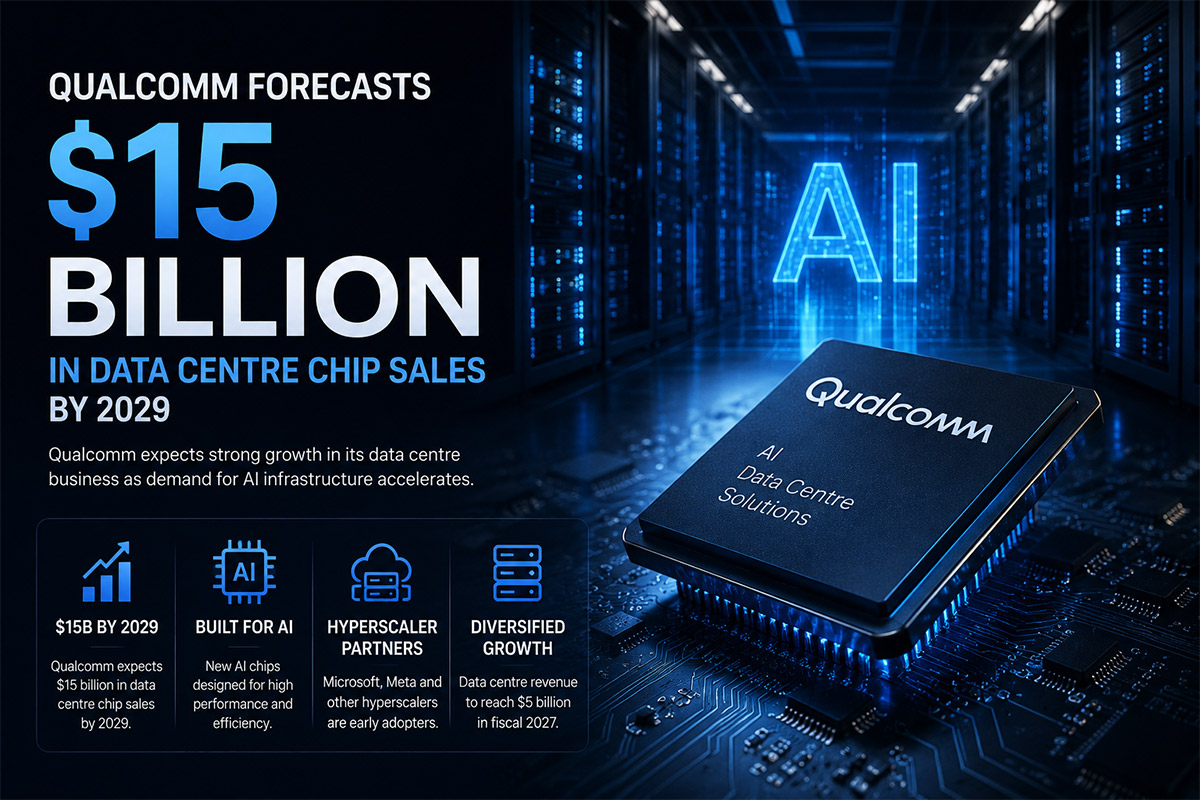
Qualcomm data centre chip sales could reach $15 billion by 2029 as the company pushes deeper into artificial intelligence infrastructure and moves beyond its traditional smartphone chip business. The forecast marks a major strategic shift for Qualcomm, which has long been best known for supplying processors and modems for mobile devices. The company now expects its data centre business to become a major growth engine as demand rises for chips that can power AI workloads.
Following the announcement, Qualcomm shares rose more than 12% in after-hours trading on Wednesday, reflecting investor optimism about the company’s expansion into the fast-growing AI chip market.
Qualcomm Expects $5bn From Data Centres in 2027
At an investor presentation, Chief Financial Officer Akash Palkhiwala said Qualcomm expects its data centre business to generate $5 billion in revenue in fiscal 2027. Of that amount, around $1 billion is expected to come from new custom-chip customers. The forecast suggests Qualcomm is not only targeting general-purpose AI chips, but also custom silicon designed for large cloud and technology companies.
The company also said it expects $40 billion in revenue from chips outside its core smartphone business by 2029, up sharply from its previous estimate of $22 billion. By then, handsets are expected to make up only about one-third of Qualcomm’s chip revenue.
Palkhiwala said the company will become “truly diversified,” signalling a future in which Qualcomm depends less on the smartphone market and more on data centres, AI infrastructure and custom chips.
Why Qualcomm Is Moving Beyond Smartphones
Qualcomm’s push into AI chips comes as the smartphone market faces mounting pressure. Demand for AI infrastructure has contributed to a memory chip shortage, putting pressure on smartphone production costs. At the same time, major customers such as Apple and Samsung have been developing more chips in-house, reducing long-term dependence on external suppliers.
For Qualcomm, that creates a clear incentive to diversify. Data centres and AI infrastructure offer a much larger growth opportunity as cloud companies, social media platforms and enterprise customers race to build systems capable of running advanced AI models. This shift also shows why enterprise technology services are becoming more important for companies that need cloud infrastructure, AI systems, custom chips and scalable data operations. The move also places Qualcomm in direct competition with some of the most powerful players in the semiconductor industry.
Microsoft and Meta Among Qualcomm AI Chip Customers
Qualcomm said Microsoft and Meta Platforms will use its new AI chips. The company also said it will make custom chips for two additional unnamed hyperscale customers. In the technology industry, hyperscalers are large cloud and computing companies that operate massive data centre networks and require specialised hardware at huge scale.
Tony Pialis, Qualcomm’s data centre chief, said the company has not had to push its way into hyperscale customers. Instead, he said those customers have been pulling Qualcomm into the market. Revenue from the custom-chip deals is expected to start before the end of this calendar year.
Qualcomm Introduces High Bandwidth Compute Chips
One of Qualcomm’s key announcements is a new chip category called High Bandwidth Compute, or HBC. Unlike many AI chips that rely on expensive high-bandwidth memory, Qualcomm’s HBC approach uses cheaper memory chips commonly found in smartphones and laptops. The company says this can offer a strong performance-per-cost advantage.
This strategy could be important in a market where AI infrastructure costs are rising quickly. If Qualcomm can deliver competitive performance at lower cost, it may attract customers looking for alternatives to more expensive AI hardware. Microsoft is expected to use this new category of Qualcomm chips.
Meta to Use Qualcomm’s Dragonfly C1000
Qualcomm also said Meta will use its new central processing unit called Dragonfly C1000, which has been designed specifically for AI data centres. This move puts Qualcomm into a market where companies such as Arm Holdings and Nvidia are already working aggressively to win large data centre customers.

Arm, which supplies underlying technology used in many Qualcomm chips, also saw its shares rise after Qualcomm’s forecast. That reaction reflects how closely the broader chip ecosystem is tied to AI infrastructure growth.
The Dragonfly C1000 gives Qualcomm another route into AI data centres, especially as companies look for more specialised and efficient processors.
A Crowded and Competitive AI Chip Market
Qualcomm is entering a fast-growing but highly competitive data centre chip market. Nvidia remains the dominant force in AI accelerators, while companies such as Cerebras, Amazon, Google, Broadcom and Marvell are also building or supplying chips for AI workloads. Amazon has its Graviton chips, Google has Axion, and custom chip designs are becoming increasingly important for major cloud and AI companies.
Bank of America analysts warned that Qualcomm faces a crowded market filled with large incumbents and specialised competitors. Earlier, they had estimated Qualcomm’s data centre push could generate a more modest $2 billion to $5 billion annually by fiscal 2027 or 2028. Qualcomm’s latest forecast is therefore more ambitious than some market expectations.
Qualcomm Targets Three AI Chip Segments
Qualcomm has said it is working with customers on three types of data centre chips. These include central processing units, AI inference accelerators and custom application-specific integrated circuits, commonly known as custom chips.
AI inference has become one of the most important battlegrounds in the chip industry. While training AI models requires massive computing power, inference refers to running trained models to generate answers, make predictions or perform tasks.
As more companies deploy AI products at scale, inference demand is expected to grow quickly. This demand is also visible in the Gulf, where the UAE and Saudi Arabia are putting agentic AI to work across government and enterprise operations. Qualcomm appears to be positioning itself for that next phase of AI adoption.
Why AI Inference Matters for Qualcomm
AI inference is especially attractive because it could become a larger and more continuous revenue opportunity than training alone. Every time a user interacts with an AI chatbot, recommendation system, voice assistant or image generator, inference chips are needed to run the model and produce the result. As AI becomes embedded in more apps, devices and enterprise tools, the need for efficient inference hardware could rise sharply.
Qualcomm already has deep experience designing efficient chips for mobile devices, where power and cost matter. The company may try to apply that same efficiency-focused approach to data centres.
If successful, this could help Qualcomm compete in areas where customers want lower operating costs and better energy efficiency. Energy efficiency is becoming a major issue across AI infrastructure, especially as AI power consumption rises with the growth of data centres and inference workloads.
What This Means for Qualcomm’s Future
The forecast for Qualcomm data centre chip sales shows how seriously the company is taking the AI infrastructure opportunity. By 2029, Qualcomm expects its chip business to be much less dependent on smartphones. If data centre revenue reaches $15 billion and non-handset chips generate $40 billion overall, the company’s business profile could look very different from today.
This shift could also help Qualcomm reduce exposure to smartphone market cycles and customer concentration risks. It also raises a wider labour-market question: will AI create good jobs in chip design, data centres and infrastructure, or mainly concentrate growth among a smaller group of specialised companies? However, success is not guaranteed. The AI chip market is capital-intensive, technically demanding and extremely competitive. Qualcomm will need to prove that its chips can deliver performance, efficiency and cost advantages strong enough to win large customers.
Final Thoughts
Qualcomm’s forecast of $15 billion in data centre chip sales by 2029 marks a major step in the company’s attempt to become a more diversified AI infrastructure player. With Microsoft and Meta among its customers, new HBC chips, the Dragonfly C1000 processor and custom-chip deals with unnamed hyperscalers, Qualcomm is trying to enter one of the most important technology markets of the decade.
The opportunity is huge, but so is the competition. If Qualcomm can deliver efficient and cost-effective AI chips at scale, its data centre business could become one of the company’s most important growth engines by the end of the decade.