

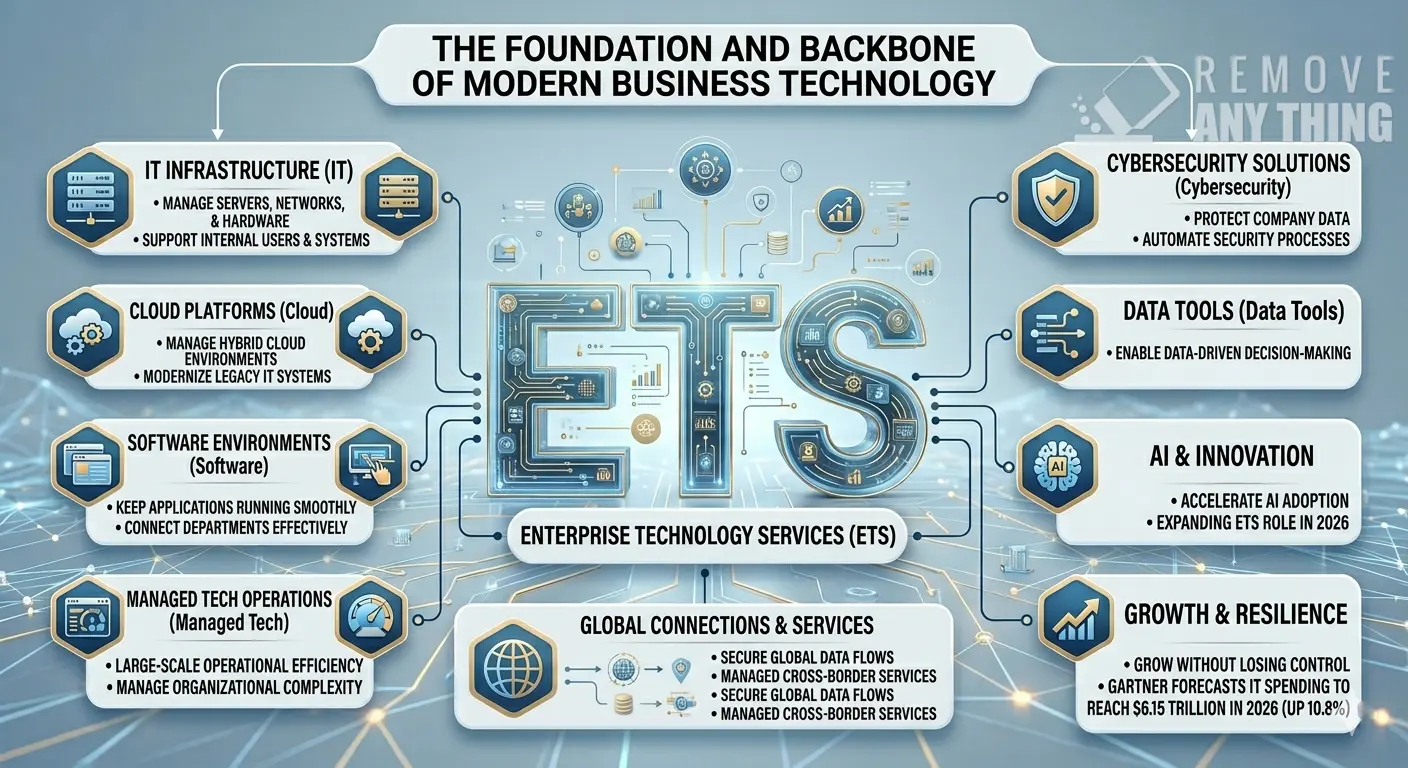
Enterprise Technology Services are the digital systems, IT infrastructure, cloud platforms, cybersecurity solutions, data tools, software environments, and managed technology operations that help large organizations run efficiently, securely, and at scale.
In simple terms, Enterprise Technology Services are the technology backbone of a modern business. They keep applications running, protect company data, support employees, connect departments, manage cloud systems, and help organizations modernize old IT environments.
For small companies, technology may mean a few software subscriptions, laptops, and basic IT support. For enterprises, technology is much more complex. Large organizations often manage thousands of users, multiple offices, hybrid cloud environments, customer databases, compliance requirements, security risks, and mission-critical applications. That is why enterprise digital technology services have become essential for businesses that want to grow without losing control of performance, security, and operational efficiency.
In 2026, the role of Enterprise Technology Services is expanding even faster as companies adopt AI, cloud modernization, cybersecurity automation, and data-driven decision-making. Gartner forecasts worldwide IT spending to reach $6.15 trillion in 2026, up 10.8% from 2025, showing how important enterprise technology investment has become for business growth and resilience.
What Are Enterprise Technology Services?
Enterprise Technology Services refer to the full range of IT and digital services that support the technology needs of medium and large organizations. These services include infrastructure management, cloud computing, cybersecurity, software support, network operations, data management, digital workplace tools, automation, and enterprise application modernization.
The purpose of ETS is not just to “fix computers” or provide technical support. The real goal is to make technology work as a strategic business function. When implemented properly, Enterprise Technology Services help companies reduce downtime, improve productivity, protect sensitive data, scale operations, and respond faster to market changes.
A good ETS strategy connects people, processes, platforms, and security into one managed environment. Instead of having disconnected systems across departments, enterprises use structured technology services to create a more reliable and scalable digital foundation.
IBM defines IT infrastructure as the hardware, software, and networking components enterprises rely on to manage and run their IT environments effectively. That definition reflects the foundation of ETS: enterprise technology must support daily operations while also enabling future growth.
Key components of enterprise technology services
The core components of Enterprise Technology Services usually include cloud infrastructure, data centers, servers, networks, endpoint devices, cybersecurity systems, enterprise software, databases, IT service management, backup and disaster recovery, and user support.
| Component | What It Does | Business Value |
|---|---|---|
| Cloud Infrastructure | Hosting, storage, scalability | Faster growth and lower hardware costs |
| Cybersecurity | Protects systems and data | Reduces security risks |
| IT Infrastructure | Servers, networks, devices | Keeps operations stable |
| Data Management | Stores and organizes business data | Better decision-making |
| Managed IT Support | Monitoring and troubleshooting | Less downtime |
Cloud is now one of the most important parts of ETS. IBM explains that cloud infrastructure includes the hardware and software resources required to deliver applications and services over the internet, including servers, storage, networks, APIs, cloud security features, and AI-powered management tools.
Cybersecurity is another major component. As businesses move more workloads to cloud, SaaS, and remote environments, security must cover identity, applications, endpoints, networks, and data. Microsoft describes cloud security as the technologies, policies, procedures, and controls that protect cloud-based data, applications, and infrastructure.
Together, these components create the technology layer that allows an enterprise to operate securely and efficiently.
Types of Enterprise Technology Services
Enterprise Technology Services can cover many areas, but most business needs fall into three major categories: cloud services, infrastructure management, and cybersecurity solutions. These services often overlap because modern enterprise environments are hybrid, connected, and data-driven.
Cloud enterprise technology services
Cloud services help businesses move from traditional on-premises infrastructure to more flexible, scalable, and cost-efficient environments. This can include cloud migration, cloud hosting, cloud optimization, hybrid cloud design, cloud security, backup, disaster recovery, and cloud-native application development.
Cloud enterprise technology services are especially valuable for companies that need to scale quickly. Instead of buying physical servers and maintaining large data centers, businesses can use cloud infrastructure to add computing power, storage, databases, analytics, and AI tools when needed.
AWS says cloud helps enterprises scale operations and support rapid business growth without requiring substantial upfront infrastructure investment. AWS also provides infrastructure-as-a-service and platform-as-a-service solutions across computing, storage, databases, analytics, and more.
For many companies, cloud services are no longer just a cost-saving option. They are now a foundation for innovation. Cloud platforms allow teams to launch digital products faster, analyze data more effectively, and support remote or global workforces.
IT infrastructure management services
IT infrastructure management services focus on keeping the core technology environment stable, secure, and available. This includes managing servers, networks, storage, operating systems, databases, endpoint devices, identity systems, and monitoring tools.
For large organizations, infrastructure management is critical because even a short outage can affect sales, customer service, supply chains, production, or financial systems. A modern enterprise may depend on hundreds of interconnected systems. Without proper monitoring and management, small issues can quickly become business disruptions.
Infrastructure services often include performance monitoring, patch management, asset management, network administration, help desk support, endpoint management, backup planning, and disaster recovery. Increasingly, these services are supported by automation and AI-based monitoring tools that detect unusual activity, predict failures, and reduce manual workloads.
The best infrastructure management services do more than maintain existing systems. They also help businesses modernize legacy platforms, reduce technical debt, improve availability, and create a cleaner foundation for cloud and AI adoption.
Cybersecurity enterprise solutions
Cybersecurity enterprise solutions protect organizations from digital threats such as ransomware, phishing, data breaches, identity attacks, insider threats, supply-chain attacks, and cloud misconfigurations.
In 2026, cybersecurity is one of the most important parts of Enterprise Technology Services because enterprise systems are more connected than ever. Employees use SaaS tools, cloud platforms, personal devices, remote access systems, and AI applications. Every new connection can create a new risk.
Modern enterprise cybersecurity usually includes identity and access management, endpoint protection, security monitoring, vulnerability management, data loss prevention, cloud security posture management, incident response, zero trust architecture, and compliance reporting.
IBM’s 2026 cyberthreat analysis highlights the growing risk of supply-chain and third-party compromises, noting that attackers increasingly target interconnected systems, vendor integrations, open-source dependencies, identity integrations, CI/CD workflows, and cloud interfaces.
This is why enterprise cybersecurity cannot be treated as a separate department. It must be built into cloud, infrastructure, software development, data governance, and daily business operations.
Benefits of Enterprise Technology Services for Businesses
The main benefit of Enterprise Technology Services is that they help companies turn technology into a reliable business advantage. Instead of reacting to IT problems after they happen, enterprises can use managed technology services to improve performance, reduce risk, support employees, and prepare for growth.
ETS also allows leadership teams to make better decisions. When data systems, cloud platforms, applications, and security tools are properly connected, businesses gain better visibility into operations. This makes it easier to identify inefficiencies, control costs, and improve customer experience.
Improving operational efficiency with enterprise technology
Enterprise technology improves operational efficiency by reducing manual work, automating repetitive processes, improving system reliability, and connecting teams through better digital tools.
For example, a company using modern cloud infrastructure can deploy applications faster than one relying on outdated servers. A business with strong IT service management can resolve employee issues faster. A company using automated monitoring can detect infrastructure problems before they cause downtime.
Efficiency also improves when departments use integrated systems instead of isolated tools. Enterprise resource planning, customer relationship management, data platforms, workflow automation, and digital workplace solutions can help teams share information more easily and reduce duplicated work.
Deloitte’s Tech Trends 2026 report notes that successful organizations are moving from technology experimentation to measurable impact, which reflects a major shift in how enterprises are using digital tools: not just to test innovation, but to improve business outcomes.
Enhancing data security and scalability
Enterprise Technology Services also improve security and scalability. A business that grows quickly needs systems that can support more users, more transactions, more data, and more digital services without becoming unstable.
Cloud platforms help businesses scale infrastructure without large upfront investments. Cybersecurity services protect sensitive information as systems expand. Data governance ensures that information is stored, accessed, and used responsibly. Backup and disaster recovery services reduce the risk of permanent data loss.
Security and scalability are closely connected. A business can grow faster when its technology environment is secure enough to support expansion. Without strong ETS, growth can create more risk, more downtime, and more operational complexity.
Microsoft’s security guidance emphasizes unified protection across multicloud and hybrid environments, including cloud security posture, DevOps security, and application protection across the full lifecycle.
How to Choose the Right Enterprise Technology Services Provider
Choosing the right ETS provider is a strategic decision. The wrong provider can create delays, security gaps, weak integrations, and unnecessary costs. The right provider can become a long-term technology partner that supports business growth.
A strong provider should understand both technology and business goals. Enterprises should not choose a provider only because it offers cheaper services. They should evaluate technical expertise, industry experience, cybersecurity maturity, service reliability, compliance knowledge, and ability to support future growth.
Factors to consider before selecting a provider
| Factor | What to Check |
|---|---|
| Enterprise experience | Has the provider worked with large organizations? |
| Security maturity | Do they have incident response and compliance processes? |
| Cloud expertise | Can they manage AWS, Azure, Google Cloud, or hybrid systems? |
| SLA quality | Are response times and uptime commitments clear? |
| Modernization support | Can they help with AI, automation, and cloud optimization? |
The first factor is experience with enterprise-scale environments. Managing technology for a small business is very different from supporting a large organization with complex systems, compliance obligations, and multiple departments.
The second factor is security capability. Any provider that manages enterprise systems must have strong cybersecurity processes, clear incident response procedures, and experience with cloud and identity security.
The third factor is cloud and infrastructure expertise. Many companies now operate across hybrid or multicloud environments, so the provider should understand platforms such as AWS, Microsoft Azure, Google Cloud, private cloud, and on-premises infrastructure.
The fourth factor is service-level agreement quality. Enterprises should ask about response times, uptime commitments, escalation processes, monitoring tools, and reporting frequency.
The fifth factor is industry knowledge. A healthcare company, financial institution, logistics business, or government contractor may have very different compliance and technology needs. A good ETS provider should understand these differences and design services around real business risks.
Finally, enterprises should evaluate whether the provider can support modernization, not just maintenance. In 2026, businesses need partners that can help with AI adoption, cloud optimization, automation, cybersecurity governance, and digital transformation.
Enterprise Technology Services Trends in 2026
The biggest trend in Enterprise Technology Services in 2026 is the shift from traditional IT support to intelligent, automated, and security-first technology operations.
AI is now central to enterprise technology strategy. McKinsey’s Global Tech Agenda 2026 states that companies are prioritizing AI as their top technology investment, ahead of cybersecurity and infrastructure modernization. This shows how quickly AI has moved from experimental projects into enterprise planning.
However, AI also creates new risks. Gartner reports that by 2028, over 50% of enterprises will use AI security platforms to protect AI investments, including protection against prompt injection, data leakage, and rogue agent actions.
Another major trend is AI-driven cybersecurity. Gartner’s 2026 cybersecurity trends highlight that GenAI adoption is already creating security challenges, including employees using personal GenAI accounts for work and entering sensitive information into unapproved tools.
Cloud modernization is also accelerating. Businesses are moving from basic cloud migration to cloud optimization, cloud-native applications, containers, serverless systems, and managed data platforms. AWS describes modernization as a way to reduce technical debt and transform business operations through migration, automation, and expert support.
Another important trend is digital sovereignty and compliance. As governments and industries become more focused on data residency, regulated cloud environments, and trusted technology stacks, enterprise technology providers must design solutions that meet legal and regional requirements.
Finally, enterprise technology is becoming more outcome-focused. Companies no longer want technology services that only provide tools. They want measurable business results: lower downtime, faster deployment, stronger security, better customer experience, improved employee productivity, and lower operational risk.
As organisations move towards agentic AI, the underlying data, cloud and integration layers become even more important. For a UAE public-services example, read our guide to agentic AI in UAE government services.
Final Thoughts on Enterprise Technology Services
Enterprise Technology Services are no longer just a support function. They are a core part of how modern businesses operate, compete, scale, and protect themselves.
In 2026, companies need technology environments that are secure, flexible, automated, and ready for AI-driven change. Cloud platforms, cybersecurity systems, infrastructure management, digital workplace tools, and data services must work together as one connected ecosystem.
For businesses, the key question is not only what is enterprise technology services, but how ETS can improve real outcomes. The best enterprise technology strategy reduces complexity, supports growth, protects data, and allows teams to work faster with fewer risks.
As enterprises become more digital, the companies that invest in strong enterprise digital technology services will be better prepared for disruption, competition, cyber threats, and future innovation.
For more AI, business and digital-industry coverage, browse the DubaiPress Technology section.
FAQ About Enterprise Technology Services
- What are enterprise technology services?
Enterprise Technology Services are the IT, cloud, cybersecurity, infrastructure, data, software, and managed technology services that help large organizations operate securely and efficiently. They support daily business operations while enabling digital transformation and long-term growth.
- Why do companies need enterprise technology services?
Companies need Enterprise Technology Services to manage complex IT environments, protect sensitive data, reduce downtime, improve productivity, scale operations, modernize legacy systems, and support cloud, AI, and digital business strategies.