
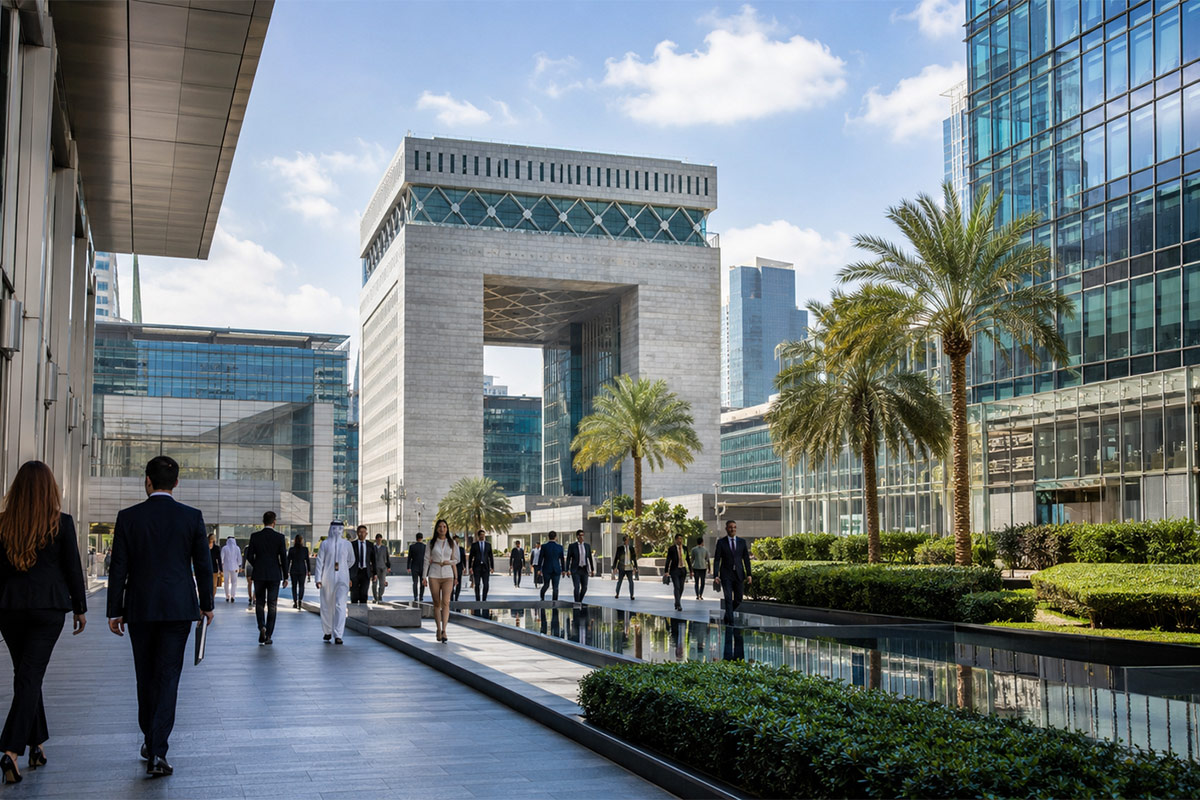
Dubai International Financial Centre, widely known as DIFC, is not just another business district in Dubai. It is the emirate’s financial heart, a globally recognised business address, and one of the most important financial hubs connecting the Middle East, Africa and South Asia with international capital markets.
For companies, being connected to DIFC can mean access to financial institutions, investors, regulators, legal specialists, wealth managers, family offices and international clients. For professionals, it can mean proximity to some of the region’s most valuable advisory, legal, investment and innovation opportunities.
DIFC matters because it combines several strengths in one place: location, international credibility, a specialised legal framework, independent financial regulation, experienced talent, global capital, lifestyle appeal and strong brand recognition. In Dubai, DIFC is more than an address. It is a signal of ambition, trust and international relevance.
What Is DIFC?
DIFC stands for Dubai International Financial Centre. Established in 2004, it was created as a world-class financial centre designed to attract international businesses, investors, financial institutions and professional service providers to Dubai.
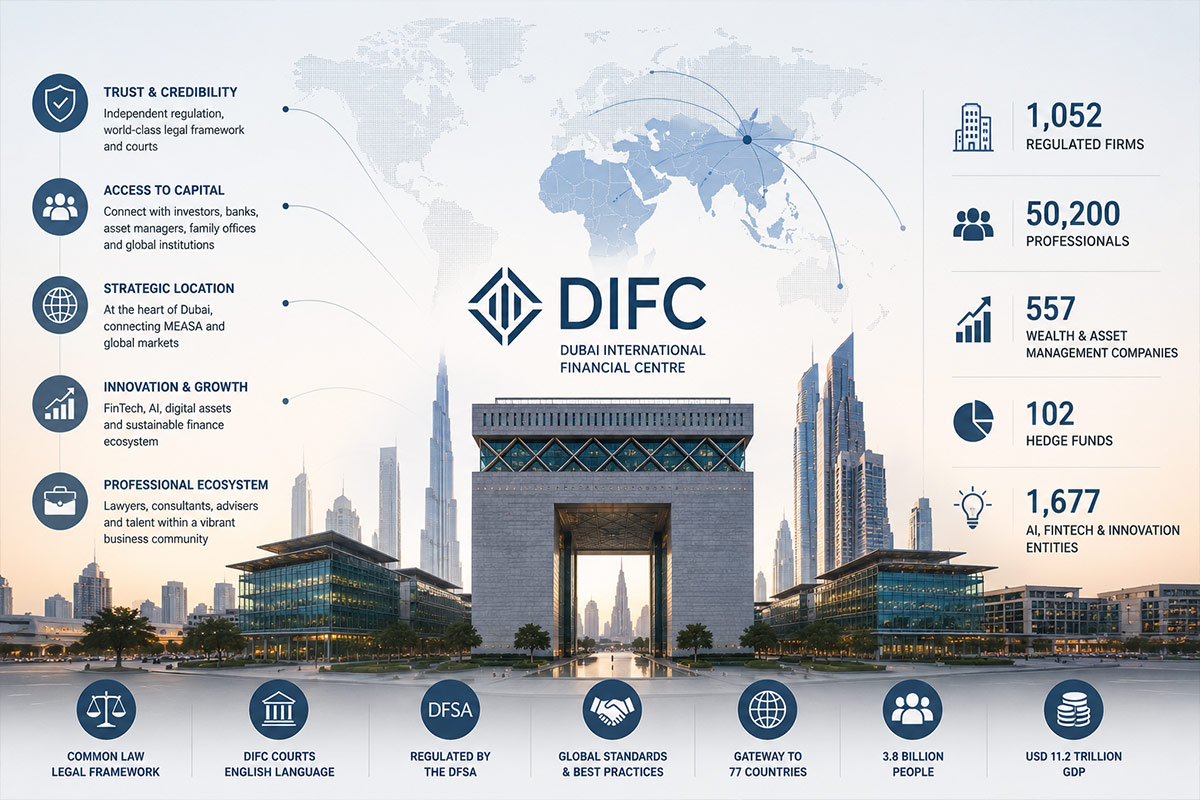
Today, DIFC describes itself as the leading global financial centre in the Middle East, Africa and South Asia region, commonly referred to as MEASA. This region includes 77 countries, with an estimated population of 3.8 billion people and combined GDP of approximately USD 11.2 trillion.
DIFC supports a wide range of business and financial activities, including:
- Banking and credit services
- Asset and wealth management
- Insurance and reinsurance
- Capital markets
- FinTech and artificial intelligence
- Digital assets and investment tokens
- Family offices and foundations
- Legal and professional services
- Sustainable finance
- International investment structures
Its importance comes from the fact that it is not only a commercial district. It is an entire financial ecosystem built to connect Dubai with regional and international capital.
Where Is DIFC Located in Dubai?
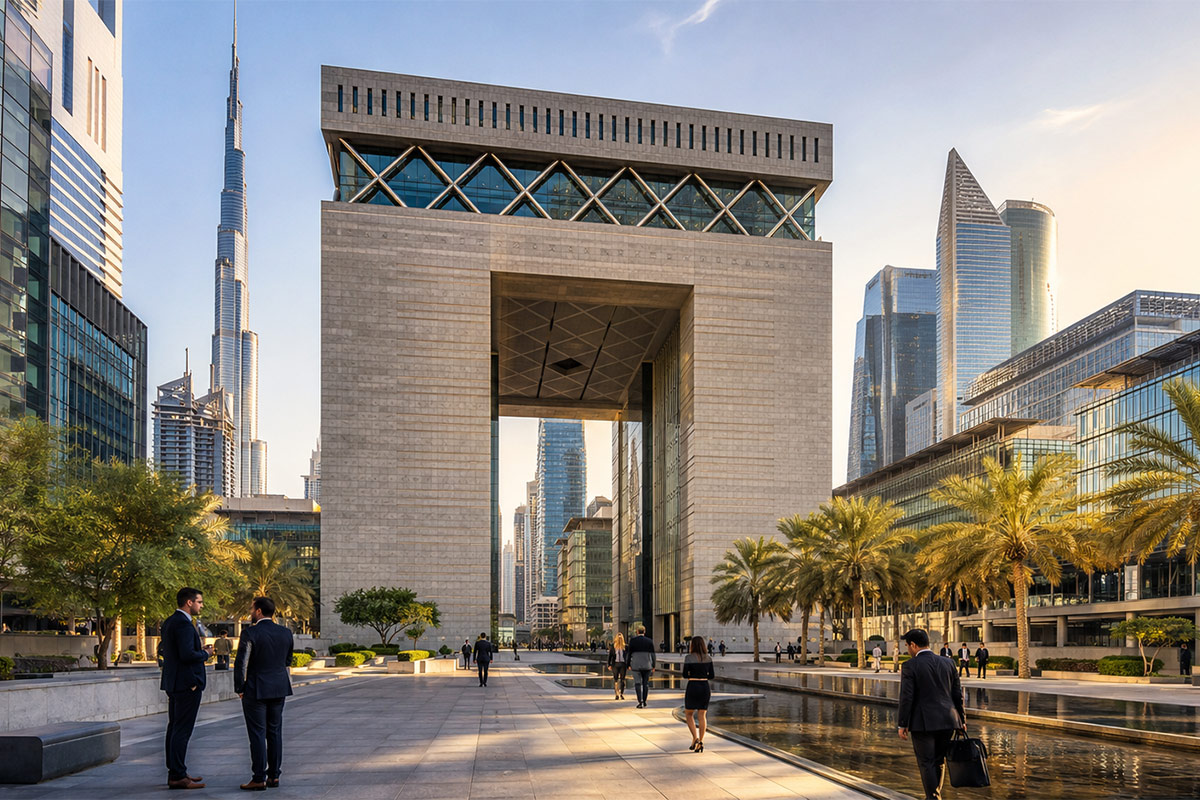
DIFC is located in the heart of Dubai, beside Sheikh Zayed Road, one of the city’s most important commercial and transport corridors. The district covers approximately 110 acres and is marked by its iconic headquarters building, The Gate. It was designed as a self-contained and concentrated hub for financial activity. Its central location places DIFC close to several major Dubai destinations and commercial areas, including:
- Downtown Dubai
- Emirates Towers
- Museum of the Future
- Business Bay
- Dubai World Trade Centre
- Major hotels, offices and luxury residential districts
This location matters. International executives, investors, advisers and business owners can reach DIFC easily from Dubai’s main commercial areas, luxury hotels, government institutions, event venues and residential communities.
Why DIFC’s Location Is Strategically Important
In global finance, location is not only about convenience. It is also about access, visibility and reputation. DIFC’s position in central Dubai gives companies and professionals access to:
- Major business decision-makers
- International investors
- Banks and financial institutions
- Luxury hospitality and meeting venues
- Corporate headquarters
- Government and economic institutions
- Premium residential and lifestyle areas
The result is a district where business, finance, networking and lifestyle are closely connected.
A Short History of DIFC
DIFC was established in 2004 under the vision of Sheikh Mohammed bin Rashid Al Maktoum. Its purpose was clear: to create a world-class financial centre capable of attracting international businesses and investors to Dubai.
The idea was ambitious because Dubai was not only trying to build another office district. It was trying to build trust. For any city to become a serious international financial centre, towers and modern infrastructure are not enough. It also needs:
- A predictable legal framework
- Independent financial regulation
- Specialised courts
- International operating standards
- Experienced global talent
- Institutional credibility
- Access to capital
- A dense professional ecosystem
DIFC was created to provide exactly that.
Over more than two decades, the district has expanded from a financial centre associated mainly with banks, insurance firms and capital markets into a wider platform for wealth management, family offices, FinTech, artificial intelligence, digital assets, sustainable finance and innovation.
DIFC’s Legal and Regulatory Framework
One of the most important reasons DIFC attracts international companies is its legal and regulatory environment. DIFC operates as a purpose-built financial free zone in Dubai with its own legal and regulatory framework for civil and commercial matters. Its judicial system operates within an English common law framework, providing a legal environment that is familiar to companies and investors used to major international financial centres.
This matters because international companies often need certainty before they commit capital, establish regional headquarters, structure investments or sign major commercial contracts.
The Role of the Dubai Financial Services Authority
Financial services conducted in or from DIFC are regulated by the Dubai Financial Services Authority, known as the DFSA. The DFSA is the independent regulator of financial services in DIFC.
Its regulatory mandate includes:
- Asset management
- Banking and credit services
- Investment advice
- Collective investment funds
- Custody and trust services
- Islamic finance
- Insurance
- Financial technology
- Crypto and investment tokens
- Money services
- Capital markets
- Crowdfunding
- International exchanges
- Anti-money laundering and counter-terrorist financing supervision
The DFSA states that its regulatory regime is designed for DIFC in line with international standards, with a risk-based approach intended to avoid unnecessary regulatory burdens while maintaining strong oversight.
DIFC Courts and Legal Confidence
DIFC also has its own courts. The DIFC Courts provide independent administration of justice for civil and commercial disputes and operate within a common law framework. This is a major advantage for international businesses. English-language proceedings, specialised commercial expertise and a familiar legal structure can make companies more confident when signing contracts, investing capital or resolving disputes in Dubai.
For global institutions, legal predictability is not a minor detail. It is one of the main factors that determines whether a financial centre can be trusted.
Why Does Everyone Want to Be Connected to DIFC?
DIFC has become one of Dubai’s most desirable business addresses because it offers more than office space. It provides credibility, access, legal confidence, professional networks and lifestyle prestige in a single district. There are five main reasons companies, investors and professionals want to be connected to DIFC.
1. DIFC Provides Credibility
The first reason is credibility.
Having a presence in DIFC, working with a DIFC-based firm, or being professionally associated with the district sends a strong signal. It suggests that a business or professional is operating within one of the region’s most respected and internationally connected commercial environments.
For companies in finance, investment, legal services, compliance, consulting, wealth management or technology, reputation matters. Clients want to know they are working with firms that understand international standards and operate in credible environments.
A DIFC address can strengthen perceptions of:
- Professional seriousness
- International exposure
- Regulatory awareness
- Financial credibility
- Access to high-value clients
- Regional business capability
This does not mean every DIFC business is automatically superior. But the district itself carries significant reputational weight.
2. DIFC Provides Access to Capital and Decision-Makers
DIFC is not simply an office zone. It is a dense network of banks, asset managers, insurers, brokers, hedge funds, wealth advisers, FinTech firms, family offices, lawyers, consultants and corporate decision-makers.
According to DIFC’s official 2025 annual results, the centre reached 1,052 regulated firms, 557 wealth and asset management companies, 102 hedge funds, 1,677 AI, FinTech and innovation-focused entities, and a total workforce of 50,200 professionals.
DIFC’s 2025 Business Ecosystem in Numbers
| Indicator | 2025 Figure | Why It Matters |
|---|---|---|
| Regulated firms | 1,052 | Reflects the strength of DIFC’s core financial sector |
| Wealth and asset management companies | 557 | Shows Dubai’s growing relevance for private capital and investment management |
| Hedge funds | 102 | Highlights DIFC’s increasing appeal to global alternative investment firms |
| AI, FinTech and innovation-focused entities | 1,677 | Shows expansion beyond traditional finance |
| Total workforce | 50,200 professionals | Demonstrates the scale of talent and professional activity in the district |
For companies, this density creates opportunity. A startup may meet investors and banking partners nearby. A law firm may access funds and corporate clients. A consultant may work with international groups. A wealth manager may be close to private clients and family offices. DIFC reduces the distance between people who have capital, people who need capital, and professionals who help structure and protect that capital.
3. DIFC Creates Legal and Regulatory Confidence
International businesses often prefer locations where rules are clear, contracts can be enforced, regulators are respected and commercial disputes can be managed predictably. DIFC offers this through its specialised legal environment, its independent financial regulator and its courts operating within a common law framework.
This is particularly important for:
- Banks
- Investment funds
- Insurance companies
- Multinational firms
- FinTech companies
- Wealth managers
- Family offices
- International law firms
- Companies entering cross-border contracts
When money, regulation and international contracts are involved, confidence becomes a competitive advantage. DIFC’s legal framework is one of the main reasons global financial institutions feel comfortable using Dubai as a regional base.
4. DIFC Benefits From a Powerful Network Effect
The fourth reason is network effect. The more major institutions establish themselves in DIFC, the more attractive it becomes for other businesses to join or remain connected to it.
A FinTech startup wants to be close to banks, investors and regulators. A law firm wants to be close to funds, insurers and corporate clients. A wealth adviser wants access to family offices and high-net-worth individuals. A compliance specialist wants to be near regulated firms. A consultant wants to be where strategic decisions are being made.
This creates a self-reinforcing ecosystem:
- Financial firms attract professional advisers
- Wealth managers attract private clients and family offices
- Investors attract startups and fund managers
- FinTech firms attract innovation partners
- Lawyers and consultants support the entire network
- Lifestyle venues attract meetings, events and professional relationships
In this type of environment, proximity creates value. Being near the right institutions can lead to faster introductions, better partnerships, stronger visibility and more valuable opportunities.
5. DIFC Combines Business With Lifestyle and Prestige
DIFC is not only a financial district. It is also one of Dubai’s most stylish urban destinations. The district is known for high-end dining, art galleries, contemporary architecture, cafés, luxury venues, retail spaces and major professional events. Visit Dubai describes DIFC as a destination offering fine dining, acclaimed art galleries, impressive architecture and a world-leading business hub at Dubai’s financial heart.
Gate Village, one of DIFC’s best-known areas, combines commerce and culture through restaurants, art galleries, luxury retail and distinctive architecture. DIFC itself describes Gate Village as a central meeting point for professionals and visitors.
Why Lifestyle Matters in a Financial District
Lifestyle may sound less important than law or investment infrastructure, but in global business it matters. Major financial districts are not only places where people work. They are places where people:
- Meet investors
- Host clients
- Attend events
- Build professional relationships
- Hold private discussions
- Develop reputation
- Spend time outside formal meetings
DIFC’s restaurants, galleries, events and luxury environment help turn the district into a business community rather than simply a group of office buildings.
DIFC and Dubai’s New Economy
In its earlier years, DIFC was mainly associated with banking, insurance, capital markets and professional financial services. Today, its role is much broader.
DIFC has expanded into:
- FinTech
- Artificial intelligence
- Digital assets
- Investment tokens
- Sustainable finance
- Private wealth
- Family offices
- Innovation companies
- Venture-backed startups
- Future-focused financial infrastructure
The growth of AI, FinTech and innovation companies inside DIFC shows how Dubai is attempting to move beyond traditional finance and build a more diversified knowledge-based economy.
DIFC’s Role in FinTech and Artificial Intelligence
In 2025, DIFC reached 1,677 AI, FinTech and innovation-focused entities, representing significant growth in its innovation ecosystem. DIFC also reports that startups supported through the DIFC Innovation Hub and Dubai AI Campus platforms have collectively raised more than USD 4.5 billion across the region.
This gives DIFC a distinctive position. It is not only home to established banks and investment firms. It is also becoming a platform where financial technology, AI, digital regulation and investment innovation can develop close to capital and regulators. For startups and global financial companies alike, this creates a rare combination:
- Regulatory structure
- International visibility
- Access to capital
- Nearby institutional clients
- Connections to emerging markets
- A recognised Dubai business address
DIFC as a Gateway to the MEASA Region
DIFC’s geographic role is also important. It connects international businesses with the fast-growing markets of the Middle East, Africa and South Asia. According to DIFC, the MEASA region includes 77 countries with an estimated population of 3.8 billion people and GDP of approximately USD 11.2 trillion. This gives global companies a strategic reason to use Dubai as a regional base: access to large emerging markets while operating from a stable, globally connected financial centre.
Why Lawyers, Consultants and Professionals Want to Be Connected to DIFC
For lawyers, consultants, compliance specialists, accountants, investment advisers and financial professionals, DIFC is one of the most attractive professional markets in the region. The reason is simple: where there is capital, there are contracts. Where there are contracts, there are advisory needs, disputes, regulatory issues, business structures, investment risks and compliance requirements.
DIFC-related professional work can involve:
- Cross-border investment
- Commercial contracts
- Fund structures
- FinTech licensing
- Banking regulation
- Digital asset compliance
- Wealth management
- Family office governance
- Insurance and reinsurance
- Corporate restructuring
- Arbitration and commercial disputes
- Sustainable finance
- International tax and business structuring
For professionals, being connected to DIFC can mean being closer to international clients, higher-value work and more complex commercial opportunities.
Why Legal Professionals Value DIFC
DIFC is especially attractive to legal professionals because of its common law environment, English-language proceedings, specialised courts and concentration of financial and commercial institutions. Lawyers operating in or around DIFC may work with banks, funds, technology firms, family offices, multinational companies, insurers and private investors. This creates demand for legal work that is often international, technical and commercially significant.
Why Consultants and Advisers Value DIFC
Consultants, compliance advisers, accountants and professional service providers are attracted to DIFC because businesses operating there often need sophisticated support. A regulated firm may require compliance advice. A family office may require governance support. A FinTech startup may need licensing guidance. A fund manager may need operational, legal or strategic services. The more DIFC grows, the greater the demand for professionals who understand complex financial businesses.
Is DIFC Only for Large Companies?
DIFC is strongly associated with major banks, global investment firms, asset managers, insurers and international law firms. However, it is no longer relevant only to large institutions.
The district has become increasingly important for:
- FinTech startups
- AI companies
- Innovation businesses
- Digital asset firms
- Boutique investment firms
- Family offices
- Specialist legal firms
- Consultants and advisers
- Technology companies serving finance
DIFC offers specialist opportunities for innovation-focused companies, including structures designed to support AI and FinTech businesses establishing and scaling in Dubai.
However, DIFC is not necessarily the cheapest option for every business in Dubai. A company that only needs a basic, low-cost trade licence may find other free zones more practical.
DIFC becomes especially valuable when a company needs:
- Financial-sector access
- International credibility
- Regulatory sophistication
- Investor proximity
- Legal confidence
- Global client perception
- A premium business address
In other words, DIFC is not the right choice for every company. But for businesses whose success depends on trust, finance, professional networks and international image, it remains one of the strongest locations in the region.
DIFC Compared With a Standard Dubai Business Location
| Factor | DIFC Advantage | Why It Matters |
|---|---|---|
| Business image | Internationally recognised financial address | Builds credibility with investors, clients and partners |
| Regulation | Independent financial regulator through the DFSA | Supports regulated financial and innovation activity |
| Legal environment | Common law framework and specialised courts | Offers greater familiarity for international firms |
| Financial access | Dense network of banks, funds, wealth managers and family offices | Improves access to capital and partnerships |
| Innovation | Strong AI, FinTech and digital asset ecosystem | Supports future-focused financial businesses |
| Professional network | Lawyers, consultants, advisers and financial experts nearby | Makes specialist support easier to access |
| Lifestyle | Dining, art, events and premium meeting spaces | Supports networking and client relationships |
| Cost | Generally positioned as a premium business environment | May not suit low-cost licence seekers |
Why DIFC Matters to Dubai’s Global Position
DIFC represents an important part of Dubai’s wider economic ambition. Dubai has long aimed to position itself as a global city for business, investment, tourism, logistics, technology and international talent. DIFC supports that goal by giving the city a globally credible financial platform.
Its value is not limited to the companies registered inside it. DIFC also strengthens Dubai by helping to attract:
- Global financial institutions
- International investors
- Wealth and asset managers
- Hedge funds
- Family offices
- FinTech companies
- AI businesses
- Legal and consulting talent
- High-income professionals
- International capital flows
As the region competes more intensely for investment, talent and financial influence, DIFC gives Dubai a powerful advantage: a recognised financial centre with regulation, courts, talent, capital and lifestyle appeal in one ecosystem.
Final Analysis: DIFC Is More Than an Address
DIFC matters because it is more than a location. It is a symbol of Dubai’s ambition to operate as a global financial capital. Its strength comes from the combination of:
- Central location
- International brand recognition
- Independent financial regulation
- A common law legal environment
- Specialised courts
- Global financial institutions
- Growing private wealth activity
- Expanding FinTech and AI ecosystem
- High-value professional opportunities
- Lifestyle and prestige
That is why companies want to work with DIFC-based firms, professionals want to be seen there, investors want access to its network, and brands want to be associated with its name.
In Dubai, DIFC is not just where financial businesses operate.
It is where credibility, capital, innovation and global ambition meet.
FAQ About DIFC Dubai
- What does DIFC stand for?
DIFC stands for Dubai International Financial Centre. It is a purpose-built financial free zone and international business hub located in central Dubai.
- Where is DIFC located in Dubai?
DIFC is located beside Sheikh Zayed Road in the heart of Dubai. It is close to Downtown Dubai, Emirates Towers, the Museum of the Future, Business Bay and Dubai World Trade Centre.
- Why is DIFC important?
DIFC is important because it connects Dubai with global financial markets and the wider Middle East, Africa and South Asia region. It provides financial regulation, a specialised legal environment, courts, international credibility, access to investors and a strong professional ecosystem.
- Is DIFC a free zone?
Yes. DIFC is a purpose-built financial free zone in Dubai. Financial services conducted in or from DIFC are regulated by the Dubai Financial Services Authority.
- What are the DIFC Courts?
The DIFC Courts provide independent administration of justice for civil and commercial disputes within a common law framework. Their English-language legal environment is particularly attractive to international businesses.
- Is DIFC only for banks and large financial companies?
No. Although DIFC is home to banks, asset managers, insurers and global law firms, it is also increasingly relevant to FinTech startups, AI companies, family offices, digital asset businesses and specialist professional service firms.
- Why do professionals want to work in DIFC?
Professionals want to work in DIFC because it offers access to international clients, financial institutions, investors, regulated companies, wealth managers and higher-value legal, consulting, compliance and advisory opportunities.