
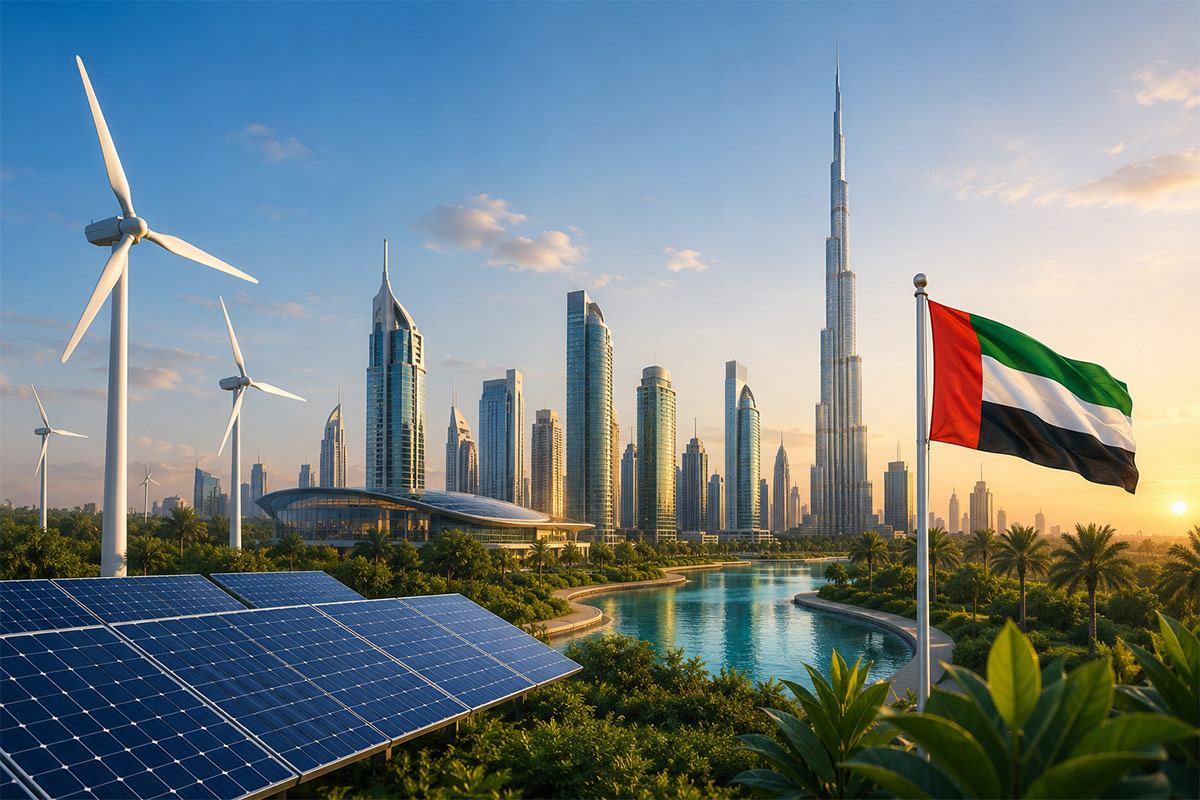
The United Arab Emirates has increasingly positioned sustainable development not as a side policy, but as a central pillar of its national growth model. Over the past decade, the country has moved from broad environmental commitments toward structured strategies covering clean energy, water security, sustainable cities, circular economy, hydrogen, climate action, and long-term national competitiveness.
The UAE’s sustainability agenda is significant because it connects environmental targets with economic development. Rather than treating climate action only as a responsibility, the country is increasingly presenting it as an opportunity to attract investment, develop new industries, improve quality of life, and strengthen its global position.
From the UAE Net Zero by 2050 Strategic Initiative to the Dubai 2040 Urban Master Plan, the country’s future development is being shaped around a clear idea: economic growth, urban expansion, and sustainability must progress together.
Why Sustainable Development Matters for the UAE
Sustainable development is especially important for the UAE because the country faces a unique combination of opportunities and pressures. It has a fast-growing economy, expanding cities, rising energy demand, limited natural freshwater resources, and ambitions to become a global center for investment, innovation, tourism, and advanced industries.
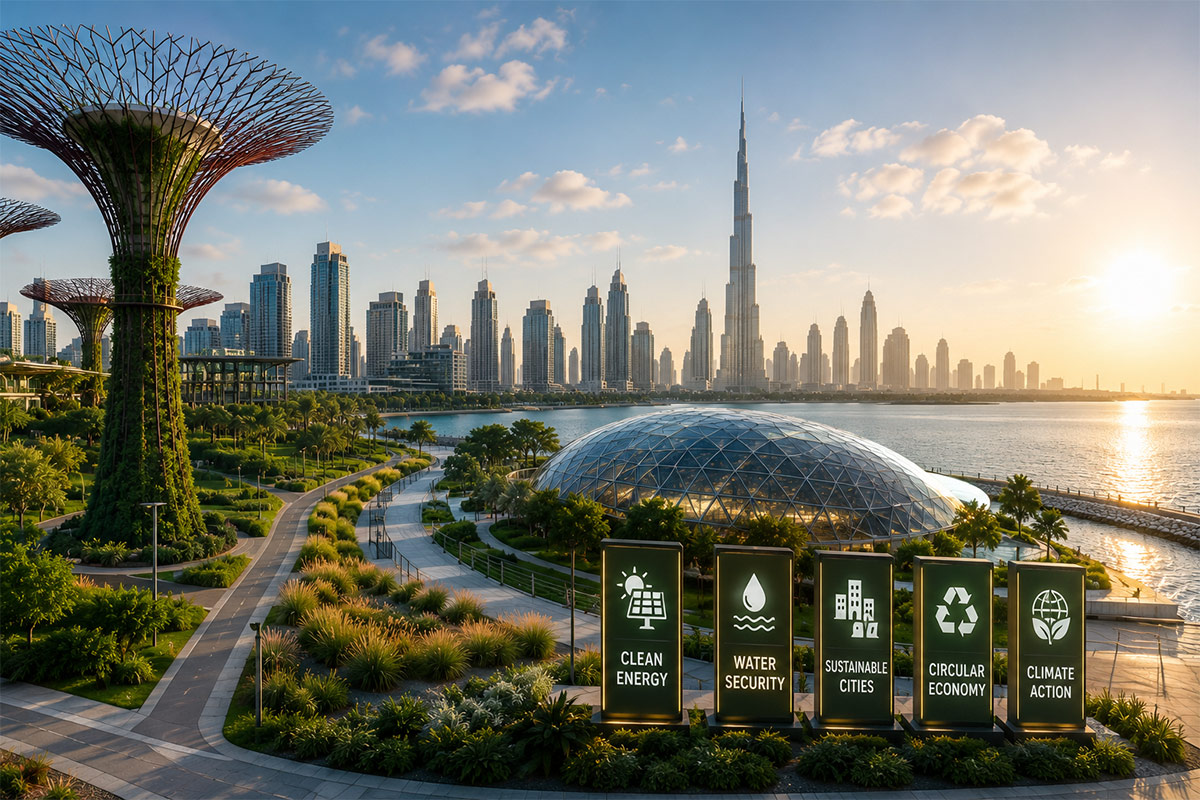
This means sustainability is not only an environmental issue. It is connected to the country’s future competitiveness and resilience. For the UAE, sustainable development now involves several priorities:
- Producing more clean and renewable energy
- Reducing emissions over the long term
- Building cities that are more livable and connected
- Protecting water security in an arid climate
- Reducing waste through circular economy models
- Developing low-emission hydrogen industries
- Encouraging private-sector participation in green growth
The country’s approach reflects a broader shift: future economic success will increasingly depend on clean infrastructure, efficient resource use, resilient cities, and industries prepared for a lower-emission global economy.
The UAE Net Zero by 2050 Strategic Initiative
One of the most important signals of the UAE’s sustainability direction is the UAE Net Zero by 2050 Strategic Initiative. The initiative provides a national framework for reaching net-zero emissions by 2050 while using the transition to support economic and social development.
This is important because it places sustainability directly inside the country’s national development agenda. The UAE is not presenting net zero only as an environmental target. It is also positioning the transition as a driver of innovation, investment, clean technology, new employment opportunities, and economic diversification.
Why the Net Zero Strategy Matters
The UAE’s net-zero direction affects several major sectors of the economy, including:
- Energy generation
- Construction and buildings
- Transportation
- Industry
- Waste management
- Water production
- Agriculture and food systems
- Sustainable finance
The challenge is significant. The UAE remains a rapidly growing economy with rising demand for electricity, cooling, water, construction, mobility, and industrial production. Reaching net zero will require both clean-energy expansion and practical changes in how resources are produced, consumed, and managed.
From Climate Commitment to Economic Opportunity
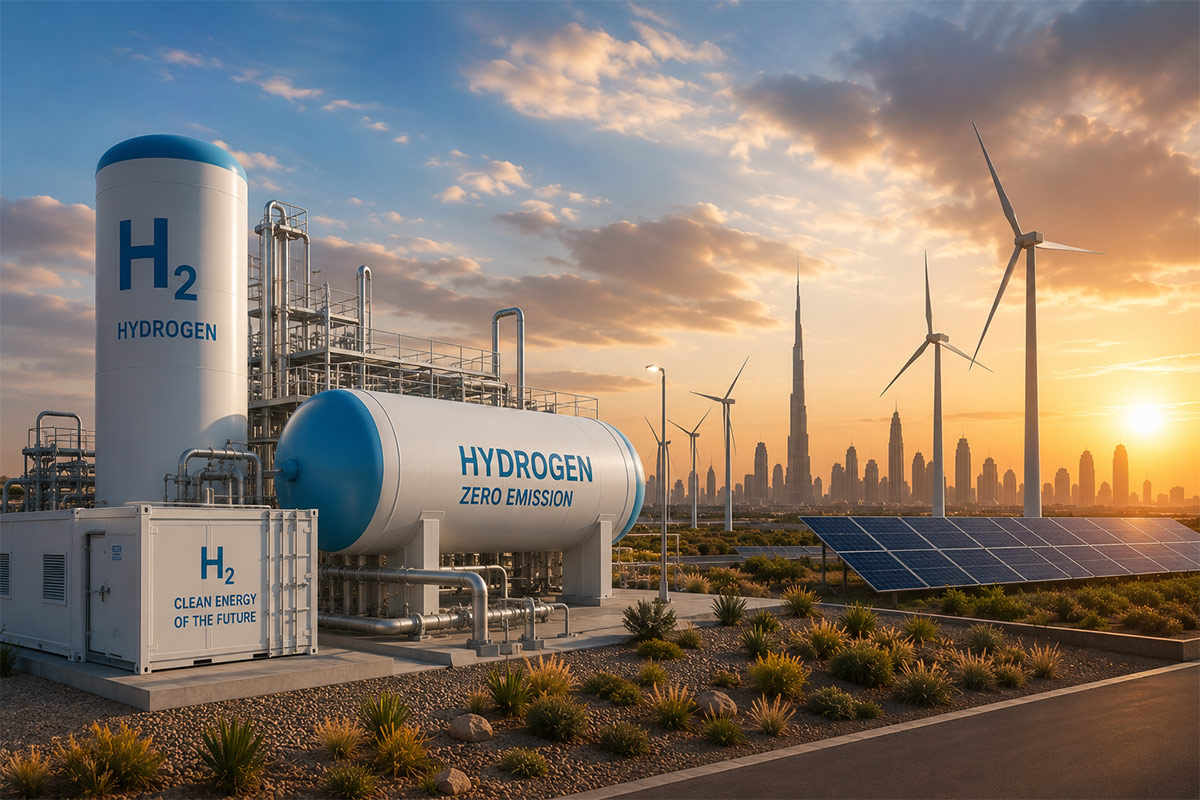
The UAE’s approach suggests that climate policy will increasingly support new economic sectors. Renewable energy, hydrogen, green finance, sustainable construction, low-carbon transport, circular production, and climate technology are all likely to become more important parts of the country’s economic model.
This makes the net-zero strategy more than a long-term environmental promise. It is also a framework for how the UAE wants to remain globally competitive in a changing economy.
The UAE and the Sustainable Development Goals
The UAE has also strengthened its institutional approach to the United Nations Sustainable Development Goals, commonly known as the SDGs. The UAE National Committee on SDGs was established to coordinate national implementation, connect government policies with the 2030 Agenda, and support monitoring and reporting across federal entities. The UAE presented Voluntary National Reviews in 2018 and 2022, and it is listed by the United Nations among the countries presenting a further Voluntary National Review in 2026.
Why the 2026 Voluntary National Review Is Important
A Voluntary National Review is more than a report. It is an opportunity for a country to assess progress, identify remaining gaps, and show how national policies contribute to global sustainability goals.
For the UAE, the 2026 review is important because it reflects a longer-term governance approach. Sustainability is no longer being treated as a temporary campaign or one-time announcement. It is becoming part of how progress is measured and communicated. The UAE’s sustainability reporting process is connected to issues such as:
- Clean energy
- Water security
- Sustainable cities
- Responsible consumption
- Climate action
- Economic diversification
- Private-sector participation
- Quality of life
This institutional approach matters because national strategies become more credible when they are supported by monitoring, data, accountability, and regular public reporting.
Clean Energy at the Heart of the UAE’s Transformation
Energy is at the center of the UAE’s sustainable development journey. As the country grows, energy demand is expected to increase. Meeting that demand while reducing emissions requires major investment in renewable energy, clean power infrastructure, energy efficiency, and new technologies.
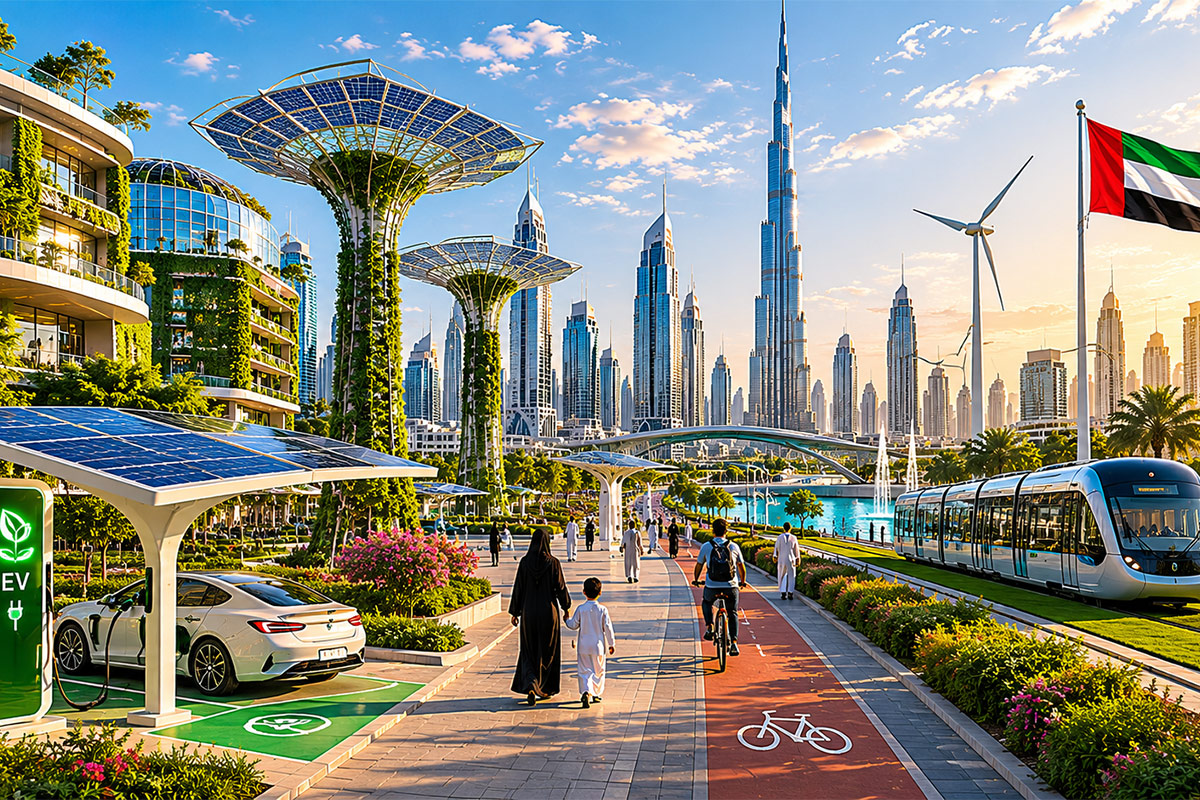
The updated UAE Energy Strategy 2050 aims to triple the contribution of renewable energy and invest between AED 150 billion and AED 200 billion by 2030 to meet growing energy demand while supporting climate objectives.
What the UAE Energy Strategy 2050 Focuses On
The strategy reflects the country’s effort to build a more diversified and sustainable energy system. Its priorities include:
- Expanding renewable energy capacity
- Meeting rising electricity demand
- Supporting the transition toward net zero
- Encouraging investment in clean-energy infrastructure
- Strengthening long-term energy security
- Developing future industries linked to clean power
This is particularly important for a country where economic growth, population expansion, cooling demand, infrastructure development, and industrial activity all require reliable energy supply.
Dubai’s Clean Energy Vision
Dubai has also established its own clean-energy ambition through the Dubai Clean Energy Strategy 2050. Under the strategy, Dubai aims to produce 75% of its energy requirements from clean sources by 2050.
This ambition places clean energy at the center of Dubai’s future economic and urban development. As the city expands, its energy system will need to support new homes, businesses, transportation networks, technology infrastructure, and tourism facilities while reducing its environmental impact.
Sustainable Cities and the Dubai 2040 Urban Master Plan
Sustainable urban planning is another major part of the UAE’s development model. This is especially important in Dubai, where population growth, tourism, real estate development, transportation, and economic expansion are continuously reshaping the city. While the Dubai luxury lifestyle is often associated with premium real estate, high-end hospitality and modern urban experiences, the city’s long-term appeal will increasingly depend on sustainability, accessibility and quality of life.
The Dubai 2040 Urban Master Plan provides a long-term framework for sustainable urban development and is designed to enhance quality of life over the coming decades. It focuses on creating a more connected, accessible, balanced, and livable city.
Why Urban Sustainability Matters in Dubai
In the future, successful cities will not be judged only by the number of towers they build or the scale of their infrastructure. They will also be judged by how efficiently people can move, how accessible services are, how much green space residents can enjoy, and how well cities respond to climate pressures.
For Dubai, sustainable urban development means focusing on:
- Better public transportation and mobility
- Improved access to services and daily needs
- More livable residential communities
- Greener public spaces
- More balanced urban growth
- Smarter infrastructure planning
- Higher overall quality of life
The Dubai 2040 Urban Master Plan reflects a change in how the city defines progress. The future of Dubai is not only about building bigger. It is also about building better.
Water Security as a National Sustainability Priority
Water security is one of the UAE’s most critical sustainability challenges. The country is located in an arid region with limited natural freshwater resources, while population growth, urban development, tourism, agriculture, and industry all increase demand for water.
The UAE Water Security Strategy 2036 aims to ensure sustainable access to water during both normal and emergency conditions. The strategy focuses on strengthening resilience, improving efficiency, managing demand, and supporting long-term water security.
Why Water Security Matters for the UAE
Unlike countries with abundant rivers, rainfall, or freshwater reserves, the UAE must plan carefully for every part of its water system. Sustainable water management is essential not only for residents, but also for food production, business activity, public services, and economic stability.
The country’s water security priorities include:
- Ensuring reliable water supply
- Improving water-use efficiency
- Reducing unnecessary demand
- Supporting water reuse
- Strengthening emergency preparedness
- Building greater resilience into the national water system
Water security will remain central to the UAE’s sustainable development journey because economic growth cannot continue without secure, efficient, and resilient water resources.
The UAE Circular Economy Policy 2021–2031
The UAE is also pushing the circular economy as a new model for sustainable growth. In a traditional economic model, resources are extracted, used, and discarded. A circular economy aims to reduce waste, extend the life of materials, reuse resources, and create more efficient systems of production and consumption.
The UAE Circular Economy Policy 2021–2031 provides a national framework for sustainable resource management and more efficient use of natural resources. Its priority sectors include sustainable infrastructure, sustainable transportation, sustainable manufacturing, and sustainable food production and consumption.
Priority Areas of the UAE Circular Economy Policy
| Priority Sector | Main Sustainability Focus |
|---|---|
| Sustainable infrastructure | Building more efficiently, reducing resource waste, and supporting greener urban development |
| Sustainable transportation | Encouraging lower-carbon mobility, public transport, shared transport, and more efficient systems |
| Sustainable manufacturing | Improving production efficiency, reducing waste, and encouraging reuse and recycling |
| Sustainable food production and consumption | Reducing food waste, improving resource productivity, and supporting more sustainable food systems |
Why the Circular Economy Matters
The circular economy is important because the UAE’s future growth will require large amounts of materials, energy, transport, construction, and food. If these systems operate inefficiently, they create more waste, higher costs, and greater environmental pressure.
A more circular model can help the UAE:
- Reduce waste
- Improve resource efficiency
- Support sustainable businesses
- Encourage innovation
- Lower environmental pressure
- Create new green economic opportunities
For businesses, this also means sustainability may become increasingly connected to competitiveness. Companies that reduce waste, use materials efficiently, and adopt greener operating models may be better prepared for future regulation, investor expectations, and market demand.
Hydrogen and the UAE’s Future Clean-Energy Economy
Hydrogen is expected to become an important part of the UAE’s future low-emission economy. The National Hydrogen Strategy 2050 aims to strengthen the UAE’s position as a producer and supplier of low-emission hydrogen by 2031.
Hydrogen is strategically important because it may support sectors that are difficult to decarbonize through electricity alone, including parts of heavy industry, transport, shipping, aviation fuels, and industrial production.
Why Hydrogen Matters for the UAE
The UAE already has major advantages in energy production, global trade connections, infrastructure, investment capacity, and access to international markets. Developing low-emission hydrogen could allow the country to build on these strengths while participating in the future clean-energy economy.
The strategy supports the UAE’s ambition to:
- Develop low-emission hydrogen production
- Build new energy supply chains
- Support lower-carbon industries
- Attract investment in clean technology
- Strengthen its position in global future-energy markets
- Contribute to net-zero objectives
Hydrogen is unlikely to replace every energy source, but it could become an important part of the UAE’s wider diversification and decarbonization strategy.
The UAE’s Main Sustainability Strategies Compared
| Strategy or Initiative | Main Objective | Target Period | Why It Matters |
|---|---|---|---|
| UAE Net Zero by 2050 Strategic Initiative | Reach net-zero emissions while supporting economic and social progress | 2050 | Connects climate action with long-term national development |
| UAE Energy Strategy 2050 | Triple renewable energy contribution and invest AED 150–200 billion by 2030 | 2030 and 2050 | Supports clean energy expansion and growing electricity demand |
| Dubai Clean Energy Strategy 2050 | Produce 75% of Dubai’s energy requirements from clean sources | 2050 | Shapes Dubai’s future clean-energy economy |
| Dubai 2040 Urban Master Plan | Guide sustainable urban development and improve quality of life | 2040 | Supports a greener, more accessible, and livable city |
| UAE Water Security Strategy 2036 | Ensure sustainable water access in normal and emergency conditions | 2036 | Protects a critical resource in an arid region |
| UAE Circular Economy Policy 2021–2031 | Improve resource efficiency and reduce waste across priority sectors | 2031 | Promotes more sustainable production and consumption |
| National Hydrogen Strategy 2050 | Strengthen the UAE’s role as a low-emission hydrogen producer and supplier | 2031 and 2050 | Builds a future-facing clean-energy industry |
The UAE’s Future Government Plans for Sustainable Development
Looking ahead, the UAE’s sustainability plans are likely to develop across several connected directions. The country has already established major national frameworks. The next phase will depend increasingly on implementation, investment, business participation, and measurable outcomes.
1. Expanding Clean Energy and Renewable Capacity
The UAE is expected to continue expanding renewable and clean-energy capacity as part of its 2030 and 2050 energy goals. This includes solar power, clean electricity infrastructure, energy storage, grid development, and technologies that can support reliable power supply. The key challenge will be meeting rising energy demand while reducing carbon intensity.
2. Building a Low-Emission Hydrogen Industry
Through the National Hydrogen Strategy 2050, the UAE is positioning hydrogen as a future industry. Low-emission hydrogen could support exports, industrial development, clean technology investment, and sectors that are difficult to decarbonize. This gives the UAE an opportunity to remain an important energy supplier in a world gradually shifting toward cleaner fuels.
3. Developing Smarter and More Livable Cities
Urban development is expected to become more closely connected with sustainability. Future planning in Dubai and across the UAE is likely to place greater importance on:
- Public transportation
- Walkability and accessibility
- Green public spaces
- Efficient buildings
- Climate resilience
- Digital urban planning
- Sustainable communities
The future city model will increasingly focus not only on commercial growth, but also on daily quality of life.
4. Strengthening Water and Food Security
Water and food security will remain strategic priorities. In an arid country with a growing population and expanding economy, resilience depends on improving efficiency, supporting innovation, reducing waste, and strengthening supply systems. Future progress may increasingly involve water reuse, smart resource management, sustainable agriculture, food waste reduction, and technologies that improve productivity.
5. Increasing Private-Sector Participation
The UAE’s sustainability transition cannot depend on government action alone. Businesses, investors, developers, banks, manufacturers, logistics companies, and consumers will all have a role to play. The private sector is likely to become increasingly involved in:
- Green finance
- ESG reporting
- Sustainable construction
- Circular business models
- Clean transportation
- Renewable energy projects
- Resource efficiency
- Climate technology investment
This means sustainability may become less of a voluntary branding choice and more of a central business requirement.
Challenges Facing the UAE’s Sustainable Development Journey
The UAE’s sustainable development journey is ambitious, but it is not without challenges. A fast-growing economy creates rising demand for electricity, cooling, water, transport, buildings, construction materials, and imported goods. At the same time, the country must respond to climate risks, limited freshwater availability, and the need to maintain global economic competitiveness.
Key challenges include:
- Managing rising energy demand while reducing emissions
- Expanding cities without increasing environmental pressure
- Ensuring water security in an arid climate
- Encouraging residents and businesses to adopt sustainable practices
- Supporting industrial growth while reducing resource intensity
- Turning long-term strategies into measurable everyday results
The real test will not be whether the UAE can announce ambitious plans. It will be whether economic growth, population expansion, investment, and sustainability can continue together in a practical and measurable way.
Final Analysis: Sustainability Is Becoming Part of the UAE’s National Identity
The direction of the UAE’s sustainable development journey is clear. Sustainability is increasingly being built into the country’s national identity, economic strategy, infrastructure planning, and global positioning.
The UAE Net Zero by 2050 Strategic Initiative provides the long-term climate direction. The Energy Strategy supports clean-power expansion. Dubai’s urban and clean-energy strategies focus on the future of city life. Water security addresses one of the country’s most important natural challenges. The circular economy policy promotes more efficient resource use. The hydrogen strategy points toward new clean-energy industries.
Together, these plans show that the next phase of sustainability in the UAE will be less about announcing visions and more about implementation. That means cleaner power, smarter cities, stronger water security, lower waste, more sustainable businesses, and a greener, more diversified economy. For the UAE, sustainable development is no longer only about protecting the environment. It is about building the future.
FAQ About Sustainable Development in the UAE
- What is the UAE Net Zero by 2050 Strategic Initiative?
The UAE Net Zero by 2050 Strategic Initiative is the country’s framework for reaching net-zero emissions by 2050 while using the transition to support economic and social development.
- What is the UAE Energy Strategy 2050?
The UAE Energy Strategy 2050 aims to support the country’s future energy needs while advancing climate objectives. Its updated targets include tripling the contribution of renewable energy and investing between AED 150 billion and AED 200 billion by 2030.
- What is Dubai’s clean energy target for 2050?
Under the Dubai Clean Energy Strategy 2050, Dubai aims to produce 75% of its energy requirements from clean sources by 2050.
- What is the UAE Water Security Strategy 2036?
The UAE Water Security Strategy 2036 aims to ensure sustainable access to water during both normal and emergency conditions by strengthening resilience, improving efficiency, and managing demand.
- What is the UAE Circular Economy Policy 2021–2031?
The UAE Circular Economy Policy 2021–2031 is a national framework designed to improve resource efficiency, reduce waste, and promote sustainable production and consumption across sectors including infrastructure, transport, manufacturing, and food systems.
- What is the UAE National Hydrogen Strategy 2050?
The National Hydrogen Strategy 2050 aims to strengthen the UAE’s position as a producer and supplier of low-emission hydrogen by 2031 while supporting clean-energy investment and future industrial development.