
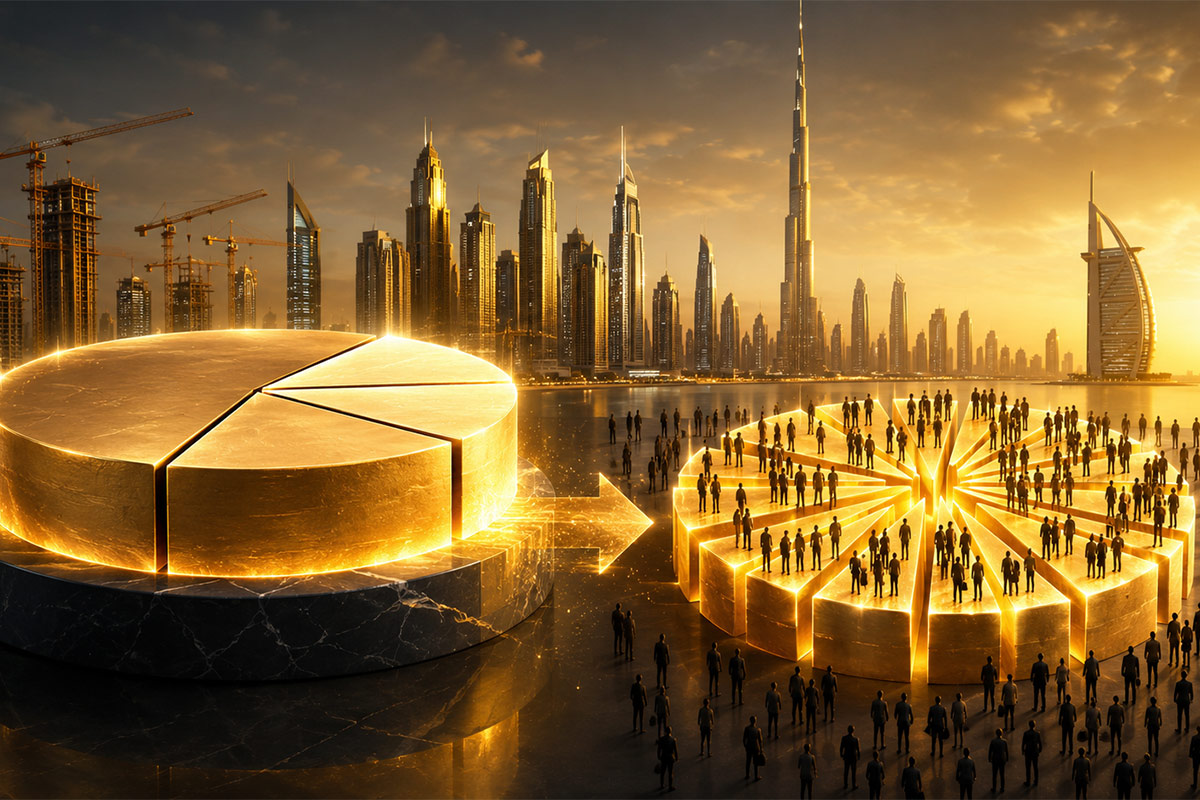
In a previous Dubai Press analysis, we examined Dubai’s GDP per resident and the difficulty of measuring inequality through city-level data. The central question was simple: if Dubai’s economy is growing, why does economic output per resident not always rise at the same pace?
That question leads to a more emotional one: Are people in Dubai becoming poorer? The most accurate answer is: not necessarily. Dubai’s economic cake has not become smaller. In fact, it has become larger. The economy continues to expand, attract investment and generate new opportunities across finance, construction, real estate, tourism, trade, logistics and digital services.
But the number of people sharing that economy has also increased quickly. Competition for housing, jobs, clients, school places and business opportunities has intensified. At the same time, Dubai’s population includes very different income groups, from global investors and senior executives to essential manual and service workers.
So the real story is not that Dubai is becoming poorer. It is that Dubai is becoming richer overall, while also becoming more competitive, more expensive and more complex in the way prosperity is experienced by different residents.
Why People Ask Whether Dubai Is Getting Poorer
Dubai is widely associated with economic success. The city attracts global businesses, entrepreneurs, property investors, high-income professionals, tourists and international capital.
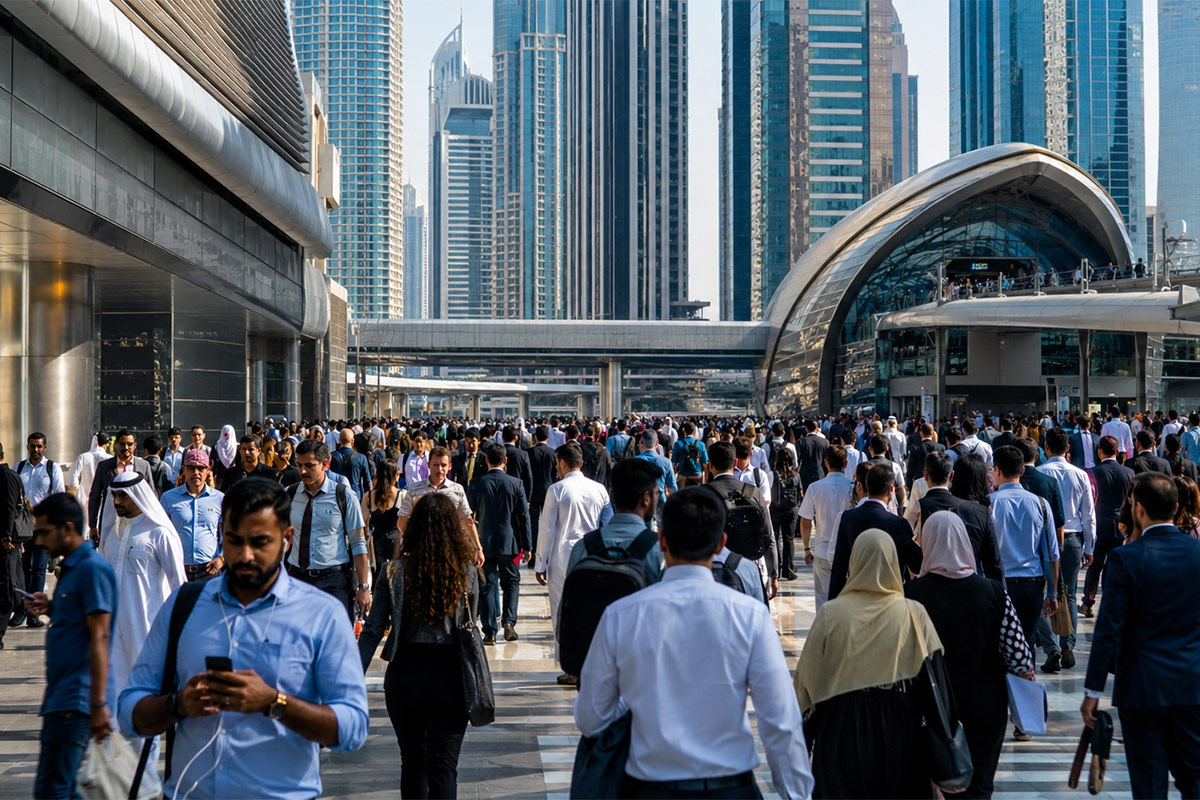
Yet many residents also feel that daily life has become more demanding. Rent can feel more expensive. Business competition is stronger. Popular neighbourhoods are harder to access. Parents face school costs. Middle-income professionals may feel that salaries do not always rise as quickly as housing and lifestyle expenses.
This creates an apparent contradiction:
- Dubai looks wealthier than ever.
- The economy continues to grow.
- Investment and property activity remain strong.
- More international residents are moving to the city.
- Yet some people feel financially under greater pressure.
Both realities can exist at the same time. A city can become economically stronger while daily life becomes harder for sections of its population. That happens when population, costs and competition rise quickly alongside growth.
Dubai’s Economy Is Not Shrinking
The first point is important: Dubai is not experiencing economic contraction. During the first nine months of 2025, Dubai recorded approximately AED 355 billion in GDP, representing growth of 4.7% compared with the same period in 2024. The third quarter alone contributed AED 113.8 billion and grew by 5.3% year-on-year.
Several major sectors also expanded during the same period:
- Financial and insurance activities grew by 8.5%.
- Construction grew by 8.5%.
- Real estate grew by 6.7%.
- Information and communications grew by 4.8%.
- Accommodation and food services grew by 4.7%.
- Wholesale and retail trade grew by 4.6%.
These are not signs of a city becoming poorer. They are signs of an economy absorbing more capital, more workers, more residents, more tourists and more business activity at the same time.
Dubai’s Main Growth Sectors in the First Nine Months of 2025
| Population Measure | 2024 Figure | What It Shows |
|---|---|---|
| People usually residing in Dubai | 4.248 million | The official resident population at the end of 2024 |
| Workers living outside Dubai and temporary residents | 1.690 million | Additional people using the city for work, tourism or daily activity |
| Total active individuals during peak daytime hours | 5.938 million | The wider daytime pressure placed on Dubai’s economy and infrastructure |
Dubai’s economy is therefore not getting smaller. The economic cake is growing. The challenge is that the city is also attracting more people who want a share of its opportunities.
The Economic Cake Is Bigger, but More People Are Sharing It
One of the most important changes in Dubai is population growth. According to Dubai’s official 2024 Population Bulletin, the number of usual residents in the emirate reached 4.248 million at the end of 2024. During peak daytime hours, the number of active individuals in Dubai reached nearly 5.938 million, once workers living outside the emirate, temporary residents, tourists and daily movement are included. That difference matters.
Dubai is not only supporting the people who officially live there. During the working day, its transport, offices, retail spaces, roads, restaurants, business districts and public infrastructure serve a much larger active population. This helps explain why the city can feel crowded, competitive and expensive even while its economy is performing strongly.
Dubai’s Resident and Daytime Active Population
| Population Measure | 2024 Figure | What It Shows |
|---|---|---|
| People usually residing in Dubai | 4.248 million | The official resident population at the end of 2024 |
| Workers living outside Dubai and temporary residents | 1.690 million | Additional people using the city for work, tourism or daily activity |
| Total active individuals during peak daytime hours | 5.938 million | The wider daytime pressure placed on Dubai’s economy and infrastructure |
More people can mean more customers, more workers, more businesses and greater economic activity. But it can also mean more competition for housing, transport, employment and services. This is why a growing city does not always feel easier to live in.
GDP Per Resident Is Not the Same as Personal Income
This is where public debate often becomes confused. GDP per capita, or more precisely in this context GDP per resident, is not the same as personal income. It is not the same as salary, household income, disposable income or wealth. It is a simple calculation: Total economic output divided by the resident population.
If Dubai’s GDP rises, but its resident population rises very quickly as well, GDP per resident can remain flat or decline. That does not automatically mean individual residents have become poorer. It means the economic output is being divided across a much larger population base.
For a detailed analysis of this calculation, population growth and the limits of available inequality data, read our previous report: Dubai’s Per Capita Income and Inequality: What Has Changed Over the Last Decade?
Why This Distinction Matters
A resident’s actual financial situation depends on much more than GDP per resident. It depends on:
- Salary growth
- Rent and housing costs
- School fees
- Transportation expenses
- Access to investment opportunities
- Business profitability
- Job security
- Ability to save
- Cost of daily services
- Whether the person owns assets such as property or a business
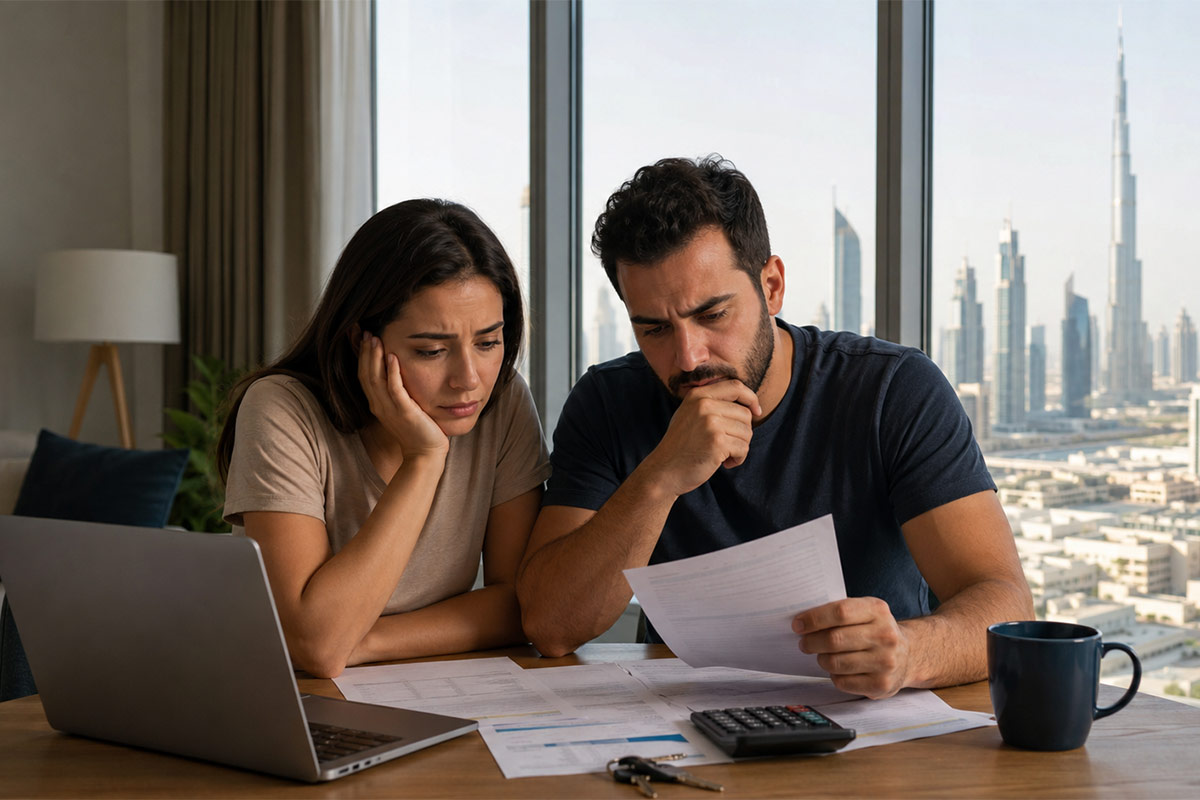
GDP per resident can show whether economic output is keeping pace with population. But it cannot show whether a specific family is financially comfortable or whether a particular worker is struggling. That requires a wider discussion about affordability, wages, housing and opportunity.
Dubai’s Demographic Structure Changes the Average
Dubai’s population is not economically uniform. The city includes investors, entrepreneurs, bankers, lawyers, executives, technology professionals, property owners and high-net-worth international residents. But it also relies heavily on construction workers, delivery workers, retail employees, hospitality staff, logistics workers, domestic service workers and other essential employees.
According to Dubai’s 2024 Population Bulletin, 68.5% of residents at the end of the year were male. The official bulletin links this imbalance to large numbers of external workers arriving without their family members. It also states that the large proportion of male foreign workers reflects Dubai’s rapid economic growth.
This is one of the most important points often missed in discussions about wealth in Dubai. Dubai is not only a city of luxury consumption and global capital. It is also a labour-intensive economy that depends on thousands of workers who help build, clean, deliver, transport, serve, maintain and operate the city.
Why Lower-Income Workers Affect Per-Capita Indicators
When large numbers of lower-income workers join the population base, average economic indicators can decline or appear weaker, even while the city becomes richer overall.
This does not mean those workers are the cause of economic weakness. In reality, they are essential to Dubai’s economic model. Without them, construction slows, logistics becomes more expensive, hotels and restaurants cannot operate efficiently, and everyday urban life becomes harder to maintain. The issue is mathematical and structural:
- High-income individuals increase wealth and investment activity.
- Skilled professionals strengthen high-value sectors.
- Manual and service workers support the city’s operational growth.
- A larger overall population lowers average per-resident measures unless productivity rises equally fast.
Dubai’s population mix therefore helps explain why a city can visibly attract more wealth while average output per resident does not rise at the same speed.
Are Middle-Income Residents Feeling More Pressure?
Although Dubai is not becoming poorer overall, many middle-income residents may reasonably feel that life has become more difficult. This is because economic growth and personal comfort do not always move together. A strong economy can increase demand for housing, schools, transport, restaurants, offices and business services. When demand rises quickly, costs can increase as well. For middle-income residents, the pressure can appear in several areas:
- Higher rent in desirable residential communities
- Stronger competition for good apartments
- More expensive family lifestyles
- Greater pressure from school and childcare costs
- Increased competition for professional jobs
- More businesses competing for the same customers
- Higher costs of establishing or operating a company
- Difficulty saving enough to buy property
For people whose income rises faster than expenses, Dubai can remain highly rewarding. For people whose salary remains relatively fixed while housing and lifestyle costs rise, the city can feel financially harder than before.
That is not the same as saying Dubai is poorer. It means the gains from growth are not experienced equally by everyone.
Dubai Is Richer Overall, but Opportunity Feels More Uneven
There is more money, more business activity and more capital in Dubai than before. But access to those opportunities is uneven. People connected to fast-growing and high-value sectors may benefit significantly from the city’s expansion. These include:
- Finance and wealth management
- Real estate investment and brokerage
- Technology and digital services
- Artificial intelligence
- Professional consulting
- Tourism and hospitality businesses
- Logistics and international trade
- Entrepreneurship and startup investment
- High-value legal and corporate services
At the same time, residents working in lower-wage or highly competitive sectors may face stronger pressure from rent, daily expenses and a larger labour pool. This is why Dubai can feel prosperous and unequal at the same time.
The city’s economy is generating more value, but that value does not reach every resident in the same way, at the same speed, or in the same amount.
Why Dubai Feels More Competitive Than Before
The real change in Dubai is not simply that the economy is larger. The opportunity market has become more crowded. Dubai was already competitive ten years ago. Today, it is more global, more visible and more attractive to people from around the world. Its reputation for business, lifestyle, investment, safety, property and international connectivity attracts:
- More skilled professionals
- More entrepreneurs
- More investors
- More international companies
- More freelancers
- More property buyers
- More service workers
- More ambitious newcomers
This creates a stronger economy, but also a more demanding environment for individuals who do not move up the value chain.
A marketer is competing with more agencies and freelancers. A professional is competing with international applicants. A business owner faces more brands entering the market. A family looking for housing faces demand from new residents and investors. Dubai still offers opportunity. But the opportunity is no longer uncrowded.
Who Benefits Most From a More Competitive Dubai?
People are more likely to benefit from Dubai’s expanding economy if they can offer skills, assets or businesses linked to high-value demand. This may include people who:
- Work in finance, technology, law or investment
- Own successful businesses
- Hold valuable real estate assets
- Build scalable digital services
- Work with international clients
- Have specialised skills that are difficult to replace
- Participate in industries supported by Dubai’s long-term plans
Those operating in easily replaceable roles or sectors with intense labour competition may find it harder to achieve strong wage growth. The key divide is increasingly not only between rich and poor. It is also between people who can access high-value growth and people who remain in sectors where competition limits earning power.
What Would Broader Prosperity Look Like in Dubai?
The real question is not whether Dubai can continue to grow. The evidence shows that it can. The more important question is whether a larger economy can translate into broader upward mobility.
For residents, broader prosperity would mean:
- Higher productivity
- Better wages in middle-income roles
- More affordable housing choices
- Stronger and more accessible public transport
- Better opportunities to build savings
- More pathways from low-value to high-value work
- Practical support for entrepreneurs and small businesses
- Greater access to education and professional development
- Improved transparency around income and wealth differences
A city can be highly successful globally while still needing to improve how everyday residents experience growth.
For Dubai, the next decade will be partly about whether economic expansion becomes easier to feel across a wider section of society.
Dubai Economic Agenda D33 and the Next Stage of Growth
Dubai’s long-term economic strategy is built around continued expansion.
The Dubai Economic Agenda D33 aims to double the size of Dubai’s economy over the decade to 2033 and position the city among the world’s top three global cities for living, investing and working. Official targets include increasing foreign trade in goods and services to AED 25.6 trillion, attracting AED 650 billion in foreign direct investment, raising private-sector investment to AED 1 trillion, and generating an annual AED 100 billion contribution from digital transformation projects.
Key D33 Targets
| D33 Target | Target Figure | Why It Matters for Residents |
|---|---|---|
| Double the size of Dubai’s economy | By 2033 | Could create more jobs, business activity and investment opportunities |
| Foreign trade in goods and services | AED 25.6 trillion | Supports Dubai’s role as an international commerce and logistics hub |
| Foreign direct investment | AED 650 billion | Could bring new companies, sectors and high-value employment |
| Private-sector investment | AED 1 trillion | Can expand entrepreneurship, services and private employment |
| Annual contribution from digital transformation projects | AED 100 billion annually | Supports productivity, technology careers and higher-value growth |
D33 matters because it is not simply a plan to make Dubai bigger. Its most important long-term question is whether growth can become more productive.
If future growth is driven by finance, AI, digital services, advanced manufacturing, high-value tourism, logistics technology, green industries and specialised professional services, Dubai may be able to raise output per resident and create stronger upward mobility.
But if population and living costs continue to rise faster than wages across many sectors, the city may remain extremely wealthy overall while feeling harder for parts of the population.
The Bigger Cake and the Unequal Slices
The economic story of Dubai can be understood through a simple comparison.
| Question | What the Data Suggests | What Residents May Feel |
|---|---|---|
| Is Dubai’s economy shrinking? | No. GDP grew 4.7% in the first nine months of 2025. | More business activity and opportunity in the city |
| Is the population growing rapidly? | Yes. The official resident population reached 4.248 million at the end of 2024. | More competition for housing, work and services |
| Does flat GDP per resident prove people are poorer? | No. It may reflect rapid population growth and labour-market composition. | Some residents may still experience affordability pressure |
| Is wealth experienced equally? | There is no regularly updated Dubai-level inequality measure showing the complete picture. | Opportunities and cost pressures can feel highly uneven |
| What determines future prosperity? | Whether productivity and wages improve alongside population and investment growth. | A better chance to benefit from Dubai’s expansion |
The cake is bigger. But there are more people at the table, and not everyone receives the same slice.
Final Analysis: Are People in Dubai Getting Poorer?
Dubai is not getting poorer. Its economy is larger, more diversified and more globally connected than before. Recent GDP data shows continued growth across finance, construction, real estate, digital services, hospitality and trade. But life in Dubai has become more competitive.
The city is attracting more residents, more capital, more workers, more businesses and more international ambition. This strengthens the economy, but it also creates pressure on housing, wages, services and access to opportunity.
A lower or flatter GDP-per-resident figure does not automatically mean ordinary residents are poorer. It may reflect rapid population expansion, a broad and diverse labour market, commuter flows, temporary residents and the large number of workers needed to operate a fast-growing global city. The more important question is whether Dubai can convert economic growth into wider prosperity.
If the city can improve productivity, support higher-value jobs, expand affordable living options, strengthen transport, encourage wage mobility and create clearer pathways into high-growth sectors, more residents may feel the benefits of the city’s economic success. Dubai’s cake is growing. The challenge now is making sure more people can access a meaningful share of it.
FAQ About Whether People in Dubai Are Getting Poorer
- Are people in Dubai becoming poorer?
Not necessarily. Dubai’s economy is continuing to grow, with GDP reaching approximately AED 355 billion in the first nine months of 2025. However, rapid population growth, increasing competition and higher living costs can make life feel more financially demanding for some residents.
- Why can GDP per resident fall while Dubai’s economy grows?
GDP per resident is calculated by dividing total economic output by the resident population. If the economy grows but the population increases even faster, the average output per resident can remain flat or decline.
- Does lower GDP per resident mean salaries are falling?
No. GDP per resident is not the same as salary or household income. Salaries vary by sector, experience and job type. To understand whether people are financially better or worse off, housing costs, wages, savings and affordability must also be considered.
- Why does Dubai feel more expensive now?
Dubai has attracted more residents, businesses, tourists and investors, increasing demand for housing, services, schools, transport and lifestyle amenities. For some residents, especially middle-income households, rising costs can make daily life feel more difficult.
- Which sectors are growing strongly in Dubai?
During the first nine months of 2025, strong growth was recorded in financial and insurance activities, construction, real estate, information and communications, accommodation and food services, and wholesale and retail trade.
- What is Dubai Economic Agenda D33?
Dubai Economic Agenda D33 is the city’s long-term strategy to double the size of its economy by 2033 and strengthen its position among the world’s top three global cities for living, working and investing.