
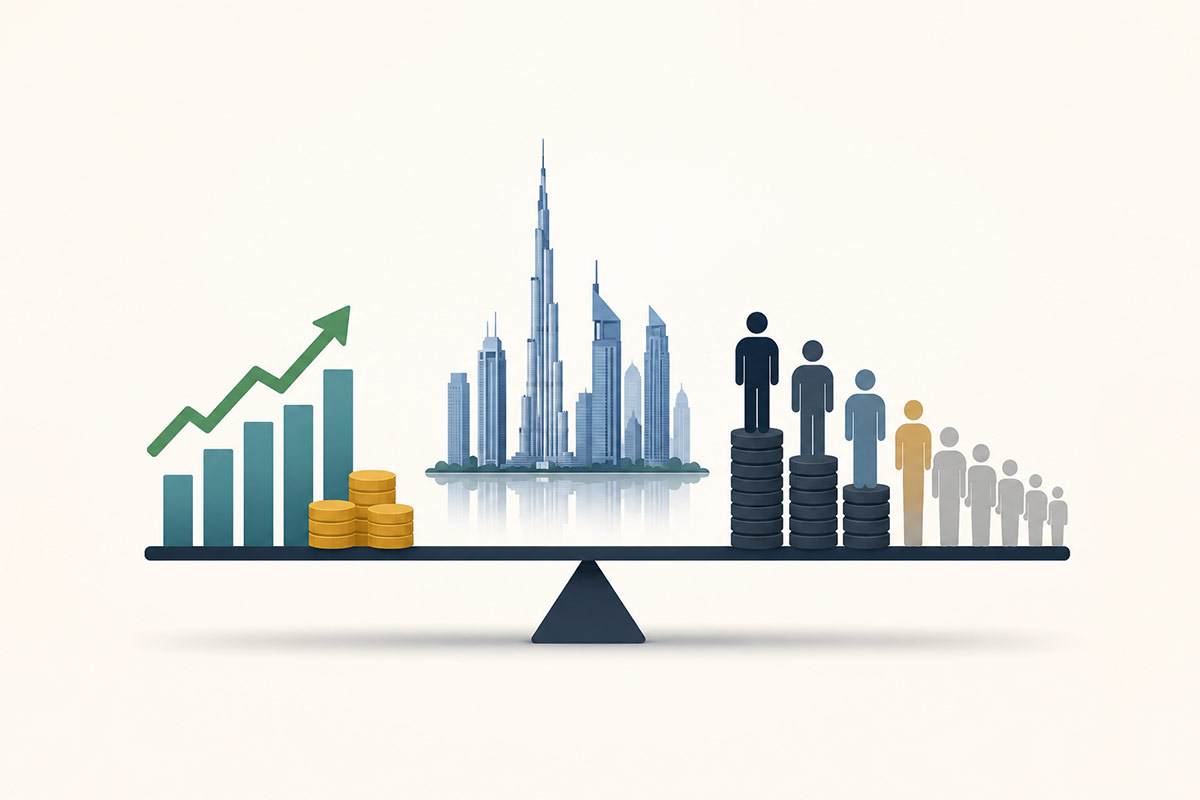
Dubai’s economy has grown significantly over the last decade. The city has strengthened its position as a global center for trade, tourism, finance, logistics, real estate, investment, and business expansion. But the story becomes more complex when Dubai’s economic output is measured against the number of people living in the emirate.
A city can become much larger economically while its output per resident grows slowly, remains flat, or even declines. This happens when population rises faster than total economic production. That is the key issue in Dubai’s recent economic story.
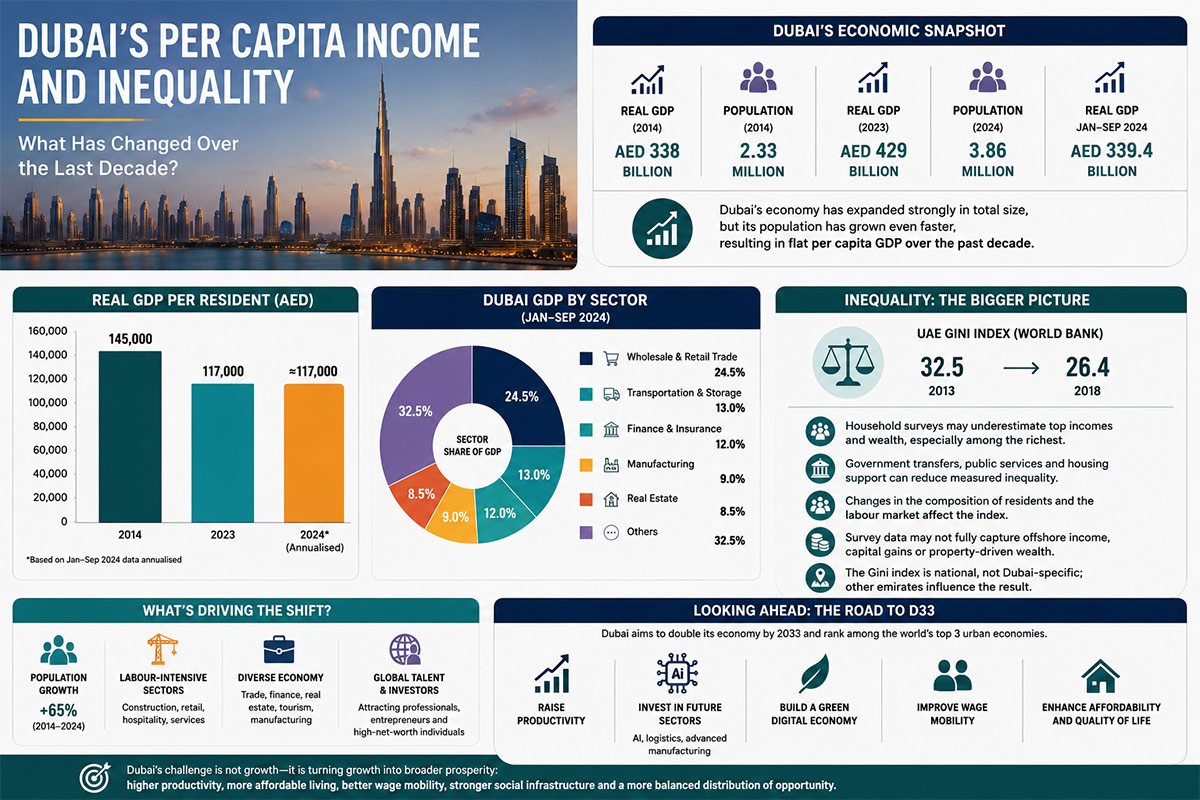
Based on earlier published figures used for the 2014 baseline, Dubai’s GDP stood at approximately AED 338 billion, with a population of around 2.33 million. By 2023, Dubai’s GDP had reached approximately AED 429 billion. Official revised population estimates now place Dubai’s population at 3.974 million in 2023 and 4.248 million at the end of 2024. Dubai’s GDP also reached AED 339.4 billion during the first nine months of 2024.
This means Dubai has clearly become a larger economy. However, because the resident population has expanded even faster, GDP per resident has moved in a different direction.
Why GDP Per Resident Matters in Understanding Dubai’s Economy
Total GDP measures the overall size of an economy. It shows how much economic activity is produced across sectors such as trade, finance, transport, real estate, construction, tourism, and manufacturing. GDP per resident asks a different question: How much economic output is being generated relative to the number of people living in the city?
This does not measure personal salary, household income, disposable income, or individual wealth. A city may have high GDP per resident while many residents still face rising rent, uneven wage growth, or limited access to asset ownership.
However, GDP per resident remains useful because it helps show whether economic expansion is outpacing population growth. In Dubai’s case, the answer appears clear: total economic output has grown strongly, but population growth has been even faster.
Dubai’s GDP and Population Growth Over the Last Decade
Dubai’s economy has expanded meaningfully since 2014. Using the baseline figures cited in the original analysis, GDP rose from approximately AED 338 billion in 2014 to AED 429 billion in 2023, an increase of about 27%.
Population growth, however, has been much faster. Dubai’s population increased from approximately 2.33 million in 2014 to a revised official estimate of 4.248 million at the end of 2024. This represents growth of more than 80% over the decade.
The latest official population bulletin also revised the estimates for 2022 to 2024 using a register-based approach under the Dubai Population Now project. It reports 3.718 million residents in 2022, 3.974 million in 2023, and 4.248 million in 2024.
Dubai’s GDP and Population Compared
| Year | Dubai GDP | Population | Approximate GDP per Resident | Note |
|---|---|---|---|---|
| 2014 | AED 338 billion | 2.33 million | AED 145,000 | Baseline based on earlier published figures |
| 2023 | AED 429 billion | 3.974 million | AED 108,000 | Uses revised official population estimate |
| 2024 | AED 339.4 billion in first nine months | 4.248 million | Not directly comparable as a full-year figure | GDP figure covers only January to September |
A simple annualisation of Dubai’s first nine months of 2024 GDP would produce an estimated full-year equivalent of approximately AED 452.5 billion. Compared with the official end-of-year population estimate of 4.248 million, this would suggest an indicative GDP per resident of around AED 107,000. However, this is only an estimate, not an official full-year GDP per resident figure.
Dubai Has Grown Larger, but Not Necessarily Richer Per Resident
The decline in estimated GDP per resident does not mean Dubai has become a poorer city.
It means that the structure of growth has changed.
Dubai has attracted multiple groups at the same time:
- Skilled professionals
- Entrepreneurs
- Investors
- High-net-worth global residents
- Service-sector employees
- Construction and logistics workers
- Hospitality and retail workers
- Freelancers and startup founders
This combination has helped Dubai expand quickly, attract global capital, and increase economic activity. But it has also increased the population denominator very rapidly.
In simple terms, more people are participating in a larger economy. However, the economy’s total output has not expanded as quickly as the number of residents.
That distinction matters because economic success should not be judged only by how large Dubai becomes. It should also be judged by productivity, affordability, wage opportunity, public services, and whether residents can benefit from growth in their daily lives.
Population Growth Is the Main Driver of the Shift
Dubai’s population growth has been one of the strongest forces shaping its economy over the past decade.
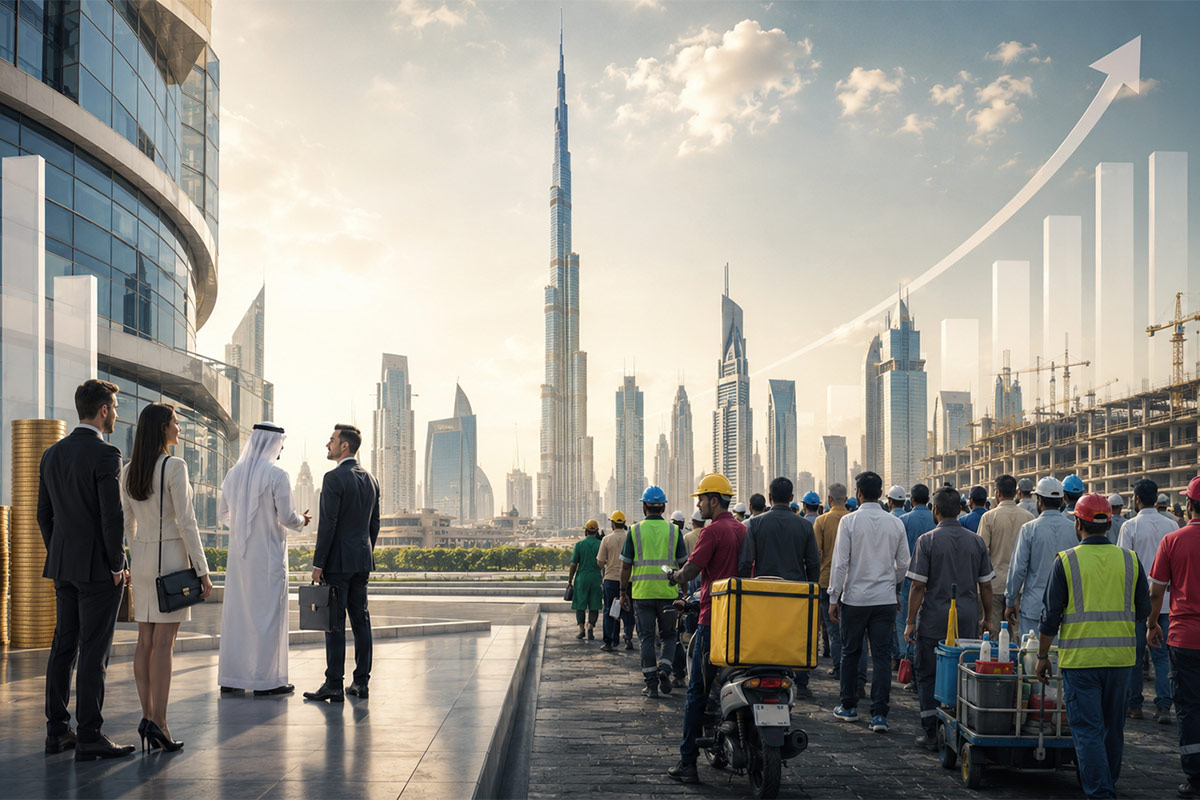
The official 2024 Population Bulletin estimates that Dubai had 4.248 million usual residents at the end of 2024. It also estimates that the number of active individuals present in Dubai during peak daytime hours reached approximately 5.938 million, because the city attracts workers from neighbouring emirates, tourists, temporary residents, and other daily visitors.
This rapid population expansion creates major economic opportunities, but it also increases demand for:
- Housing
- Public transport
- Roads and mobility
- Schools
- Healthcare
- Retail services
- Electricity and cooling
- Logistics and delivery
- Public infrastructure
- Affordable living options
A growing population can support business activity and investment. But if housing, wages, transport, and public services do not expand efficiently, residents may feel increasing pressure even during periods of strong GDP growth.
Why Dubai’s Population Structure Matters
Dubai’s demographic structure is highly unusual. According to the official population bulletin, 68.5% of residents at the end of 2024 were male, a pattern linked to large numbers of foreign workers arriving without their families. The bulletin also reports that residents aged 25 to 44 represented more than half of the emirate’s population.
This matters economically because Dubai is not only attracting wealthy residents or senior professionals. It is also attracting large numbers of workers needed to support construction, logistics, retail, hospitality, property services, domestic services, transport, and other labour-intensive parts of the economy.
As a result, economic expansion and average output per resident may move differently.
Which Sectors Are Driving Dubai’s Economic Growth?
Dubai’s recent growth has been supported by a diversified economy rather than dependence on a single sector.
During the first nine months of 2024, Dubai’s GDP reached AED 339.4 billion, representing growth of 3.1% compared with the same period in 2023. Wholesale and retail trade remained the largest contributor, accounting for 24.5% of GDP during that period. Transportation and storage contributed 12.4%, while finance and insurance contributed 11.6%. Manufacturing, real estate, construction, and accommodation and food services also remained important parts of the economy.
Dubai GDP by Major Sector in the First Nine Months of 2024
| Sector | Share of GDP |
|---|---|
| Wholesale and retail trade | 24.5% |
| Transportation and storage | 12.4% |
| Finance and insurance | 11.6% |
| Manufacturing | 8.4% |
| Real estate | 8.0% |
| Construction | 6.5% |
| Accommodation and food services | 3.4% |
| Other sectors | 25.2% |
This sector mix helps explain why GDP per resident can remain under pressure even while the economy appears strong. Several of Dubai’s major growth sectors require substantial numbers of workers. Trade, transport, logistics, construction, hospitality, retail, and real estate services all rely on large labour forces.
At the same time, Dubai is also attracting high-income professionals, founders, investors, finance companies, technology firms, and wealthy international residents.
The result is a highly dynamic economy with both significant wealth creation and a wide range of incomes across its resident population.
GDP Per Resident Is Not the Same as Personal Income
It is important not to confuse GDP per resident with average salary or household prosperity.
GDP per resident measures the emirate’s total economic output divided by the number of residents. It does not tell us exactly how much people earn, how wealth is distributed, how much rent households pay, or whether middle-income workers are better off financially.
For example, GDP can rise because of strong activity in finance, property, tourism, trade, or corporate profits, while many residents may still face:
- Higher rents
- Increased transport costs
- Pressure on household budgets
- Limited wage growth
- Difficulty buying property
- Unequal access to investment opportunities
This is why the discussion about Dubai’s prosperity cannot stop at GDP growth alone. A complete analysis must also consider affordability, wages, housing access, asset ownership, and inequality.
Why Inequality in Dubai Is Difficult to Measure
The inequality picture is much more difficult to measure than GDP or population growth.
Dubai does not publish a regularly updated city-level Gini coefficient in the same way that it publishes economic and demographic indicators. The most comparable internationally available public benchmark is the UAE-level Gini index reported through World Bank data.
According to available World Bank-linked figures, the UAE’s Gini index declined from approximately 32.5 in 2013 to 26.4 in 2018, which remains the latest widely available World Bank figure for the country. The Gini index measures income or consumption inequality, with a higher number generally indicating greater measured inequality.
UAE Gini Index: Latest Available Public Benchmark
| Year | UAE Gini Index | Interpretation |
|---|---|---|
| 2013 | 32.5 | Higher measured inequality than in 2018 |
| 2018 | 26.4 | Lower measured inequality in the latest widely available World Bank data |
However, these national figures should not be used as a simple description of inequality inside Dubai.
They apply to the UAE as a whole, not Dubai alone. They are also based primarily on household survey data, which may not fully capture top incomes, investment gains, offshore assets, or high-value property wealth.
Why Official Inequality Data May Not Capture the Full Dubai Experience
The World Bank notes that its inequality estimates are based on household survey data, while research on inequality measurement warns that household surveys may underrepresent the richest households because of non-response or incomplete reporting. The World Inequality Database addresses this limitation by combining surveys with national accounts, fiscal data, and wealth information where available.
This limitation is especially important in Dubai because the city has a distinctive economic and demographic structure:
- A large expatriate population
- A significant blue-collar labour force
- A growing class of high-income international professionals
- Wealthy global residents and investors
- Major property ownership differences
- Strong exposure to capital income and real estate gains
- Large differences in housing quality and rent burden
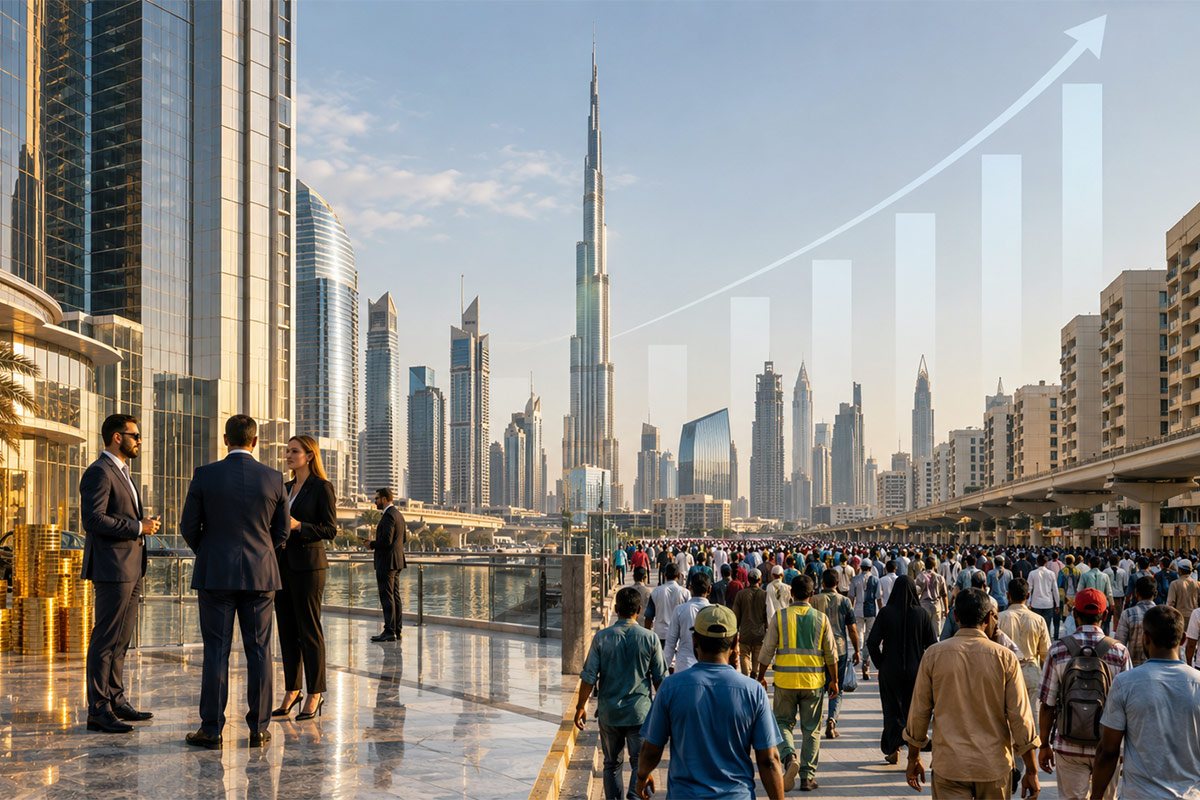
A national household-survey-based Gini figure may suggest moderate measured income inequality, while lived differences in housing, assets, lifestyle, rent pressure, and wealth-building opportunity appear much wider.
This does not mean the official data is wrong. It means the data measures only part of a more complex reality.
Why Might the UAE’s Measured Gini Index Have Declined?
The apparent decline in the UAE-level Gini index does not necessarily mean that every form of inequality in Dubai decreased.
Several factors may explain the lower measured national figure:
- Government support, public services, housing programmes, and social benefits may reduce measured inequality among Emirati households.
- Changes in the composition of the expatriate population can affect national household survey results.
- Survey-based data may not fully capture the wealthiest residents, capital gains, offshore income, or property-driven wealth.
- The data is national rather than Dubai-specific, meaning results from Abu Dhabi, Sharjah, and other emirates influence the final measure.
- Income inequality and wealth inequality are different; property and investment wealth may be distributed more unevenly than regular household income.
This is why inequality in Dubai should be discussed carefully. The available data is useful, but it does not provide a complete city-level picture.
Dubai’s Economic Growth and Inequality: The Main Picture
Dubai’s economic story over the past decade can be understood through two different lenses.
On one side, the city has achieved clear economic success. It has expanded total GDP, diversified its economy, attracted businesses and investors, strengthened global connectivity, and positioned itself as a leading destination for finance, trade, tourism, logistics, and real estate.
On the other side, population has grown extremely quickly. This has diluted GDP per resident and created pressure on housing, transport, infrastructure, affordability, and public services.
The Main Changes in Dubai Over the Last Decade
| Economic Indicator | What Has Changed? | What It Means |
|---|---|---|
| Total GDP | Increased significantly since 2014 | Dubai’s economy is larger and more diversified |
| Resident population | Increased even faster than GDP | More people are sharing the benefits and pressures of growth |
| GDP per resident | Lower than the 2014 baseline in this analysis | Economic output has not grown as fast as population |
| Major growth sectors | Trade, transport, finance, real estate, manufacturing and construction remain important | Growth includes both high-value and labour-intensive activity |
| Measured inequality | UAE-level Gini declined in latest available World Bank data | Useful benchmark, but not a complete picture of Dubai |
| Lived economic pressure | Housing, affordability and wage mobility remain important questions | Growth does not automatically guarantee broader prosperity |
Dubai Economic Agenda D33 and the Future of Prosperity
Looking ahead, Dubai’s Economic Agenda D33 aims to double the size of the economy over the decade to 2033 and strengthen Dubai’s position among the world’s leading cities for living, investing, and working. This creates an important question for the next phase of Dubai’s development: Can Dubai increase productivity faster than it increases population?
If the city can build more high-value economic activity, GDP per resident may begin to rise again. Sectors that could support this shift include:
- Financial services
- Artificial intelligence
- Digital services
- Advanced manufacturing
- Green economy industries
- High-value tourism
- International trade
- Logistics technology
- Innovation-led startups
- Professional and knowledge-based services
These sectors can potentially generate greater economic value without relying only on continuous expansion of labour-intensive activity.
What Could Improve GDP Per Resident in Dubai?
Dubai’s GDP per resident could improve if future growth is increasingly driven by:
- Higher productivity per worker
- More high-skilled and high-value employment
- Stronger technology and innovation sectors
- Growth in financial and professional services
- Increased advanced manufacturing
- Better digital infrastructure
- Higher-value tourism rather than only visitor volume
- More efficient transport and urban infrastructure
- Affordable housing that supports workforce stability
The city’s future economic success will not be measured only by how many people, businesses, or towers it attracts. It will increasingly be judged by how effectively that growth improves productivity and quality of life.
The Challenge of Turning Growth Into Broader Prosperity
Dubai has already proven its ability to grow rapidly. The next challenge is more complex: turning growth into broader prosperity. That means creating an economy where total GDP expansion is accompanied by stronger opportunities for residents, better affordability, improved wage mobility, accessible housing, efficient infrastructure, and practical paths to wealth building.
The most important priorities for the coming decade may include:
- Increasing productivity faster than population growth
- Expanding high-value employment opportunities
- Improving affordability for middle-income residents
- Strengthening transport and public infrastructure
- Supporting access to housing and long-term financial security
- Improving transparency around income and wealth inequality
- Ensuring that economic growth benefits a broader section of society
Dubai does not face a shortage of ambition. Its challenge is ensuring that growth is experienced not only in headline GDP figures, but also in the daily economic reality of people living in the city.
Final Analysis: Dubai’s Success Story Is Entering a New Phase
Dubai’s economic success over the past decade is clear. The city has grown in size, global relevance, sector diversity, population, and international attractiveness. But the next phase requires a more careful definition of success.
A larger economy does not automatically mean higher output per resident. More international wealth does not automatically mean lower lived inequality. More residents do not automatically mean greater prosperity for everyone.
The official data shows that Dubai’s population has expanded dramatically, while GDP growth, although strong, has not kept pace on a per-resident basis. At the same time, inequality remains difficult to evaluate because regularly updated Dubai-level distribution data is limited.
The central question for Dubai over the next decade is therefore not whether it can continue growing. It almost certainly can. The real question is whether it can make growth more productive, more affordable, and more broadly beneficial.
If Dubai can combine D33 expansion with higher-value industries, better wage mobility, stronger infrastructure, accessible living costs, and improved measurement of economic inequality, its next decade may be defined not only by growth, but by wider prosperity.
FAQ About Dubai’s GDP Per Resident and Inequality
- What is Dubai’s GDP per resident?
Using Dubai’s 2023 GDP of approximately AED 429 billion and the revised official 2023 population estimate of 3.974 million, Dubai’s GDP per resident was approximately AED 108,000. This measures economic output per resident, not personal salary or household income.
- Has Dubai’s GDP per resident increased over the last decade?
Using the baseline figures in this analysis, Dubai’s GDP per resident was approximately AED 145,000 in 2014 and approximately AED 108,000 in 2023. This suggests that population growth outpaced total GDP growth over the period.
- Why has Dubai’s GDP per resident declined despite economic growth?
Dubai’s total economy has grown, but its resident population has increased even faster. The city has attracted professionals, entrepreneurs, investors, service workers, construction workers, and other expatriate residents at a rapid pace, increasing the population denominator used in GDP-per-resident calculations.
- Does lower GDP per resident mean Dubai has become poorer?
No. Lower GDP per resident does not mean Dubai has become poorer overall. It means total output has been spread across a much larger resident population. To understand living standards, other factors such as salaries, rents, household costs, asset ownership, and public services must also be examined.
- What is the Gini coefficient for Dubai?
Dubai does not publish a regularly updated city-level Gini coefficient comparable to its GDP and population statistics. The closest widely available public benchmark is the UAE-level World Bank Gini index, which stood at 26.4 in 2018, the latest widely available figure.
- What is Dubai Economic Agenda D33?
Dubai Economic Agenda D33 is the city’s long-term economic strategy aimed at doubling the size of Dubai’s economy over the decade to 2033 and strengthening its position among the world’s leading cities for living, working, and investing.