

Finding the worst time to post on Instagram is just as important as finding the best time. A strong Reel, carousel, or product post can underperform if it goes live when your audience is asleep, busy, commuting, or simply not in the mood to engage.
In 2026, Instagram timing is not about chasing one universal “magic hour.” The platform is algorithm-driven, audience-specific, and heavily influenced by content format, industry, location, and early engagement signals. Still, broad engagement studies show clear low-performance windows. Buffer’s 2026 analysis of 9.6 million Instagram posts found that posts published between 1 AM and 5 AM tend to receive the lowest engagement, while Friday and Saturday are among the weakest days overall. Sprout Social’s 2026 Instagram data also identifies weekends, especially Saturday and Sunday, as the lowest-engagement days across many profiles and industries.
For UAE brands, the worst time to post on Instagram UAE can also be shaped by local routines: office hours, prayer times, weekend behavior, Ramadan schedules, late-night social habits, and the difference between Dubai, Abu Dhabi, and international audiences. This guide explains the worst posting times in 2026, how they change by industry, and how to find the exact low-engagement windows for your own account.
Is There Really a “Worst” Time to Post on Instagram?
Yes, but not in the same way for every account. There is no single worst time to post on Instagram that applies perfectly to every brand, creator, or country. A Dubai restaurant, a B2B consulting firm, a fashion influencer, and a gaming page may all see different audience behavior.
However, there are time slots that consistently perform worse across large datasets. Overnight posting is usually weak because most users are offline or less likely to engage actively. Weekends can also underperform for many brands, especially if their content is professional, educational, or product-focused rather than entertainment-driven.
The important point is that “worst time” means “lowest probability of early engagement.” Instagram does not simply show every post chronologically to all followers. Instead, it evaluates signals such as interaction history, content relevance, viewing behavior, watch time, shares, saves, and how people respond shortly after a post is published. Instagram’s own creator guidance explains that different ranking systems are used across Feed, Stories, Explore, and Reels, and these systems personalize what each user sees.
So, if you post when your core audience is inactive, your content may receive weaker early signals. That can reduce reach, especially for posts that need quick saves, shares, comments, or watch time to gain momentum.
How the Instagram Algorithm in 2026 Affects Posting Time
The Instagram algorithm in 2026 is not one single algorithm. Feed, Stories, Explore, and Reels each use ranking systems that try to predict what users are most likely to watch, like, save, share, comment on, or revisit. This means posting time matters because timing influences the first wave of engagement.
If your post goes live when followers are active, it has a better chance of earning quick signals. If it goes live during a dead zone, the post may receive fewer immediate interactions. That does not automatically kill the post, but it can slow down distribution.
This is especially true for Reels. Reels can continue gaining reach for days or weeks, but early watch behavior still matters. If people skip quickly, do not finish the video, or do not share it, Instagram has fewer reasons to push it to more users.
The platform is also becoming more personalized. Meta introduced more user control over Reels recommendations through a feature called “Your Algorithm,” allowing users to influence topics they see more or less often. This shows that Instagram is moving deeper into personalized recommendation behavior, not simple chronological distribution.
That means your posting time should not be based only on global benchmarks. You need to understand when your audience is active and when they are likely to engage with your specific type of content.
The Worst Times to Post on Instagram Based on Engagement Trends
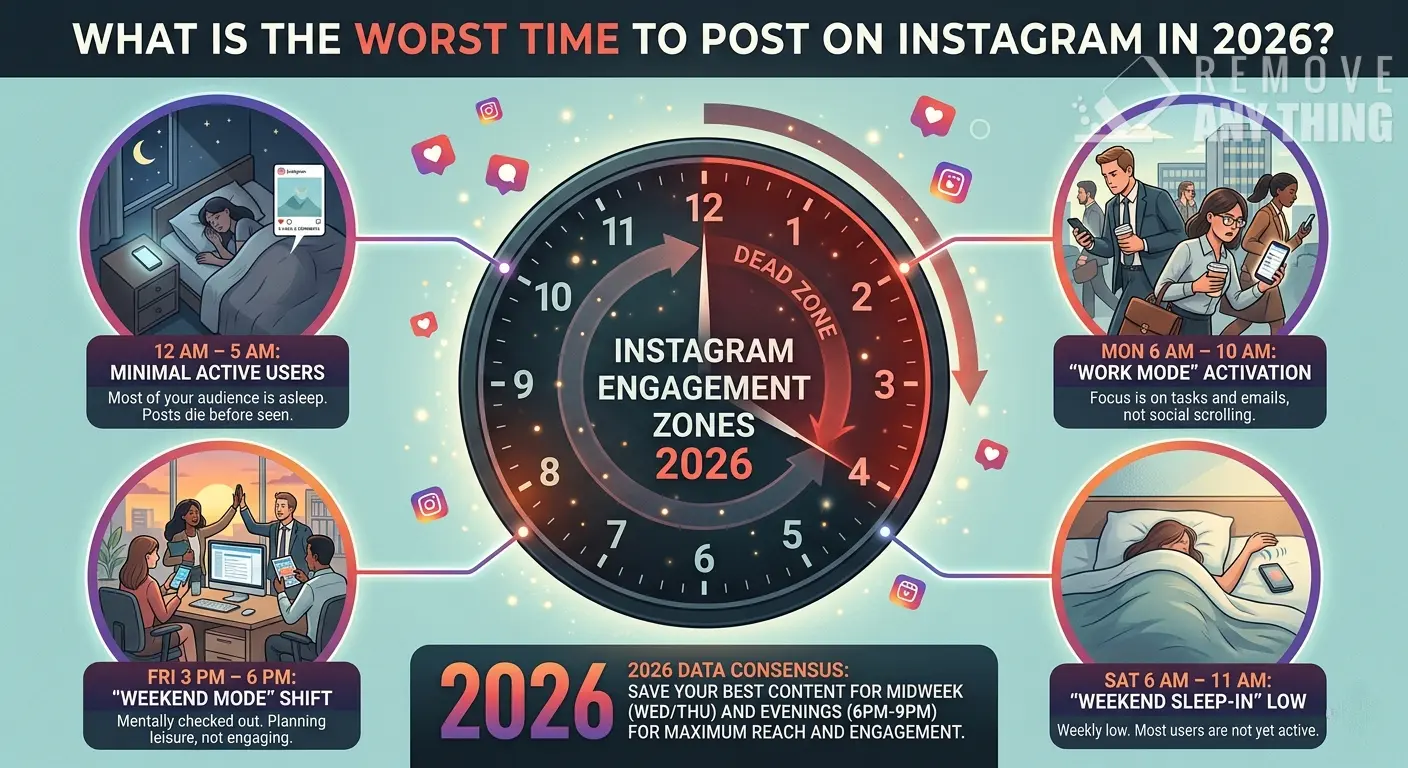
Broad 2026 data suggests that the worst time to post on Instagram is usually overnight, followed by low-attention weekday work periods for certain industries and weak weekend windows. Buffer found that 1 AM to 5 AM tends to generate the lowest engagement across days, while Friday and Saturday are weaker overall. Sprout Social’s 2026 data also shows weekends as low-engagement days, with Tuesdays and Wednesdays generally showing stronger activity.
For UAE accounts, you should interpret these windows in Gulf Standard Time and adjust for your audience location. If your page targets UAE residents, use UAE time. If your audience is global, check whether your followers are mainly in the UAE, Saudi Arabia, India, the UK, or the US.
Late Night Posting (12 AM – 5 AM)
Late night is usually the clearest low-engagement window. Most users are sleeping, preparing for the next day, or browsing passively without meaningful engagement. Buffer’s 2026 Instagram timing research specifically notes that posts shared between 1 AM and 5 AM tend to receive the lowest engagement across the week.
For UAE brands, 12 AM to 5 AM can be risky unless your audience is nightlife-focused, gaming-focused, entertainment-heavy, or targeting late-night users. Even then, you should test carefully. A nightclub, gaming streamer, or late-night food delivery brand may perform better after midnight than a real estate agency, clinic, school, or B2B service provider.
For most businesses, avoid publishing important posts during this window. If you must post overnight, use it for lower-priority content, Stories, reminders, or posts designed for later discovery rather than immediate engagement.
Midday Work Hours (10 AM – 3 PM on Weekdays)
Midday work hours are tricky. Some global studies show good engagement around lunch windows, especially for retail, education, government, and tech pages. Sprout Social’s 2026 data even identifies strong weekday windows around midday and afternoon for several industries.
However, for many UAE accounts, 10 AM to 3 PM can still become a weak period if the audience is working, commuting between meetings, attending school, or not in a browsing mindset. This is especially true for personal brands, entertainment pages, lifestyle creators, and accounts that rely on comments or deeper engagement.
Midday may not be universally bad, but it can become the worst time to post on Instagram UAE for content that needs emotional attention, long watch time, or direct response. A quick retail offer may work at lunch, but a long Reel, personal story, or detailed carousel may perform better in the evening.
Sunday Afternoons
Sunday afternoons can be weak for many accounts, especially in markets where users are mentally preparing for the workweek. In the UAE, Sunday is a working day for many businesses under the Monday-to-Friday workweek, so the pattern is not identical to Western markets. Still, Sunday afternoons can be a low-energy period for professional audiences, students, and families.
Sprout Social’s 2026 broader social media research identifies Sunday as the worst day across major platforms, while its Instagram-specific data also lists weekends as weaker engagement days overall.
For UAE-focused accounts, Sunday afternoon should be tested rather than automatically avoided. It may work for workplace-related content, but it may underperform for shopping, lifestyle, entertainment, or long-form educational posts if your audience is busy.
Worst Time to Post on Instagram by Industry
The worst time to post on Instagram changes by industry because user intent changes. Someone looking for fashion inspiration behaves differently from someone researching business software or comparing clinic services.
E-commerce and Product Brands
For e-commerce brands, the worst times are usually overnight and moments when users are unlikely to shop. Late-night posting between 12 AM and 5 AM is generally weak unless the product is impulse-driven or tied to nightlife, food delivery, gaming, or entertainment.
Midday can work for retail because users browse during lunch breaks, but it depends on the product. Sprout Social’s 2026 retail data shows strong weekday engagement around 12 PM to 3 PM, which means midday is not always bad for e-commerce.
For UAE e-commerce, avoid launching major product posts very late at night. Instead, test early evening, lunch breaks, and payday-related windows. If your audience includes working professionals in Dubai and Abu Dhabi, evenings after work may give better attention for product comparison and checkout behavior.
Personal Brands and Influencers
For personal brands and influencers, the worst posting time is usually when followers cannot give attention. Late night can sometimes work for lifestyle creators, but it often produces passive scrolling rather than strong saves, comments, or shares.
Influencer content often depends on relatability and emotional connection. That means posting during rushed weekday work hours can underperform if the content needs people to watch, read captions, or comment thoughtfully.
For creators in the UAE, evening windows often feel more natural because users are more likely to relax, browse, and respond. However, influencers should still test because audiences differ. A fitness creator may perform well early morning, while a food creator may perform better before dinner.
B2B and Professional Services
For B2B and professional services, weekends and late nights are usually the weakest. A law firm, consulting agency, SaaS company, recruitment brand, or financial service provider should be careful with Friday evening, Saturday, and late-night posts.
Sprout Social’s 2026 data for software and technology shows stronger windows during weekdays, especially late morning to mid-afternoon, while weekends are weaker.
For B2B companies in the UAE, the worst time to post on Instagram UAE is often outside professional attention windows. Posting serious business content at midnight or during weekend leisure hours usually reduces engagement quality. Educational carousels, case studies, and industry insights often need a time when users are mentally in business mode.
Worst Time to Post Reels vs Feed Posts in 2026
Reels and Feed posts behave differently. Feed posts, especially carousels, often depend on saves, comments, and swipe-through behavior. Reels depend heavily on watch time, replays, shares, and completion rate.
The worst time to post Reels is when users are unlikely to watch long enough. Late-night scrolling may create views, but not necessarily quality watch time. If users are tired, distracted, or skipping quickly, your Reel may not gain momentum.
The worst time to post Feed posts is when users are not ready to read, swipe, or engage. A detailed carousel posted during a busy work period may get impressions but fewer saves and shares. For educational posts, avoid times when users are likely to be rushed.
In 2026, timing should match format. Short, entertaining Reels may survive weaker time slots better than detailed Feed carousels. But for high-value content, it is still smarter to post when your audience is active and likely to engage deeply.
How to Find Your Personal Worst Posting Time
Global benchmarks are useful, but your account data is more important. The real worst time to post on Instagram is the time that consistently produces low reach, low engagement rate, weak watch time, or poor conversion for your own audience.
Using Instagram Insights
Instagram Insights can show useful audience and performance data, including follower growth, top locations, age range, and times your followers are most active. Meta’s Business Help Center describes Instagram Insights as including information such as follower activity times, top locations, and audience demographics.
Use this data to identify when your audience is online. If your followers are mostly in the UAE, focus on Gulf Standard Time. If your audience is split between UAE, India, Saudi Arabia, and the UK, you may need separate posting windows for different content types.
Analyzing Engagement Rate by Hour
Do not judge posting time only by likes. In 2026, you should track engagement rate by hour using a mix of metrics:
- Reach
- Impressions
- Likes
- Comments
- Saves
- Shares
- Profile visits
- Website clicks
- Reel watch time
- Completion rate
- DM replies
A time slot may bring decent reach but poor saves. Another may bring fewer views but stronger conversions. For a business, the “worst” time is not always the time with the lowest likes; it may be the time with the weakest business outcome.
Testing and Comparing Time Slots
Test posting times for at least four to six weeks before making conclusions. Compare similar content formats, not completely different posts. For example, compare Reels with Reels, carousels with carousels, and product posts with product posts.
You can create a simple test schedule:
- Week 1: post at 9 AM, 1 PM, 7 PM
- Week 2: post at 11 AM, 4 PM, 9 PM
- Week 3: repeat your strongest and weakest slots
- Week 4: compare by engagement rate, not just reach
After enough testing, you will see your personal low-performance windows.
Common Mistakes That Make a “Good Time” Perform Badly
A good posting time cannot save weak content. Many brands blame timing when the real issue is the post itself.
The first mistake is posting content that does not match the audience’s intent. A B2B carousel may fail on Friday night because people are not thinking about work. A restaurant Reel may fail on Monday morning because the audience is not planning dinner yet.
The second mistake is using generic global timing without adjusting for UAE behavior. The best time in US-based studies may not apply to Dubai audiences.
The third mistake is ignoring content format. A Reel, Story, carousel, and single-image post may all need different timing.
The fourth mistake is posting without a strong hook. Even at the best time, users will skip content that does not catch attention in the first few seconds.
The fifth mistake is inconsistency. If you post randomly, it becomes harder to identify your true worst and best windows.
What to Do If You Must Post at a Low-Engagement Time
Sometimes you cannot avoid a weak posting time. News, announcements, live events, product drops, and urgent updates may need to go live immediately.
If you must post during a low-engagement window, improve the post’s chances by making the hook stronger. Use a clear opening line, strong visual, simple caption, and direct call to action. For Reels, make the first two seconds highly engaging.
You can also support the post with Stories, email, WhatsApp broadcast, paid boosting, or reposting at a better time later. For important announcements, post once when necessary and then create a second version for the stronger engagement window.
For UAE brands, if you must post late at night, consider scheduling a Story reminder the next morning or repurposing the content as a Reel, carousel, or short update during peak activity.
Conclusion | The Smart Way to Avoid the Worst Posting Time on Instagram
The worst time to post on Instagram in 2026 is usually when your audience is inactive, distracted, or unlikely to engage deeply. Broad data points to overnight hours, especially 1 AM to 5 AM, and weak weekend periods such as Friday, Saturday, and Sunday depending on the market. Buffer’s 2026 Instagram study identifies 1 AM to 5 AM as a low-engagement window, while Sprout Social’s 2026 data shows weekends as weaker overall.
For UAE brands, the worst time to post on Instagram UAE depends on your audience’s lifestyle. B2B accounts should avoid late nights and weekend leisure hours. E-commerce brands should avoid dead overnight slots for major launches. Influencers should test evenings, mornings, and weekend behavior instead of copying global benchmarks blindly.
The smartest strategy is to use global research as a starting point, then validate everything through Instagram Insights. Track engagement rate by hour, compare content formats fairly, and build a posting schedule around your real audience data.