
Playing at the FIFA World Cup is one of the greatest achievements in football. For most players, simply reaching the tournament is the result of years of sacrifice, discipline and national level excellence. For a small number of families, however, that dream has been achieved across two generations.
These father-son World Cup duos represent some of the rarest stories in international football. Their stories form a unique part of FIFA World Cup history, showing how football legacy can continue across generations.
In each case, a father reached the biggest stage in the sport, and years later, his son followed with his own journey, his own pressure and his own legacy. From the legendary Maldinis to the modern rise of the Haalands, these football families show how talent, mentality and national pride can pass from one generation to the next.
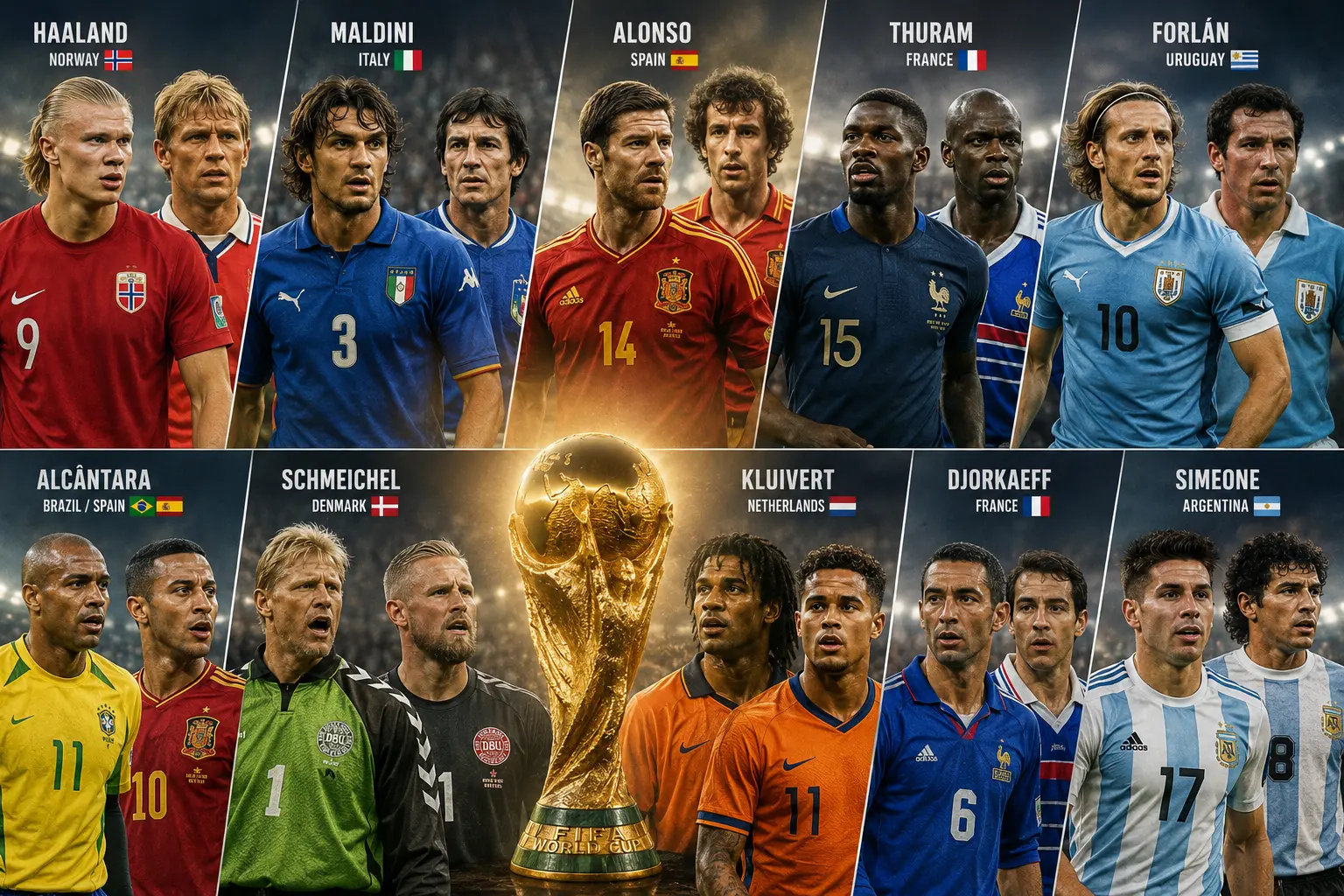
Alf Inge Haaland and Erling Haaland , Norway
The Haaland family has become one of the most talked-about football stories of the modern era. Alf-Inge Haaland represented Norway at the 1994 FIFA World Cup, making two appearances at the tournament. He also built a strong club career in England, playing for Nottingham Forest, Leeds United and Manchester City.
His son Erling Haaland has taken the family name to a different level. Widely regarded as one of the best strikers in the world, Erling made a major impact at the 2026 FIFA World Cup, scoring four goals in his first two World Cup matches. His tournament form made Norway one of the most watched teams before their decisive World Cup 2026 match against France.Alf-Inge was known for his strength, versatility and toughness. Erling, meanwhile, has become famous for his explosive speed, power and ruthless finishing. Together, they represent one of football’s most fascinating generational stories.
Cesare Maldini and Paolo Maldini , Italy
Few football families carry the weight of history like the Maldinis. Cesare Maldini made two appearances for Italy at the 1962 FIFA World Cup, while his son Paolo Maldini became one of the most iconic defenders in football history. Paolo made 23 World Cup appearances across four tournaments: 1990, 1994, 1998 and 2002.
Both father and son captained AC Milan and represented Italy with distinction. Their connection to Milan and the national team helped make the Maldini name almost synonymous with defensive excellence. Paolo never won the World Cup, but his consistency, elegance and leadership made him one of the greatest defenders the tournament has ever seen. Cesare also later became an important managerial figure, further strengthening the family’s influence on Italian football.
Periko Alonso and Xabi Alonso , Spain
Spain’s Alonso family also produced a remarkable World Cup legacy. Miguel Ángel Alonso, widely known as Periko Alonso, made five appearances at the 1982 FIFA World Cup. Although he enjoyed a successful club career and won major trophies, he never lifted the World Cup. His son Xabi Alonso went further on the international stage. Xabi made 13 World Cup appearances across the 2006, 2010 and 2014 tournaments, scoring two goals and playing a major role in Spain’s golden generation.
His greatest moment came in 2010, when Spain won the FIFA World Cup in South Africa. Known for his intelligence, passing range and calm control of midfield, Xabi became one of the finest midfielders of his generation. After retiring, he continued the family’s football influence by becoming one of Europe’s most respected coaches.
Lilian Thuram and Marcus Thuram , France
The Thurams are one of France’s most important football families. Lilian Thuram made 16 World Cup appearances across the 1998, 2002 and 2006 tournaments. He was a key part of the France team that won the 1998 FIFA World Cup, and his two goals in the semi-final against Croatia remain among the most memorable moments in French football history.
His son Marcus Thuram has built his own international career with France, making appearances at the 2022 and 2026 World Cups. Unlike his father, who was one of the world’s best defenders, Marcus developed as an attacking player and became one of France’s leading forwards. Marcus was named after Jamaican political activist Marcus Garvey, adding another layer of meaning to a family story already rich in identity, history and influence.
Pablo Forlán and Diego Forlán , Uruguay
Uruguay’s Forlán family produced one of South America’s most memorable father-son World Cup stories.
Pablo Forlán represented Uruguay at the 1966 and 1974 FIFA World Cups, making three appearances across the two tournaments. He was a respected defender who played during an important era for Uruguayan football.
His son Diego Forlán became one of Uruguay’s greatest attacking players. Diego scored six goals in 12 World Cup appearances across the 2002, 2010 and 2014 tournaments.
His finest World Cup came in 2010, when he won the Golden Ball as the tournament’s best player. With his long-range shooting, leadership and technical quality, Diego helped lead Uruguay to the semi-finals and restored the country’s presence among world football’s elite.
Mazinho and Thiago Alcântara , Brazil and Spain
The Alcântara family story is unusual because it crosses national football identities. Mazinho represented Brazil at the 1990 and 1994 FIFA World Cups, making six appearances and winning the 1994 tournament with Brazil. He was part of a team that returned Brazil to the top of world football.
His son Thiago Alcântara represented Spain, making two appearances at the 2018 FIFA World Cup. Thiago became known as one of the most technically gifted midfielders of his generation, combining Brazilian flair with Spanish control and passing intelligence. Mazinho’s second son, Rafinha Alcântara, also became a professional footballer, making the family one of the most talented in modern football.
Peter Schmeichel and Kasper Schmeichel , Denmark
Goalkeeping greatness runs strongly through the Schmeichel family. Peter Schmeichel made five appearances for Denmark at the 1998 FIFA World Cup and is widely regarded as one of the greatest goalkeepers in football history. His commanding presence, leadership and shot-stopping made him a defining figure for both club and country.
His son Kasper Schmeichel followed in the same position, representing Denmark at the 2018 and 2022 FIFA World Cups. Kasper made seven World Cup appearances and became one of Denmark’s most reliable modern players. Following a legendary father can be difficult, especially in the same role, but Kasper built a respected career of his own. Together, Peter and Kasper stand among the best father-son goalkeeping stories in football.
Patrick Kluivert and Justin Kluivert , Netherlands
The Kluiverts have carried Dutch attacking tradition across generations. Patrick Kluivert made four appearances at the 1998 FIFA World Cup, a tournament in which the Netherlands played some of the most exciting football in the competition. Patrick was one of Europe’s most talented strikers during his career, known for his movement, finishing and technical skill.
His son Justin Kluivert made two appearances at the 2026 FIFA World Cup, continuing the family’s international story with the Netherlands. While Patrick was a central striker, Justin developed as a wide attacker with pace and creativity. Their careers show how footballing identity can evolve between generations while still carrying the same family legacy.
Jean Djorkaeff and Youri Djorkaeff , France
The Djorkaeff family played an important role in French football history. Jean Djorkaeff made three appearances at the 1966 FIFA World Cup, representing France during a challenging period for the national team.
His son Youri Djorkaeff became a key part of one of France’s greatest generations. Youri made nine World Cup appearances across the 1998 and 2002 tournaments and scored one goal. Most importantly, he helped France win the 1998 FIFA World Cup on home soil. As a creative attacking midfielder, Youri brought skill, intelligence and experience to a team that became world champions and changed French football history.
Diego Simeone and Giuliano Simeone , Argentina
The Simeone family represents another powerful football lineage. Diego Simeone made 11 World Cup appearances for Argentina across the 1994, 1998 and 2002 tournaments. Known for his intensity, aggression and leadership, Diego became an Argentina legend before later becoming one of the most successful managers in modern football.
His son Giuliano Simeone made his FIFA World Cup debut in 2026, adding a new chapter to the family’s international story. The connection is especially interesting because Giuliano also plays for Atlético Madrid, where Diego is the manager. That makes them one of football’s rare father-son stories involving both the national team stage and a coach-player relationship at club level.
Why Father-Son World Cup Duos Are So Rare
The World Cup is difficult enough to reach once. For two generations of the same family to reach it is extraordinary. A footballer must be good enough to represent his country at the highest level, stay fit, earn selection and perform during a short tournament cycle. For a son to later do the same requires not only inherited talent, but also discipline, timing, opportunity and the ability to handle pressure.
In many cases, these sons grew up with famous surnames and major expectations. Some matched or even surpassed their fathers. Others created different roles and identities. What makes these stories special is that each generation contributed something unique. The sons did not simply continue a legacy; they reshaped it.
Final Thoughts
The greatest father-son World Cup duos show how football history can live across generations. From the Maldinis’ defensive elegance to the Haalands’ Norwegian rise, from the Thurams’ French success to the Schmeichels’ goalkeeping excellence, these families have created rare football dynasties on the world’s biggest stage.
Some fathers won the World Cup. Some sons lifted the trophy. Others delivered unforgettable performances without ever winning it. But all of them share something few football families can claim: they represented their countries at the greatest tournament in the sport.cThat is what makes these father-son World Cup stories so powerful. They are not only about football talent, but also about legacy, pressure, national pride and the passing of dreams from one generation to the next.