
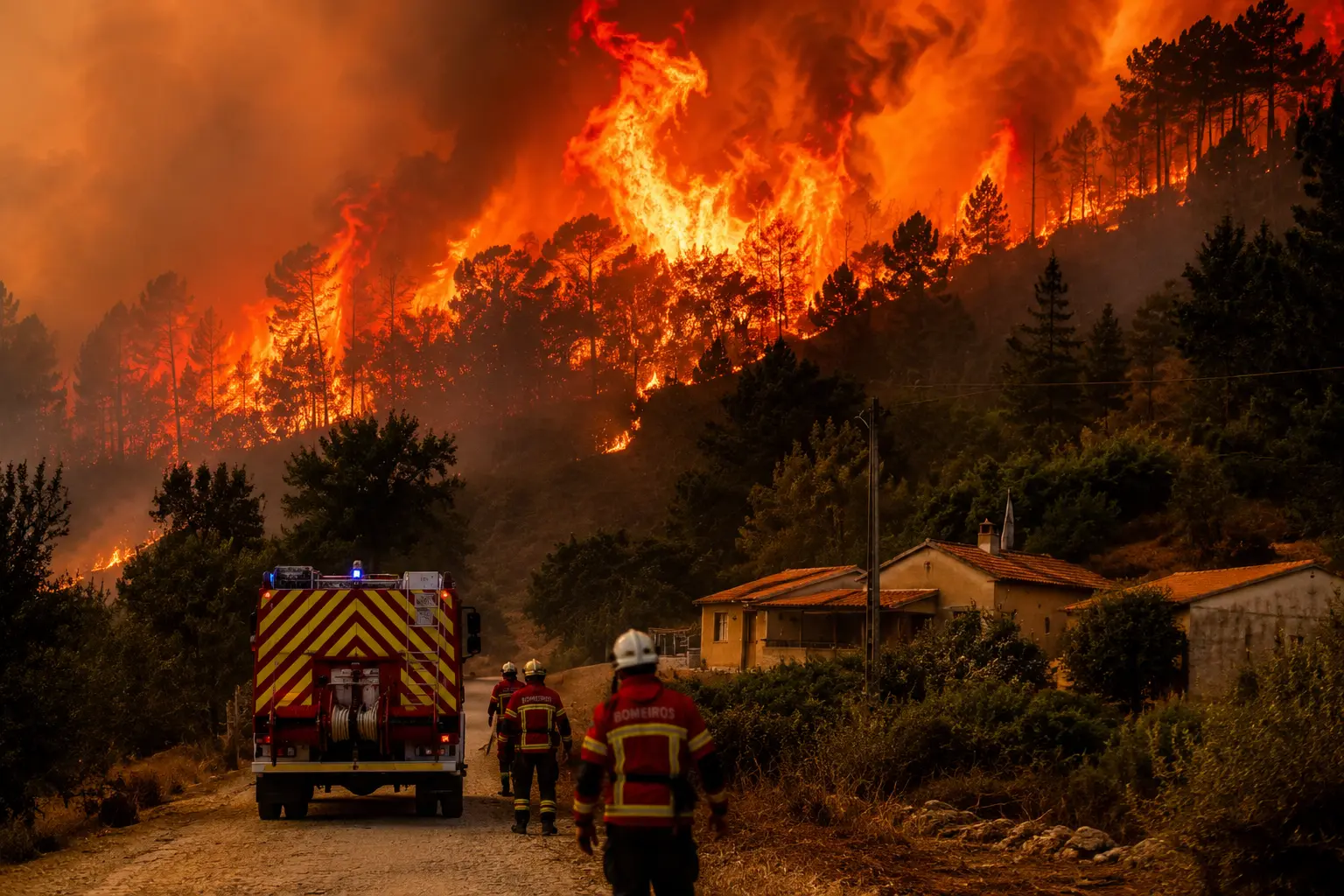
Thousands of residents and holidaymakers crowded into emergency shelters across France and Spain on Sunday as fast-moving wildfires forced more than 300,000 people to leave their homes, hotels and campsites. The crisis has become one of Europe’s largest wildfire evacuations in recent years, with major blazes still threatening communities near Bordeaux and west of Madrid.
In southwestern France, exhibition centres, schools and gymnasiums were converted into temporary shelters filled with camp beds and emergency supplies. Thousands spent the night at Bordeaux’s exhibition centre after being ordered to flee smoke and flames advancing through the Gironde region. Some evacuees described seeing towering columns of smoke as the fires approached residential and tourist areas.
French authorities said more than 220,000 people had been evacuated in Gironde alone, while tens of thousands more were displaced in the Landes and Var regions. The fire near Bordeaux had burned approximately 42,000 hectares and destroyed homes and other buildings as it moved through extremely dry forests and scrubland.
The Gironde blaze also produced highly dangerous atmospheric conditions. Firefighters reported that the fire generated powerful winds and behaved unpredictably, making containment operations more difficult. Around 2,500 firefighters were deployed with military and aerial support, including helicopters and an A400M military transport aircraft adapted to drop water and fire retardant.
Spain was facing a similarly severe emergency. Wildfires west of Madrid and near Toledo forced more than 100,000 people to evacuate, while several municipalities were placed under new evacuation orders as winds threatened to push separate fires together. One man was confirmed dead after being found inside a vehicle near a wildfire in Manises, Valencia.
Spanish Prime Minister Pedro Sánchez said saving lives remained the government’s priority, while emergency officials warned that weather conditions could make firefighting operations even harder. Two major fires in the Madrid region had already merged, creating a much larger blaze and forcing authorities to warn residents about smoke and poor air quality.
The fires have also disrupted major public events. The final stage of the Tour de France was shortened because security personnel assigned to the race were redirected to support emergency operations. France and Spain also received assistance through European Union emergency mechanisms, including firefighting aircraft and crews from other member states.
Scientists have repeatedly warned that hotter temperatures, prolonged drought and more frequent heatwaves are increasing the risk of severe wildfires across southern Europe. France has recorded around 98,000 hectares burned this year, while Spain has experienced one of the European Union’s most destructive fire seasons.
With strong winds, dry vegetation and extreme heat continuing, authorities warned that the danger was not over. For many displaced families, the immediate concern remained whether their homes would still be standing when evacuation orders were finally lifted.