

UAE emergency alerts are official warning messages sent to mobile phones in a given area, and the National Emergency Crisis and Disaster Management Authority (NCEMA) has been clear about what to do when one arrives: do not go outside to film, go straight to a safe place, and stay there until an “all clear” alert is issued for your area. This guide sets out that official advice for citizens, residents and visitors, along with the emergency numbers to call, how the law treats rumours and filming, and where official updates are published.
The box below lists the latest official notices and is updated when UAE authorities publish something new. The rest of the page is standing guidance on UAE emergency alerts from official sources.
Latest official notices
- 15 November 2026: The UAE Ministry of Foreign Affairs condemned in the strongest terms the renewed hostile attack by Iran targeting the Kingdom of Bahrain with drones, calling it a flagrant violation of Bahrain’s sovereignty, and reiterated the UAE’s full solidarity with Bahrain, WAM reported.
- Iranian airlines: The General Civil Aviation Authority (GCAA) suspended flights operated by Iranian airlines to and from the UAE from 24 September 2026 until further notice, and said it would keep the public informed (WAM).
- Flights to Israel: Emirates lists its codeshare flights with flydubai to and from Tel Aviv as suspended until further notice on its travel updates page. flydubai lists its own flights to and from Israel as suspended while the investigation into the 30 September incident involving flight FZ 1073 continues, on its operational updates page.
What UAE emergency alerts are and who sends them
UAE emergency alerts come through the National Early Warning System, which sends messages over telecom networks to phones based on their location. When NCEMA launched the system, it said each message appears on the screen automatically, comes with a sound and vibration alarm, and tells people what action to take, according to WAM.
Only designated authorities can send them. The government portal lists them as NCEMA, the Ministry of Interior, the police of the seven emirates and the Ministry of Health and Prevention, on its Handling emergencies page. NCEMA calls the system “a vital preventive tool designed to promptly alert the public” and asks everyone to rely on official instructions, in a post on its official X account.
Receiving one of these UAE emergency alerts does not by itself mean something has landed in the UAE. NCEMA has said that precautionary alerts and warning messages are part of a proactive approach and can be sent even where the likelihood of impact is low. After one such alert, it confirmed that the missile threats detected were outside the UAE’s borders (WAM). Either way, the instruction is the same: follow the message, then check official channels for what happens next.
What to do when UAE emergency alerts go off
NCEMA’s official graphic “What To Do When You Hear a Warning Alert” notes that some people have left their homes or stopped their cars to record videos after receiving an alert. Its advice is short:
- Do not go outside to film or record. “The warning is issued for your safety,” the graphic says.
- Go to a safe place immediately and take shelter there until an “all clear” alert is issued for your area.
- If you are driving, continue to your intended destination. When you arrive, go to the nearest safe place.
- Follow official instructions and take your information only from verified sources.
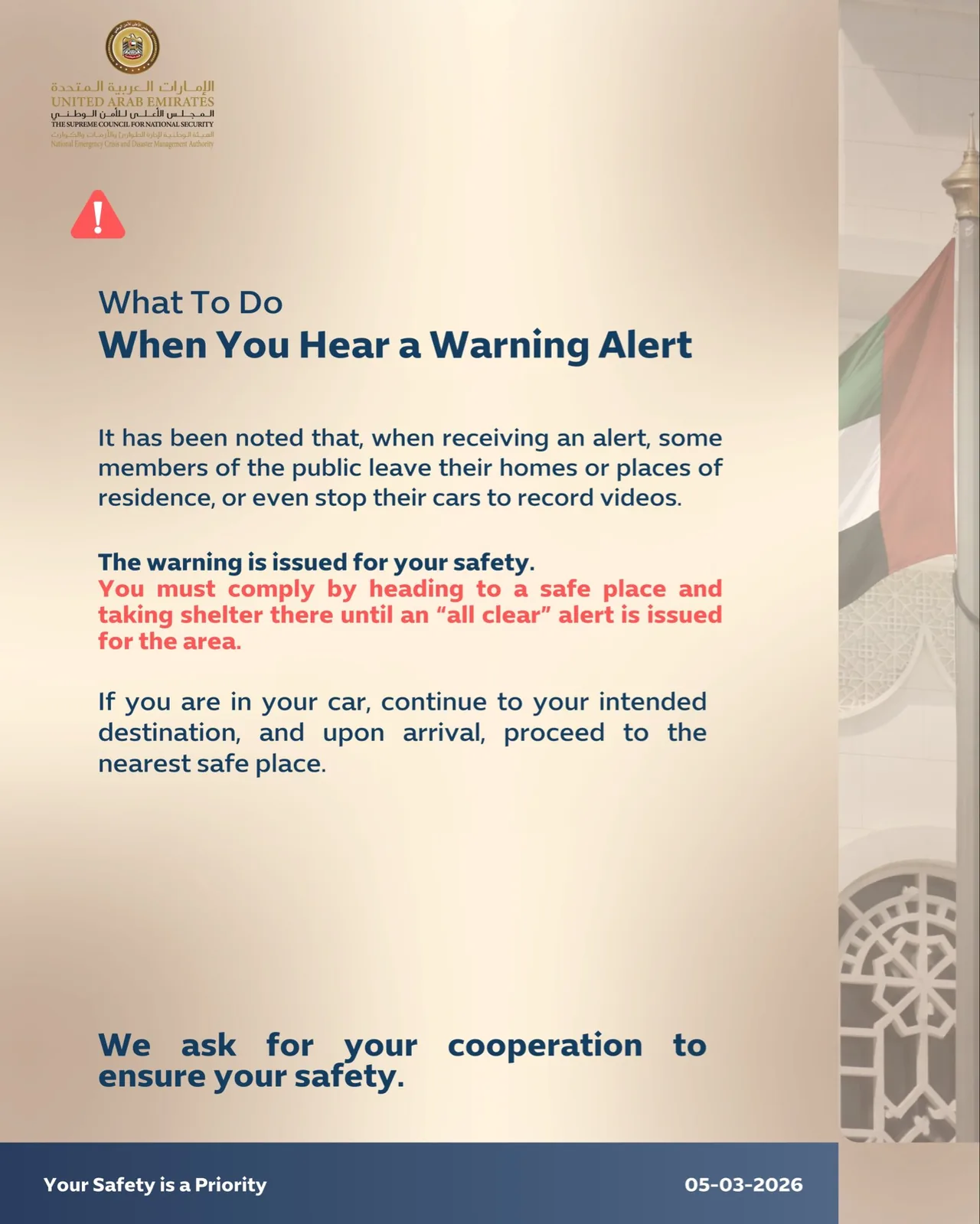
Follow these steps whenever UAE emergency alerts are issued. They are based on NCEMA’s official guidance. If the authority adds new instructions, they will appear first on its official X account and website.
If you see debris or a suspicious object
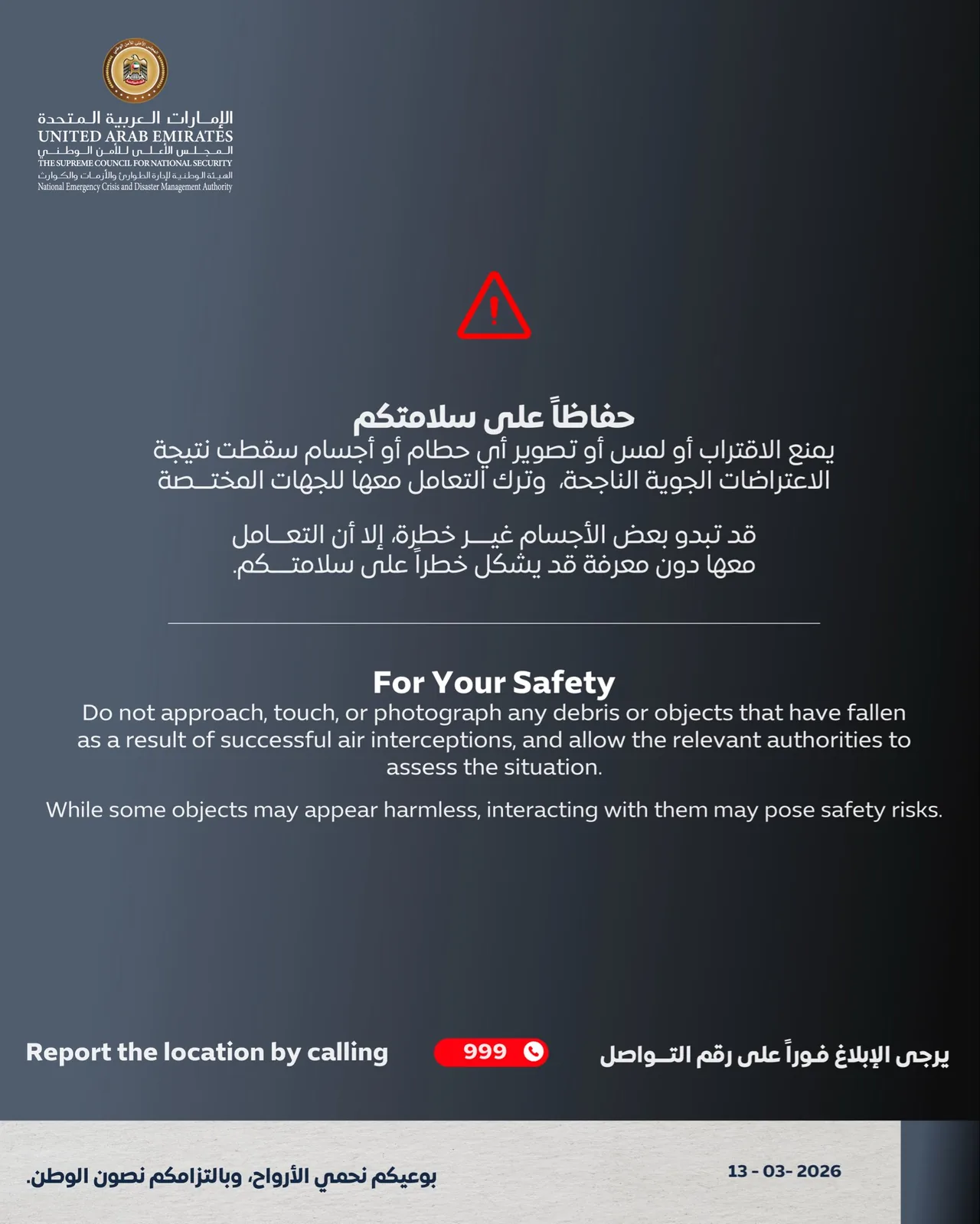
NCEMA’s guidance on fallen debris is as direct as its advice on UAE emergency alerts. Do not approach, touch or photograph any debris or objects that have fallen as a result of air interceptions, and leave it to the relevant authorities to assess the situation. “While some objects may appear harmless, interacting with them may pose safety risks,” the authority says.
- Move away from the spot straight away and do not go back to look.
- Report the location by calling 999.
- Do not film it or share photos or videos of it.
Emergency numbers and official channels
UAE emergency alerts tell you what to do, but if you need help, call. The national emergency numbers below are listed on the government portal. Electricity emergency numbers differ in some emirates, and 901 is for non-emergencies only. The Ministry of Interior stresses that 999 is for situations that need urgent intervention, while 901 handles general inquiries and non-emergency police services. When you call, give your exact location, explain clearly what is happening and answer the call taker’s questions, the ministry said in its emergency number awareness campaign.
| Service | Official number or channel |
|---|---|
| Police (emergencies) | 999 |
| Ambulance | 998 |
| Civil Defence (fire) | 997 |
| Coastguard | 996 |
| Find and Rescue | 995 |
| Electricity failure | 991 (DEWA in Dubai, SEWA in Sharjah); 8002332 in Abu Dhabi; 8003392 in the other emirates |
| Police inquiries and non-emergency services | 901 (not 999) |
| Fallen debris or a suspicious object | 999, without approaching or filming it |
| Official emergency guidance | NCEMA: ncema.gov.ae and @NCEMAUAE |
| Government portal | u.ae Handling emergencies |
| Official news agency | WAM |
| UAE nationals abroad | Twajudi (Ministry of Foreign Affairs) or the UAEMOFA app; emergency line 00971-80024 |
| Civil aviation | GCAA |
| Dubai government news | Dubai Media Office |
Two official apps can help as well. In Abu Dhabi, the Abu Dhabi Police AD999 app lets you report a fire, request an ambulance or reach the emergency line with an SOS button. In Dubai, the DCAS SOS app requests an emergency ambulance from Dubai Corporation for Ambulance Services. Both are listed on the government portal, and calling 999 or 998 is still the direct route.
Travel: check with your airline first
UAE emergency alerts do not cover flight changes, and schedules in the region can change at short notice. Before you leave for the airport, check your flight on the airline’s official flight status page or app, rather than relying on a list in a news report. Restrictions in force are listed in the notices box at the top of this page.
| Airline or authority | Official pages |
|---|---|
| Emirates | Travel updates and flight status |
| Etihad Airways | Flight status |
| flydubai | Operational updates and flight status |
| Air Arabia | Official website (manage booking and flight status) |
| General Civil Aviation Authority | gcaa.gov.ae and NOTAM information |
DubaiPress has reported on Etihad and flydubai flight changes to Saudi Arabia, but individual flights can change from one day to the next, so the airline’s own page is the one to trust.
UAE nationals travelling abroad should register in the Twajudi service through the Ministry of Foreign Affairs website or the UAEMOFA app, so the ministry and UAE missions can reach them in an emergency. Emiratis who need help abroad can call 00971-80024. The service is for UAE nationals, so foreign residents should follow UAE official sources and stay in touch with their own embassy.
Rumours, filming and the law
Going outside to film after UAE emergency alerts is exactly what NCEMA has asked people not to do. Its message on sharing is simple: “Verify the source of any news before sharing it, and rely on official sources for updates.” The UAE Public Prosecution has warned against publishing or circulating rumours, false news or news from unknown sources on social media. It said anyone who shares or republishes such content exposes himself to legal accountability, even if he did not create it.
Attorney-General Dr Hamad Saif Al Shamsi has said that publishing misleading or fabricated clips of this kind is a crime punishable by imprisonment of no less than one year and a fine of no less than AED 100,000, according to WAM. He added that the Public Prosecution will not tolerate the circulation of clips showing the country’s defence systems intercepting attacks. Defendants he referred for urgent trial are alleged to have posted real interception footage, AI-generated videos of fake explosions, and clips from abroad presented as events in the UAE. Abu Dhabi Police have also announced the arrest of 375 suspects on suspicion of filming incidents and sharing misleading information, and referred them to the Public Prosecution.
The law that applies is Federal Decree-Law No. 34 of 2021 on Combating Rumours and Cybercrimes, which took effect on 2 January 2022. Its text is on the official UAE legislation portal, and the government portal explains it on its cyber safety page. Fake video is not limited to war footage, either. Our guide to spotting deepfake scams in Dubai shows how AI video and voice clips are used to fool people.
Where to find official updates on UAE emergency alerts
For UAE emergency alerts and safety instructions, follow NCEMA. For official statements, follow WAM and the government portal u.ae. UAE nationals abroad should keep the Ministry of Foreign Affairs app on their phones, and travellers should watch the GCAA and their airline. In Dubai, follow Dubai Media Office, and wherever you live, follow your local police.
Incidents at sea have been reported as separate news stories, including the attack on an ADNOC Logistics vessel in UAE territorial waters and the strike on the Dubai-bound Fujairah Energy tanker. For more local news, see the DubaiPress UAE section.
If something you read about UAE emergency alerts does not match what the authorities say, go back to the source: the UAE Government’s Handling emergencies page, NCEMA’s official website and its official X account.
Related: ADNOC Vessel Damaged in Attack in UAE Territorial Waters | Dubai-Bound Fujairah Energy Tanker Hit in Arabian Gulf | UAE de-escalation: Iran call as Iraq proposes regional diplomatic mission
Read more: Etihad Saudi Flights: Jeddah Resumes as Riyadh and Dammam Stay Cancelled