
Samsung vs Redmi battery life is not decided simply by choosing the phone with the biggest battery. Samsung generally focuses on software support, display quality, camera consistency and long-term usability, while Redmi, Xiaomi’s value-focused brand, often emphasizes larger batteries, faster charging and higher specifications for the price.
For UAE buyers, the decision also depends on how much you want to spend, whether you need 5G, how long you plan to keep the phone and whether you prefer a UAE-approved version with local warranty support. So, when comparing Samsung vs Redmi battery life, the answer depends heavily on the individual models. A Redmi phone may have a larger battery, but battery capacity alone does not determine real-world endurance.
Samsung vs Redmi Battery Life Compared
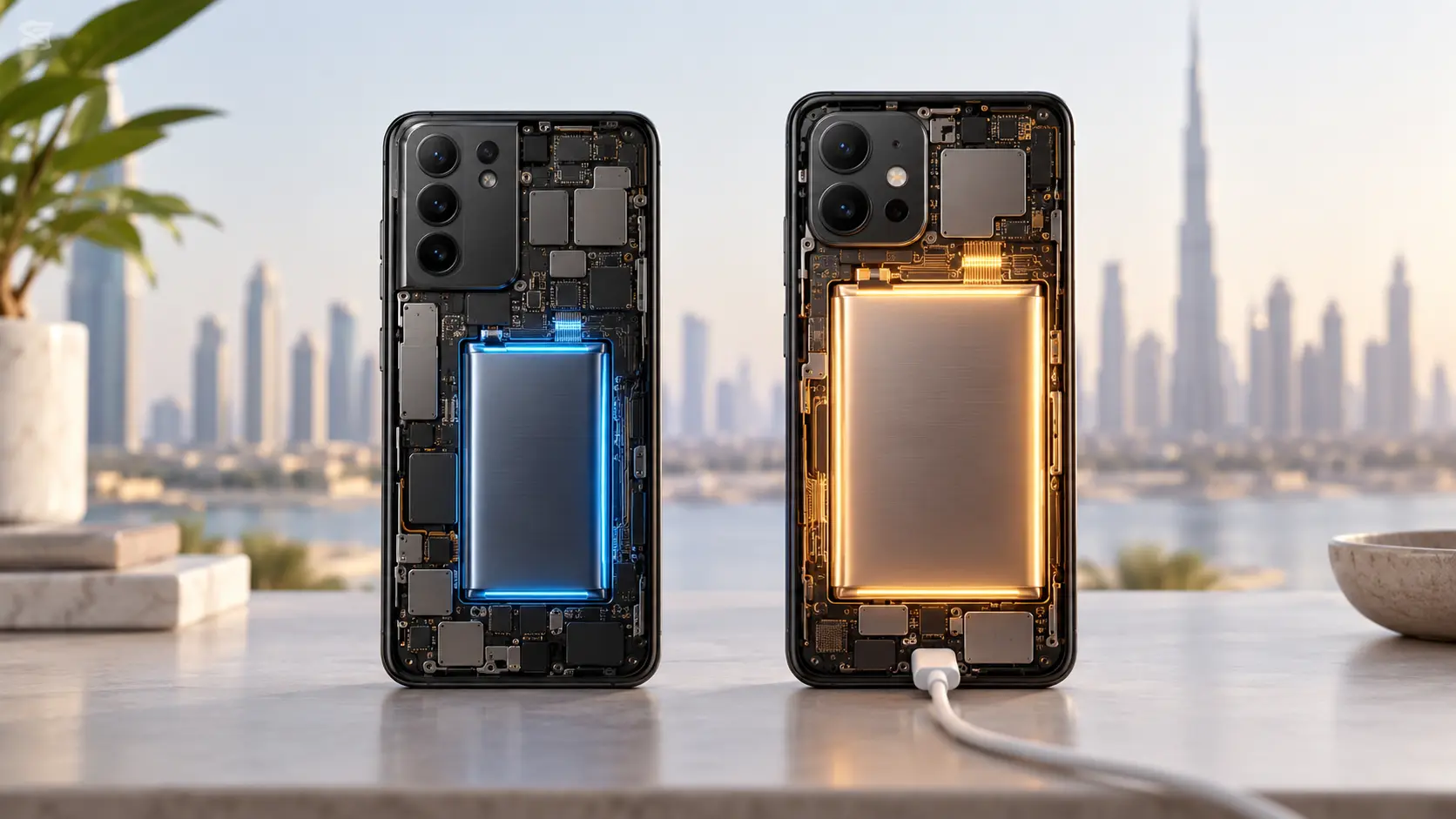
Battery capacity has become one of Redmi’s strongest selling points. For example, the Redmi Note 15 4G available in the UAE has a 6,000mAh battery, while the Samsung Galaxy A26 5G has a 5,000mAh battery.
Recent independent testing also shows why capacity and efficiency need to be considered together. PhoneArena’s 2026 battery testing lists the Redmi Note 15 at an estimated 8 hours 2 minutes of battery life, compared with 8 hours 6 minutes for the Samsung Galaxy A17 5G.
| Factor | Samsung | Redmi |
|---|---|---|
| Typical battery capacity | Around 5,000mAh in many mid-range models | Often 5,000–7,500mAh or more |
| Charging speeds | Generally more conservative | Often significantly faster |
| Battery endurance | Strong, depending on model | Strong, especially in larger-battery models |
| Heavy gaming | Depends heavily on chipset | Several models target performance users |
| Best for | Balanced everyday use | Long battery life and fast charging |
| What matters most | Efficiency + software optimization | Battery capacity + charging speed |
A good example is the Redmi 17 5G, which is listed in the UAE with a 7,500mAh battery and 45W charging. By comparison, the Samsung Galaxy A26 5G uses a 5,000mAh battery. This means Redmi can have a clear hardware advantage for buyers who prioritize battery capacity. However, Samsung can still deliver competitive real-world battery life because capacity is only one part of the equation. If gaming performance matters as much as battery life, see our guide to the best gaming phones in 2026 for a closer look at processors, cooling and sustained performance.
What you give up at each price point
The biggest difference between the two brands becomes clearer when you compare what you get — and what you sacrifice — at different budgets.
Under AED 1,000
This is where Redmi can be particularly attractive to specification-focused buyers. The Redmi Note 15 4G, for example, has been listed in the UAE at around AED 759 with 8GB RAM, 256GB storage, a 6,000mAh battery and a 120Hz AMOLED display. Its main limitation is that it is a 4G-only device.
Samsung’s Galaxy A26 5G has been listed around AED 815 and offers 5G connectivity, IP67 protection and UAE warranty stock, depending on the retailer and configuration. At this price point, choosing Redmi can mean getting more storage, battery capacity and hardware for your money. Choosing Samsung can mean giving up some hardware specifications in exchange for features such as 5G, water resistance and local warranty availability.
Around AED 1,000–2,000
The differences become less straightforward. Redmi and other Xiaomi models can continue to offer larger batteries, faster charging and high-refresh-rate AMOLED displays. Samsung’s A-series phones, meanwhile, typically put more emphasis on software support, camera processing, durability and a consistent user experience. For someone keeping a phone for several years, software support can be just as important as the specifications on the box.
Above AED 2,000
The comparison becomes more model-specific. Samsung’s premium Galaxy phones compete through features such as advanced displays, camera systems, long-term software support and integration with Samsung’s wider ecosystem.
Redmi’s higher-end models can put more emphasis on raw performance, battery capacity and charging speeds. Therefore, at this level, comparing the exact Samsung and Redmi models is more useful than comparing the brands as a whole. If you are considering a Galaxy flagship rather than a mid-range model, see our iPhone vs Samsung comparison before choosing between the two ecosystems.
Cameras, screens and updates
Battery is only one part of the buying decision. Samsung has traditionally placed considerable emphasis on display quality and camera processing. Its AMOLED displays are a major feature across much of the Galaxy range, while higher-end Galaxy phones add more advanced camera systems.
Redmi can also offer impressive displays and high-resolution cameras at lower prices. However, a 108MP or 200MP specification does not automatically mean better photographs. Image processing, stabilization, sensor quality and software all influence the final result. Software updates are another important difference. Samsung has made long-term software support a major part of its smartphone strategy, particularly on newer Galaxy models. Some newer Samsung devices are promised multiple years of Android and security updates, making them more relevant for buyers who plan to keep a phone for a long time.
Redmi’s software experience is based on Xiaomi’s HyperOS, which offers extensive customization and features, but update policies vary between models and regions. If your priority is keeping the same phone for several years, check the exact update policy of the model you are considering rather than relying only on the brand name.
Prices in AED and where to buy
UAE smartphone prices can change frequently because retailers run promotions and sell different regional versions.
As a September 2026 snapshot, some examples include:
| Phone | Example UAE price | Battery | Main consideration |
|---|---|---|---|
| Samsung Galaxy A26 5G | Around AED 815 | 5,000mAh | 5G, IP67, UAE warranty stock |
| Samsung Galaxy A27 5G | Around AED 999 | — | Longer software support |
| Redmi Note 15 4G | Around AED 759 | 6,000mAh | Large battery, 4G only |
| Redmi 17 5G | Around AED 849 | 7,500mAh | Very large battery, 45W charging |
These prices were reported from UAE retailer listings checked in September 2026 and should be treated as price snapshots rather than fixed prices. When comparing Xiaomi phone prices in the UAE, shoppers should also check the exact version being sold. UAE retailers may list UAE, Middle East, Global or International versions of the same phone.
The cheapest listing is not necessarily the most convenient option if it comes without a UAE warranty or official regional support. For Samsung phones, buyers can check the official UAE range through Samsung UAE. For Xiaomi and Redmi models, Xiaomi UAE is useful for checking official specifications and regional availability. The regional version and warranty deserve a closer look before you choose a retailer. Our guide to Where to Buy a Phone in Dubai: Official vs Grey Market explains what to check when comparing listings.
Which one suits which buyer?
There is no single answer to Samsung vs Redmi which is best 2026, because the right choice depends on what you value most.
Choose Samsung if you:
- Want longer-term software support.
- Care about consistent camera processing.
- Prefer Samsung’s One UI interface.
- Want strong integration with Galaxy watches, tablets and other devices.
- Prefer a UAE-market model with local warranty options.
- Plan to keep your phone for several years.
Choose Redmi if you:
- Want the largest battery possible for your budget.
- Prioritize fast charging.
- Want more RAM or storage at a lower price.
- Play games or use demanding apps.
- Prefer high specifications at a competitive price.
- Don’t mind comparing regional versions before buying.
What about battery life?
If your main question is Samsung vs Redmi battery life, don’t compare battery capacity alone. A 7,500mAh Redmi can offer substantially more battery capacity than a 5,000mAh Samsung, but actual endurance depends on the processor, display, refresh rate, software optimization and your usage.
Independent testing illustrates this point: the Redmi Note 15 and Samsung Galaxy A17 5G have different battery capacities but recorded very similar estimated battery-life scores in PhoneArena’s testing. For extreme battery users, Redmi currently has some particularly large-capacity options. For example, the Redmi 17 5G is listed with a 7,500mAh battery in the UAE, while newer Redmi models can go even further in markets where they are available.
Final thoughts
Samsung and Redmi approach the UAE smartphone market from different directions. Samsung puts significant emphasis on software support, displays, cameras, durability and a connected device ecosystem. Redmi tends to compete aggressively on hardware specifications, battery capacity and charging speeds. For a broader comparison that looks beyond Redmi’s value-focused models, read our Samsung vs Xiaomi phone comparison.
For a buyer who wants maximum specifications for a limited budget, a Redmi model can make a strong case. For someone who values long-term software support, a polished interface and the broader Samsung ecosystem, a Galaxy phone may be more suitable. The most important step is to compare the exact models, not just Samsung vs Redmi as brands. Check the battery, chipset, display, camera system, update policy, 5G support, warranty and current UAE price before buying.
For more buying guides, phone comparisons and technology news, browse the DubaiPress Technology section.