
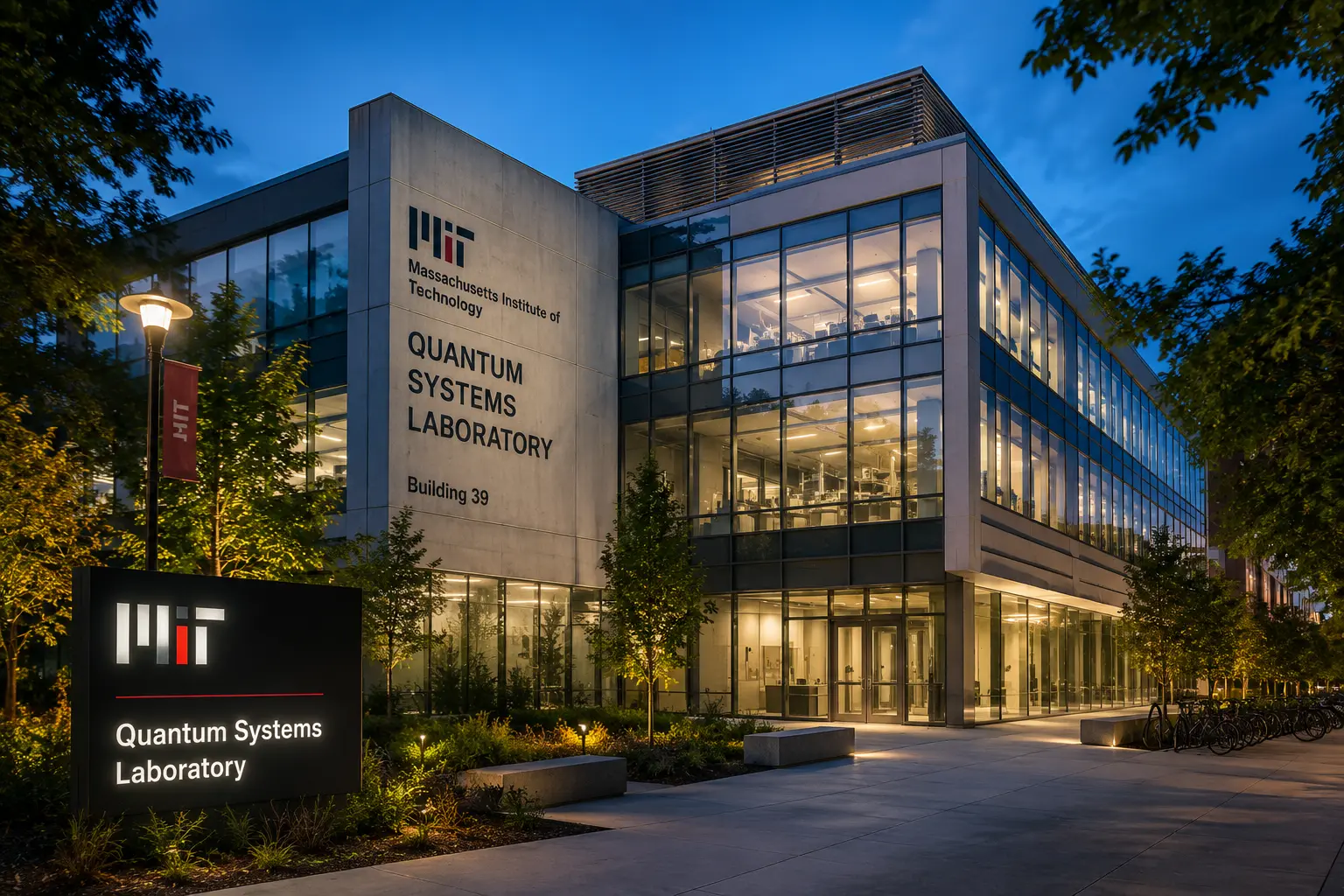
MIT and the Commonwealth of Massachusetts have announced plans to establish a new regional quantum research hub, backed by a $25 million investment from the state. The new facility, called the Quantum Systems Laboratory, will be built at MIT and is designed to serve researchers across Massachusetts as a shared-use “quantum toolbox” for advanced scientific and technological development.
The state funding will match part of the federal support for quantum research already underway at MIT, allowing the Institute to move forward with construction as early as this summer. Once completed, the lab is expected to give researchers access to advanced quantum hardware, specialized experimental infrastructure and tools needed to push quantum technologies closer to real-world applications.
A New Shared Facility for Quantum Research
The Quantum Systems Laboratory will be located in Building 39 on the MIT campus. It is planned as a multidisciplinary facility that brings together quantum computers, quantum sensors, quantum peripherals and quantum interconnects, which are physical channels used to transfer quantum information.
Quantum research requires highly controlled environments because researchers are working with delicate coherent phenomena that must be isolated from outside interference. MIT has already begun upgrading Building 39 to meet these technical demands, and the new state funding is expected to accelerate that transformation into a broader regional hub.
Why Massachusetts Is Investing in Quantum Technology
Quantum technologies are expected to influence major fields including computing, cybersecurity, navigation, life sciences, defense, advanced sensing and space exploration. For Massachusetts, the investment is not only about scientific research, but also about economic competitiveness, national security and maintaining leadership in emerging technologies.
The new lab is intended to support scientists from MIT and other institutions across the region. It will also provide infrastructure for startups and industry partners working on quantum applications in areas such as health technology, defense systems and next-generation computing.
Economic and Workforce Impact
The Quantum Systems Laboratory is also expected to create near-term and long-term economic benefits. Construction alone is projected to support more than 150 full-time on-site construction jobs, along with another 75 to 100 jobs across Massachusetts in supply chain and professional services connected to the project.
In the longer term, MIT officials expect the facility to strengthen the state’s innovation economy by giving researchers and startups access to equipment that would be difficult or expensive to build independently. This could help small companies test ideas, develop prototypes and move quantum technologies closer to commercial use.
Supporting Startups and Advanced Research
MIT has a long history of turning research into companies, and the new quantum hub could become an important part of that ecosystem. The facility is expected to provide tools and experimental capabilities for startups working on quantum hardware, sensing, communication, computing and related technologies.
The lab will also serve as the physical home of the MIT Quantum Initiative, known as QMIT. Beyond supporting on-campus research, it is intended to become a regional center that helps attract investment, talent and collaboration in quantum science and engineering.
What the Lab Will Include
One floor of the new facility will focus on developing radio-frequency electronics used to control and connect with quantum systems. The lab will also support customized quantum experiments using advanced high-frequency packages, which are important for protecting quantum data in practical applications.
The facility is also expected to support the development of terahertz electronics for advanced quantum systems. Together, these capabilities could help researchers scale experiments and explore new applications across biology, chemistry, defense, computing and other fields.
Building on MIT’s Shared-Use Research Model
MIT’s quantum investment follows a model the Institute has used before with MIT.nano, a major shared-use nanotechnology facility on campus. MIT.nano gives researchers and industry users access to advanced tools for imaging, fabrication, characterization and prototyping, and has become a key platform for nanoscale research and startup activity.
The Quantum Systems Laboratory is expected to play a similar role for quantum science. It will also complement the capabilities of MIT Lincoln Laboratory’s SQUILL Foundry, a quantum fabrication hub focused on superconducting qubit systems and available to researchers across Massachusetts and the United States.
Final Outlook
The new Quantum Systems Laboratory represents a major step in Massachusetts’ effort to become a national center for quantum innovation. With state support, federal research funding, MIT investment and philanthropic backing, the facility is positioned to become a critical resource for researchers, startups and institutions working on next-generation quantum technologies.
If successful, the lab could help accelerate breakthroughs in computing, sensing, health sciences and defense while strengthening the region’s position in one of the most important technology races of the coming decade.