
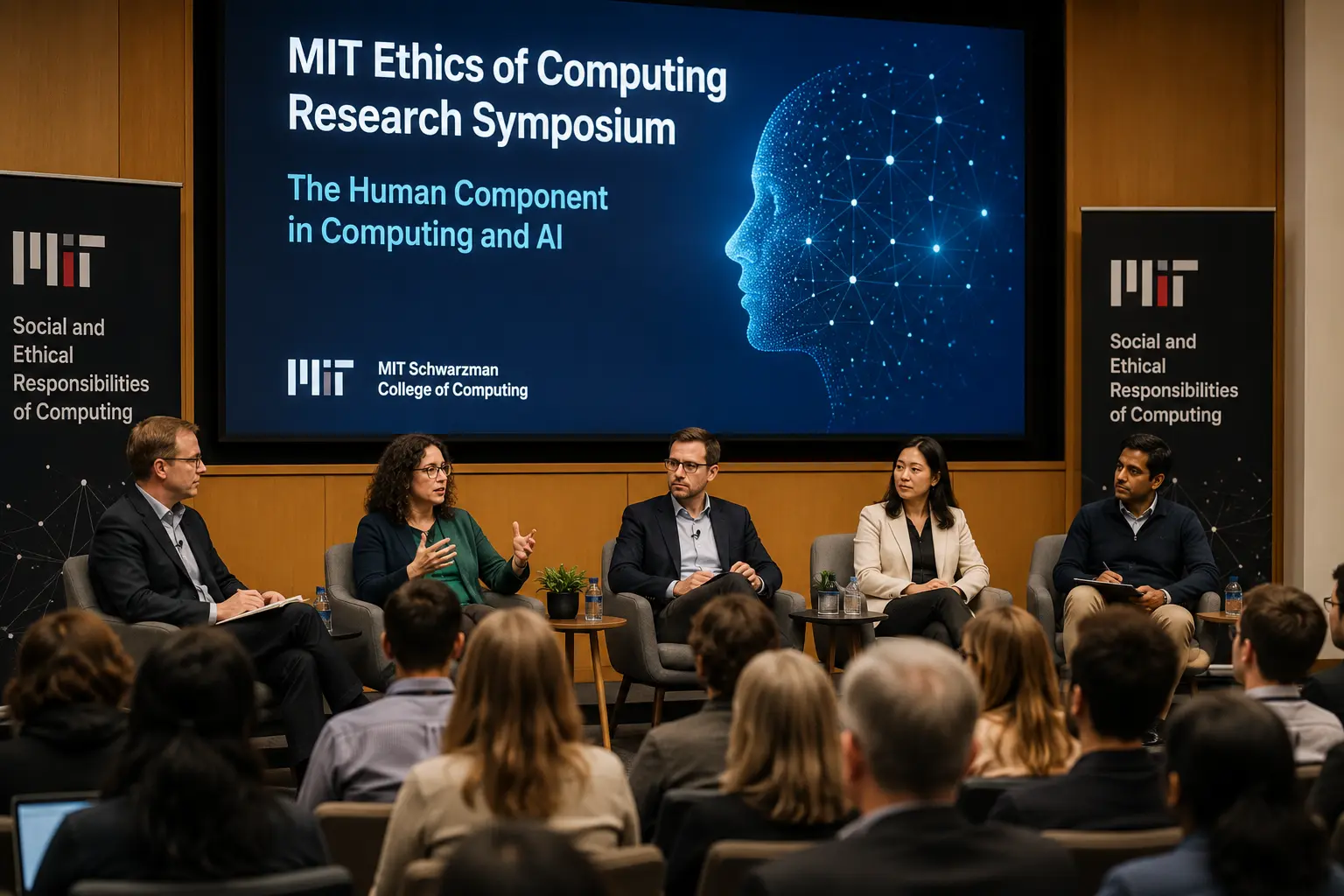
MIT brought together researchers, technologists and ethics experts for a full-day symposium focused on one central question: how can artificial intelligence and computing advance while still serving human values? Hosted by the Social and Ethical Responsibilities of Computing initiative at the MIT Schwarzman College of Computing, the event explored the social impact of AI, the responsibilities of developers and the growing need to keep human judgment at the center of technological progress.
The symposium included research talks, student poster presentations, panel discussions and a keynote address by Jon Kleinberg, a Cornell University professor and MIT alumnus. Topics ranged from responsible computer vision and air pollution forecasting to AI alignment, education and the risks of relying too heavily on systems that may not understand the world in the same way people do.
AI Alignment and Human Values
One of the major themes of the symposium was AI alignment, or the challenge of making artificial intelligence systems act in ways that match human goals and values. This issue sounds simple at first, but it quickly becomes complicated. Different people, cultures, institutions and governments may disagree about which values should guide powerful AI systems, who should choose those values and how they should be translated into machine behavior.
Panelists discussed the difficulty of building ethical frameworks for AI without pretending that any system can be morally perfect. Instead, some experts argued that AI should be designed to follow human instructions while interpreting them through reasonable and transparent values. Others emphasized that the bigger question is not only what AI should do, but who has the right to govern different types of AI systems in the first place.
Why Human Judgment Still Matters
Several speakers warned that AI systems are being deployed faster than society can fully understand their consequences. As organizations rush to use AI in education, business, government and science, the challenge is not only technical performance but also institutional wisdom. In many cases, AI may replace older systems before people fully understand why those systems worked, what weaknesses they had and what forms of human judgment they preserved.
Despite those concerns, the discussions were not purely pessimistic. Many participants highlighted the potential for AI to support public good if it is designed carefully. The key message was that technical progress and ethical reflection should move together, rather than being treated as separate conversations.
AI in Education: Helpful Tool or Shortcut?
Another major discussion focused on the role of AI in education. As students increasingly use AI tools for writing, coding, research and problem-solving, educators are trying to decide how to use these systems responsibly without weakening learning. The concern is that students may use AI to avoid difficult work rather than to deepen their understanding.
MIT faculty discussed the difference between using AI to “offload” work and using it to support learning. Real learning often requires struggle, mistakes and repeated attempts. If students immediately turn to AI whenever they face difficulty, they may get the answer without developing the underlying skill. That creates a challenge for teachers: how can assignments remain difficult enough to build understanding, but not so frustrating that students simply hand the task to an AI system?
Rethinking What Students Need to Learn
Speakers also argued that AI should not be handled with a single universal policy. Different tools can support different forms of learning, depending on how they are designed and used. An AI assistant could weaken critical thinking if it simply gives answers, but it could also support creativity, reflection and deeper inquiry if it helps students ask better questions or understand their mistakes.
Some educators suggested that schools may need to rethink the curriculum itself. Instead of constantly adding new material, institutions may need to decide which older expectations are still essential and which should be removed or redesigned in an AI-shaped learning environment. The goal is not only to stop misuse, but to help students understand when and why AI should be used.
When AI and Humans Think Differently
The keynote address explored another important issue: the difference between how AI systems model the world and how humans understand it. AI systems can become extremely powerful in narrow tasks, such as chess, where they can calculate moves far beyond human ability. But when humans and algorithms work together, problems can appear if the AI’s strategy cannot be understood by its human partner.
This mismatch can make human-AI teamwork fragile. If an AI system hands control back to a person, the person may not know what the system was planning or why it made certain choices. The result can be confusion, even when the AI itself was performing well. That matters in fields far beyond games, especially in medicine, finance, education and public decision-making, where humans may need to step in after an algorithm has shaped the situation.
Final Outlook
The MIT symposium made clear that the future of computing and AI is not only about better models, faster systems or more advanced automation. It is also about people: the students who use AI, the engineers who build it, the institutions that govern it and the societies affected by its decisions.
As AI becomes more embedded in daily life, the human component becomes more important, not less. Ethical design, public accountability and thoughtful education will be essential if AI is to become a force that supports human progress rather than simply replacing human judgment.