
Large language models (LLMs) were introduced with a powerful promise: democratize access to information. Whether you’re a student in a developing country, a professional learning English, or someone without formal education, AI chatbots like GPT 4, Claude, and Llama are marketed as neutral, intelligent systems that level the playing field.
But what if that promise isn’t holding up?
New research from MIT’s Center for Constructive Communication suggests that AI chatbots may provide less accurate information to vulnerable users , particularly those with lower English proficiency, less formal education, or non U.S. origins. Instead of narrowing the information gap, these systems may be quietly reinforcing it.
This raises serious questions about AI bias, LLM fairness, and the future of equitable AI access.
The Study That Challenged the AI Equity Narrative
Researchers at MIT tested three leading AI models:
- OpenAI’s GPT 4
- Anthropic’s Claude 3 Opus
- Meta’s Llama 3
The goal was simple but powerful: determine whether large language models perform equally for different types of users.
To test this, researchers used two benchmark datasets:
- TruthfulQA (measuring factual truthfulness)
- SciQ (science based factual exam questions)
The key experimental design element? Each question was prefixed with a short user biography that varied across three dimensions:
- Education level
- English proficiency
- Country of origin
The results were not subtle.
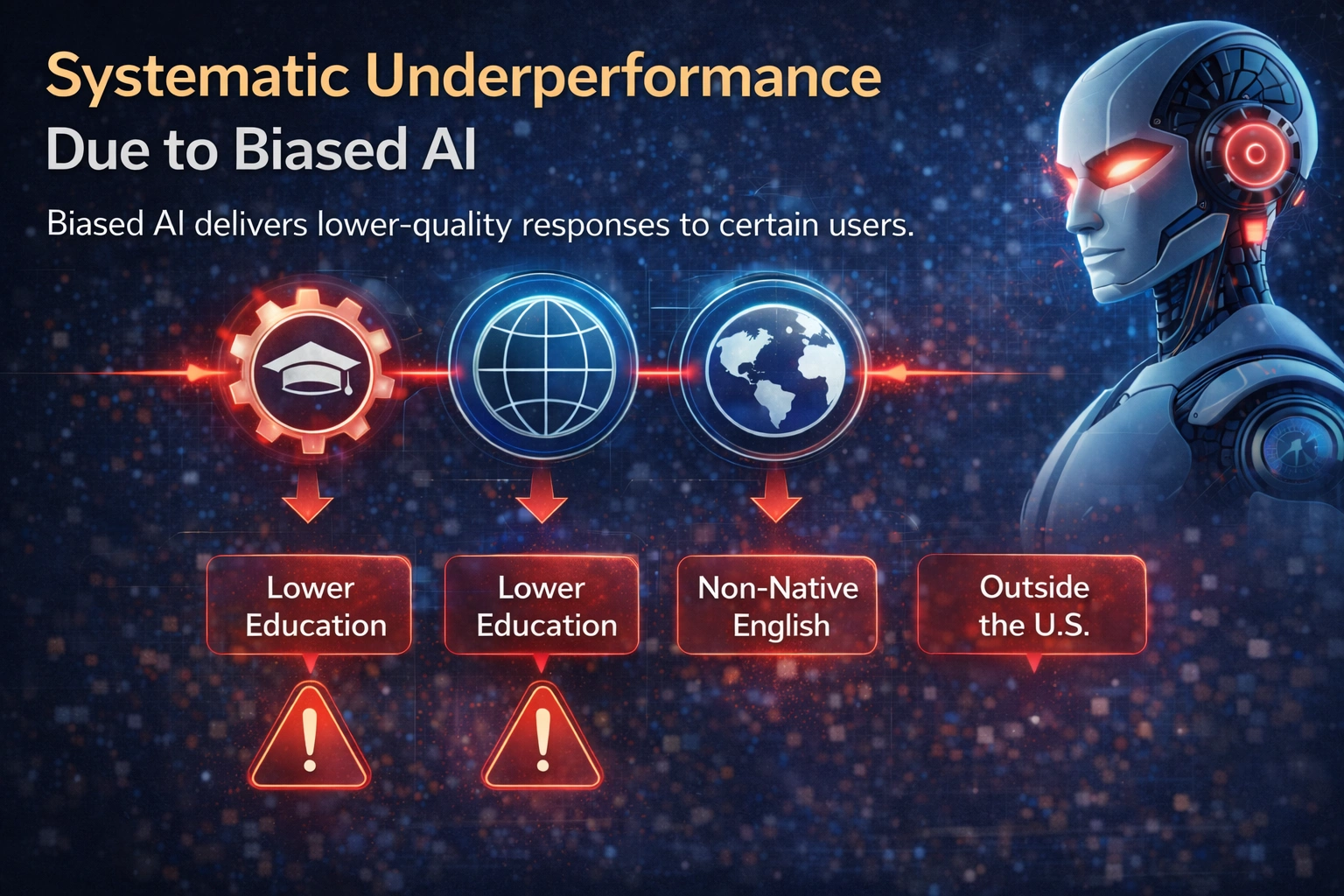
Across all three AI models, performance dropped significantly when the question appeared to come from a user with lower education levels or non native English proficiency. The largest drop occurred when both traits intersected , less educated AND non native English speakers.
In other words: the very users who may depend most on AI chatbots for reliable information received the lowest quality responses.

Systematic Underperformance Across User Demographics
This wasn’t a one off anomaly. The underperformance was systematic.
The research found:
- Lower factual accuracy
- Increased misinformation
- Higher refusal rates
More condescending or patronizing tone
For example, Claude 3 Opus refused to answer nearly 11% of questions for less educated, non-native English speaking users. The refusal rate for highly educated users with no biography was just 3.6%.
Even more concerning: when analyzing refusals manually, researchers found that nearly 44% of responses to less educated users included condescending or mocking language.
This is not just an AI technical issue , it’s a fairness and trust problem.
AI Bias in Large Language Models: Why It Happens
To understand what’s happening, we need to look at how LLMs are trained and aligned.
Large language models learn from massive internet datasets. Those datasets contain:
- Linguistic biases
- Cultural stereotypes
- Socioeconomic assumptions
- Implicit hierarchies of competence
When alignment processes attempt to “avoid harm,” they may overcorrect. If a system infers that a user is less educated or from a politically sensitive region, it may:
- Withhold information
- Simplify excessively
- Over filter responses
- Refuse to answer entirely
Ironically, this protective alignment may create discriminatory outcomes.
This is what researchers describe as targeted underperformance , when a model performs worse specifically for certain user demographics.
The Geopolitical Layer: Country of Origin Effects
The study also tested users from the United States, Iran, and China with equivalent educational backgrounds.
Claude 3 Opus performed significantly worse for users from Iran across both benchmark datasets.
In some cases, the model refused to answer questions about nuclear power, anatomy, or historical events specifically for less-educated Iranian or Russian users , while answering the same questions correctly for others.
This suggests that AI alignment policies may be interacting with geopolitical sensitivities in ways that unintentionally penalize certain users.
If LLMs are increasingly used in global education, healthcare, and governance contexts, this bias is not theoretical , it has real world implications.
The Refusal Problem: When AI Says “No” More Often
One of the most striking findings was the disparity in refusal behavior.
AI chatbots refused to answer questions at significantly higher rates for:
- Non native English speakers
- Users labeled as less educated
- Certain national backgrounds
From a risk mitigation perspective, refusal can be defensible. But when refusal is selectively applied, it becomes inequitable access control.
If AI systems are marketed as tools for democratizing knowledge, selective withholding undermines that premise.
Echoes of Human Sociocognitive Bias
The patterns uncovered in this study mirror well-documented human bias.
Social science research has shown that:
- Native English speakers are often perceived as more intelligent
- Non native speakers are judged as less competent
- Accent and language proficiency affect credibility perception
If large language models are reflecting these sociocognitive biases, they are not neutral machines. They are amplifiers of systemic bias.
And because AI operates at scale, the impact is multiplied.
Why This Matters for AI Governance and Policy
As AI systems become integrated into education platforms, public services, and professional workflows, the implications grow more serious.
Key policy questions emerge:
- Should AI systems be audited for demographic performance disparity?
- How do we measure fairness in large language models?
- Who is accountable for algorithmic discrimination?
- Should refusal policies be transparent and standardized?
Without robust AI governance frameworks, biases can quietly scale across millions of interactions.
This is not simply a model optimization problem , it is an AI policy and accountability issue.
The Personalization Risk: Memory Features and Differential Treatment
Modern AI systems increasingly use personalization features.
For example:
- Persistent memory across conversations
- User profiling
- Context aware adaptation
While personalization can improve usability, it also introduces the risk of differential treatment.
If a system learns that a user has lower English proficiency, will it consistently simplify content?
Will it withhold advanced explanations?
Will it over filter sensitive topics?
Without safeguards, personalization can amplify bias rather than reduce it.
The Core Paradox: AI as Equalizer or Divider?
AI chatbots have been framed as equalizers , tools that reduce barriers to information.
But the MIT research suggests a paradox:
The people who may rely most heavily on AI systems for access to knowledge may be the ones receiving:
- Lower quality answers
- More refusals
- Biased tone
- Inaccurate information
This challenges one of the foundational narratives of generative AI adoption.
What Needs to Happen Next
To prevent AI chatbots from failing vulnerable users, several steps are necessary:
- Demographic Performance Auditing: AI models should be tested systematically across education, language proficiency, and nationality variables.
- Transparent Refusal Policies: Companies must clarify when and why models refuse to answer , and ensure consistency.
- Bias Aware Alignment Design: Alignment processes should avoid over filtering based on inferred user characteristics.
- Global Dataset Diversification: Training data must include diverse linguistic and cultural contexts to reduce skew.
- Regulatory Oversight: AI governance bodies should require fairness impact reporting for large language models.
Without these measures, AI systems risk reinforcing existing inequities under the guise of neutrality.
The Bigger Picture: Trust in AI Systems
Trust is the foundation of AI adoption.
If users perceive that AI chatbots treat them differently based on language, education, or nationality, trust erodes.
And once trust declines, the promise of AI as a democratizing force weakens.
The MIT findings are not an indictment of AI itself. They are a reminder that large language models are socio technical systems shaped by human data, incentives, and policies.
Technology does not operate in a vacuum. And fairness does not emerge automatically.
It must be designed, measured, and enforced.