
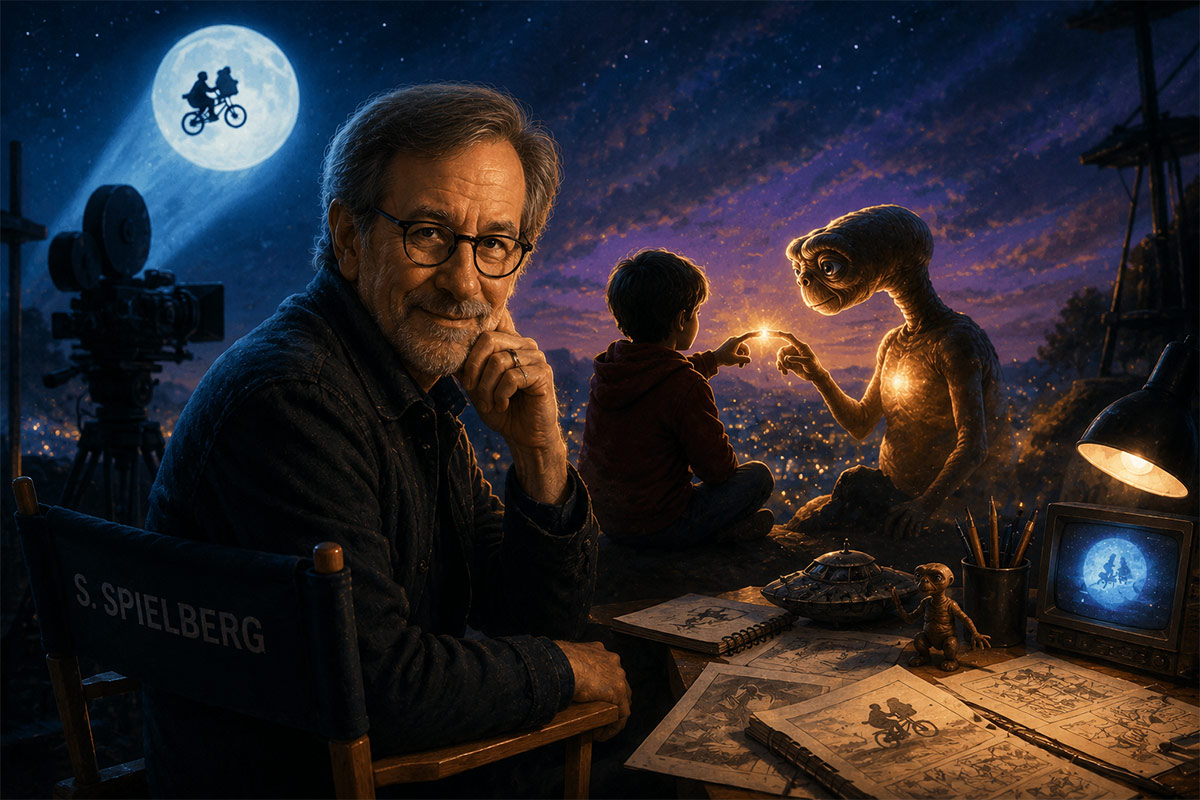
Steven Spielberg recently gave a simple answer to one of the biggest lingering questions about E.T. the Extra-Terrestrial: did Elliott ever see E.T. again? According to Spielberg, the answer is no. In a recent podcast interview, the filmmaker said Elliott did not reunite with the alien after the events of the 1982 classic, although he suggested that Elliott may have dreamed about E.T. through the psychic connection they shared.
That answer sounds emotionally fitting for the film’s bittersweet ending. But it also creates an unusual problem, because an officially approved sequel to E.T. once told a very different story.
The Forgotten Official E.T. Sequel
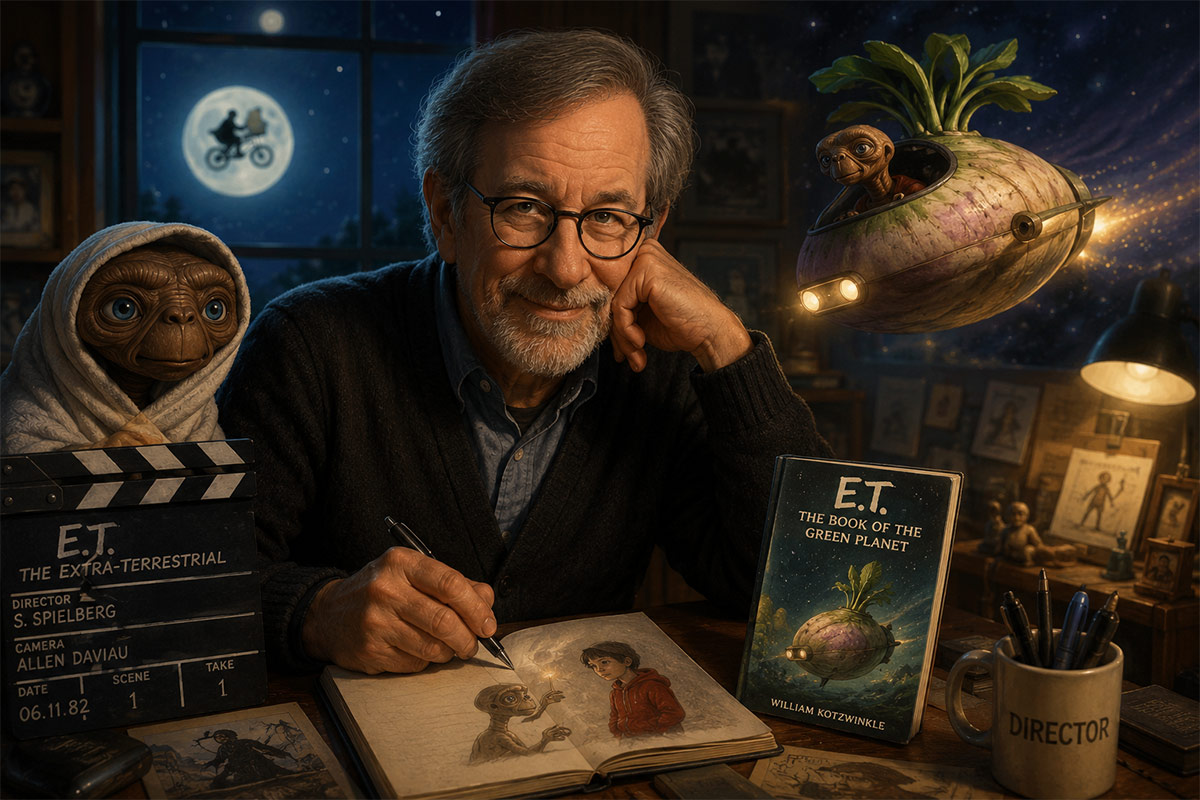
In 1985, author William Kotzwinkle published E.T.: The Book of the Green Planet, a sequel novel that continued the story after the events of Spielberg’s film. Kotzwinkle was not a random writer brought in for a loose spin-off. He also wrote the official novelization of E.T. the Extra-Terrestrial, giving the sequel a stronger connection to the original movie than many fans may realize.
The book begins shortly after E.T. leaves Earth and returns to his home planet, Brodo Asogi, often referred to as The Green Planet. Instead of receiving a heroic welcome after his time on Earth, E.T. faces questioning about his journey and suffers a surprising fall in status.
Rather than being celebrated, he loses his respected position as a plant biologist and is demoted to work as a low-ranking farmer.
E.T. Wants to Return to Elliott
The emotional core of the novel reverses the situation from the movie. In the film, E.T. desperately wants to go home. In the book, he gets home but spends much of the story longing to return to Earth and see Elliott again.
E.T. uses his psychic connection with Elliott to watch him from across space. Elliott, meanwhile, is a few years older and beginning to live a more ordinary human life, including developing feelings for a girl at school. This creates a strange and melancholy version of the story. E.T. has returned to his own world, but he no longer fully belongs there. His connection to Elliott remains strong enough that Earth begins to feel like the place he truly wants to be.
The Book Gets Very Weird Very Quickly
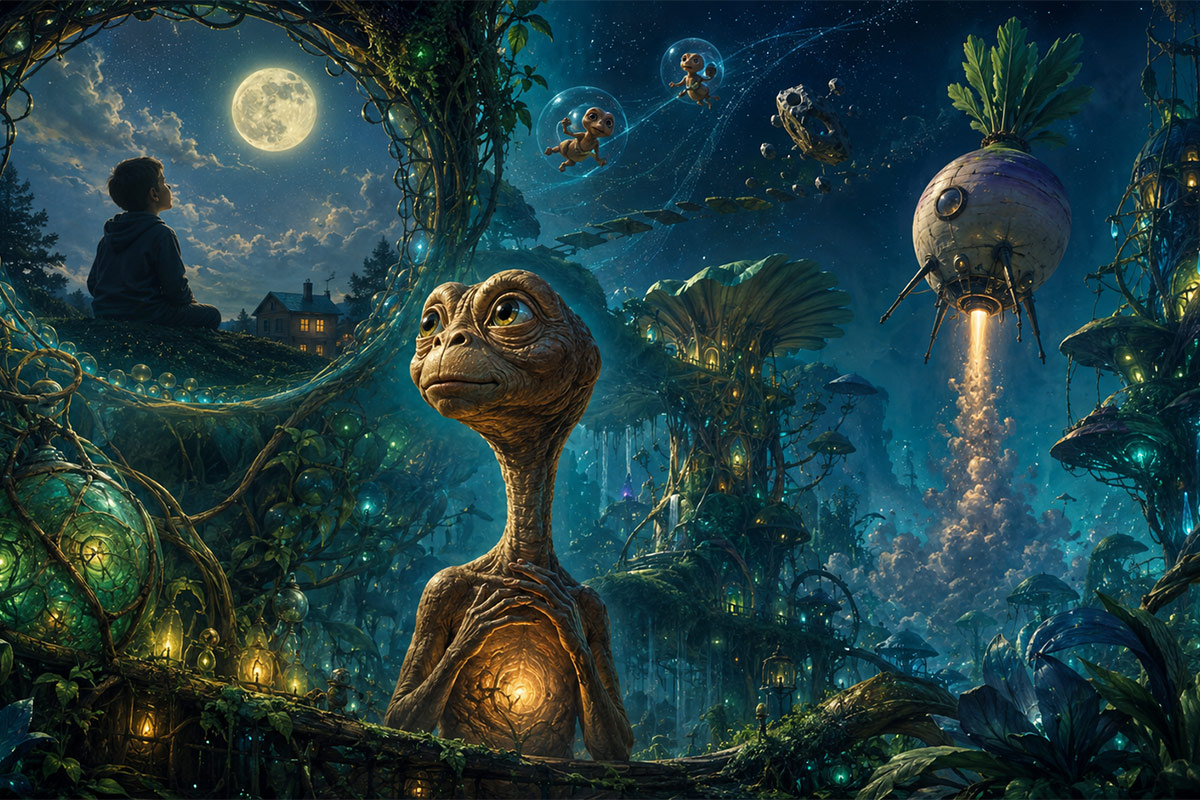
While the idea of E.T. missing Elliott is emotionally understandable, the details of the sequel become far stranger. At one point, E.T. creates miniature psychic versions of himself and sends them toward Earth in an attempt to reach Elliott. These are not just ghostly visions. They are physical little replicas that can interact with the world, but their attempts to make contact repeatedly fail in bizarre ways.
The tiny versions of E.T. get crushed, trapped and even sucked down drains as they try to reach Elliott.
It is a strange image for anyone who remembers the soft emotional tone of Spielberg’s original film. The sequel novel keeps the sadness of separation, but surrounds it with surreal comedy and odd science-fiction details.
Life on E.T.’s Home Planet
A large part of The Book of the Green Planet is devoted to building the world of E.T.’s home planet. The novel reveals that E.T.’s species is known as the Asogians and that they are not the only intelligent life on Brodo Asogi. The planet is filled with unusual species, strange social systems and plant-based technology.
Plants play a major role in the worldbuilding. Homes can be made from giant squash, some plants are intelligent enough to speak, and the natural environment functions almost like a living technology system.
The most memorable detail may be the spaceship E.T. and his friends eventually steal. It is not a sleek metal spacecraft or a traditional sci-fi vessel. It is a giant flying turnip.
Does E.T. Actually Reunite With Elliott?
By the end of the novel, E.T. and his companions set off in the turnip-shaped ship to find Elliott. The journey is not smooth, but the book strongly suggests that the ship reaches the Milky Way and that E.T. may be close to returning to Earth. The implication is that a reunion with Elliott could happen after all.
That is why Spielberg’s recent answer is so interesting. If Elliott truly never saw E.T. again, then either the novel no longer fits the story in Spielberg’s mind, or the filmmaker simply does not consider it part of the real E.T. canon.
There is also another possibility: Spielberg may remember the book but prefer the movie’s ending to remain final. The emotional power of E.T. comes from goodbye, not reunion. Bringing the alien back could weaken the beauty of that ending.
Was Spielberg Involved in the Sequel Novel?
The sequel novel was officially approved, but Spielberg’s involvement appears to have been limited. Kotzwinkle later said Spielberg was only briefly involved at the beginning of the project. Even so, the book was published as an official continuation, which makes it a fascinating piece of forgotten franchise history.
It also shows how different licensed sequels could be in the 1980s. Long before modern cinematic universes and carefully managed continuity, official tie-in novels sometimes took major creative swings that later became easy to ignore.
Why This Forgotten E.T. Sequel Still Matters
E.T.: The Book of the Green Planet is not remembered like the original film, and it is easy to see why. Spielberg’s movie is simple, emotional and iconic. The sequel novel is strange, expansive and sometimes surreal. It turns E.T.’s home world into a bizarre plant-based society and imagines the alien trying to return to Elliott in a flying vegetable.
But that weirdness is exactly what makes the book interesting today. It is a reminder that some franchises have forgotten corners that do not fit neatly into the version fans remember. The E.T. sequel novel may not be part of Spielberg’s preferred interpretation, but it remains one of the strangest official follow-ups ever attached to a beloved sci-fi movie.
Final Thoughts
Steven Spielberg may say that Elliott and E.T. never met again, but E.T.: The Book of the Green Planet once imagined a very different future. In that version, E.T. returns home, loses his status, misses Elliott, sends tiny psychic copies of himself to Earth and eventually escapes in a flying turnip-shaped spaceship in the hope of reuniting with his human friend.
It is sentimental, bizarre and almost completely forgotten. For fans of E.T., that makes it more than just an obscure sequel novel. It is a strange reminder that even one of cinema’s most beloved stories has a weird hidden chapter that many people, perhaps even Spielberg himself, would rather leave behind.