
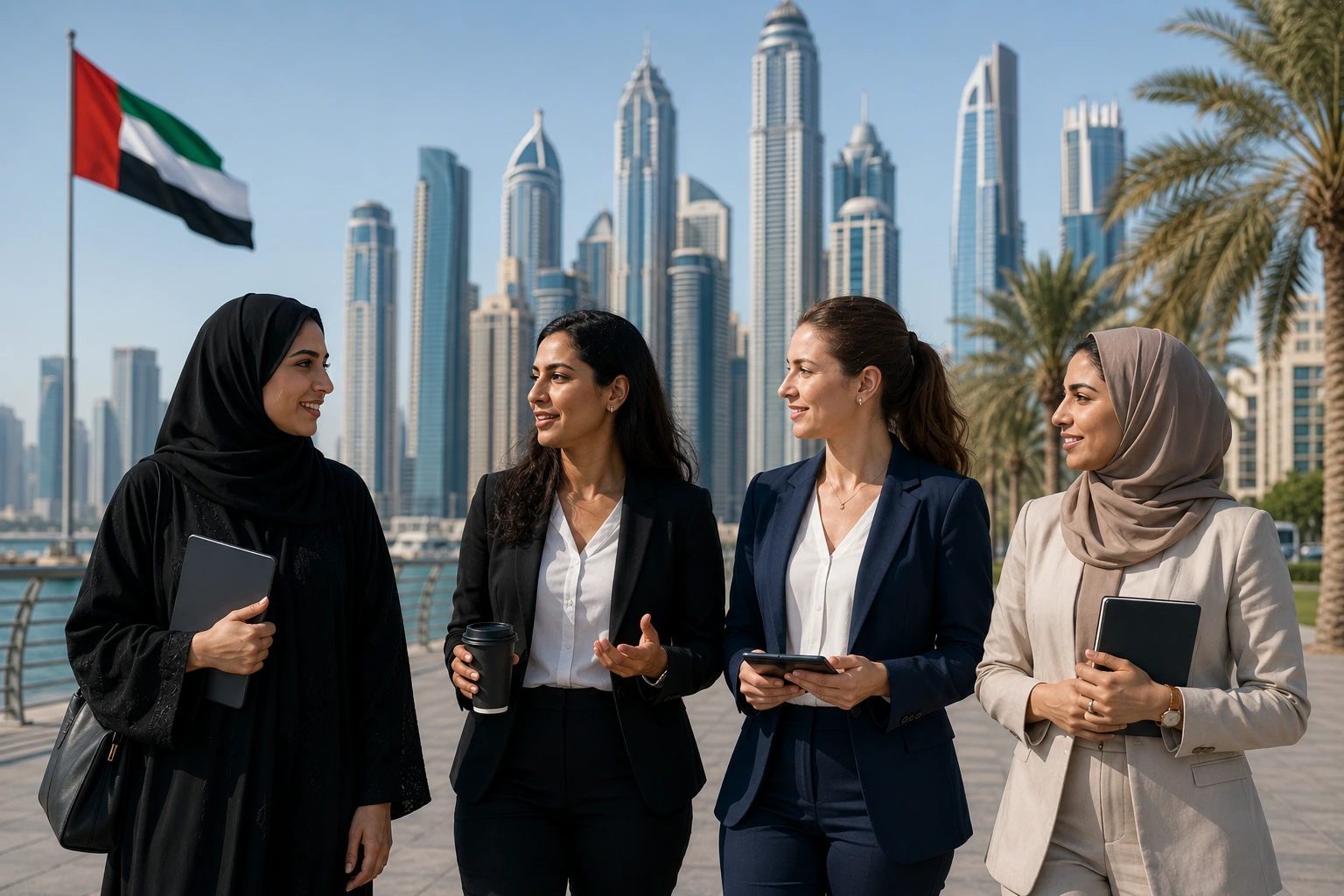
Dubai’s labour market has changed dramatically over the past few decades. This shift has also changed the wider Dubai lifestyle, as more women become visible in professional, entrepreneurial, social and family life across the city. Once known mainly as a male dominated trading, construction and logistics hub, the city is now home to a growing number of women working in government, finance, education, healthcare, real estate, tourism, aviation, media, technology, entrepreneurship and professional services.
But the story of working women in Dubai is not one story. It is two overlapping stories: the rise of Emirati women in education, public service, leadership and national economic participation; and the growth of non Emirati women who form part of Dubai’s global workforce across both high skilled and service sector jobs.
To understand women’s work in Dubai, it is important to look beyond simple gender comparisons. Dubai’s labour market is shaped by migration, nationality, sector structure, family patterns, the cost of living in Dubai, and the city’s unusual demographic profile. Women’s participation is rising, but the total workforce remains heavily influenced by male migrant labour in sectors such as construction, logistics, delivery, transport and industrial services.
Dubai’s Unusual Demographic Structure
To understand women’s employment in Dubai, we must first understand the city’s population structure. According to Dubai’s 2024 Population Bulletin, Dubai had 4,248,200 residents at the end of 2024. Women represented 31.47% of residents, or 1,336,700 people, while men represented 68.53%. The bulletin links the high male share to external workers arriving individually without family members.
This matters because Dubai’s labour market is shaped by migration. Large numbers of male workers in construction, logistics, transport, delivery and industrial services pull the gender balance strongly toward men. Therefore, even when women’s participation is rising, women may still appear as a smaller share of the total resident population and total workforce.
Dubai’s daytime population is even larger. The same official bulletin estimates that active individuals during peak daytime hours reached 5,937,800 in 2024, including residents, workers living outside Dubai, temporary residents, tourists and daily movement into the city. This shows that Dubai is not only a residential city; it is also a daily work hub for the wider UAE.
Dubai Population Structure in 2024
| Indicator | 2024 Figure | Why It Matters |
|---|---|---|
| Total resident population | 4,248,200 | Shows the official resident base of the emirate |
| Female residents | 1,336,700 | Women represented 31.47% of Dubai’s resident population |
| Male residents | 2,911,500 | Men represented 68.53% of residents, partly due to male migrant labour flows |
| Peak daytime active population | 5,937,800 | Shows Dubai’s role as a daily work hub beyond its resident population |
Emirati and Non-Emirati Women: What the Older Dubai Data Shows
The most useful publicly available Dubai labour-force breakdown by nationality and sex comes from the 2011 Labour Force Survey data published by Dubai Statistics Center and reproduced by the Gulf Labour Markets, Migration and Population Programme. In 2011, Dubai had 17,671 employed Emirati women and 138,009 employed non-Emirati women. That means non-Emirati women accounted for roughly 89% of employed women in Dubai, while Emirati women accounted for about 11%.
But the interpretation is more nuanced. Among Emiratis employed in Dubai in 2011, women represented about one-third of the Emirati employed population: 17,671 women out of 52,783 employed Emiratis. Among non Emiratis, women were a much smaller share: 138,009 women out of 1,273,166 employed non-Emiratis.
This reveals an important pattern. In absolute numbers, non-Emirati women dominate the female workforce because Dubai’s population and labour force are mostly expatriate. But within the Emirati workforce, women have had a significant presence, especially in public-sector, professional, administrative and education-linked roles.
Employed Women in Dubai by Nationality in 2011
| Group | Employed Women | Total Employed Population in Group | What It Shows |
|---|---|---|---|
| Emirati women | 17,671 | 52,783 employed Emiratis | Women formed a significant share of employed Emiratis |
| Non-Emirati women | 138,009 | 1,273,166 employed non-Emiratis | Expat women dominated female employment in absolute numbers |
| Total employed women | 155,680 | 1,325,949 total employed population | Women were a smaller share of total employment due to Dubai’s male-heavy labour structure |
How the Trend Has Changed
Since the early 2000s, women’s participation in the UAE labour market has risen significantly. World Bank gender data estimates female labour force participation in the UAE at 53% in 2025, compared with 91.5% for men. The World Bank also notes that female labour force participation in the UAE has increased since 1990.
This does not mean Dubai has reached full gender parity in the labour market. It means the direction has changed. Women are no longer marginal participants in the economy. They are now part of the city’s professional, administrative, entrepreneurial and public-sector backbone.
The shift is especially visible among Emirati women. The UAE’s policy direction has strongly encouraged women’s education, public-sector leadership, entrepreneurship and private-sector participation. As the country has invested in gender balance and workforce reforms, women’s role in the national economy has become more visible and strategically important.
Why Emirati Women’s Role Has Expanded
Several forces explain the rise of Emirati women in Dubai’s workforce and the wider UAE economy. First, education has transformed the pipeline. Emirati women are strongly represented in higher education, which has helped them enter fields such as law, public administration, education, healthcare, science, finance, government policy and corporate leadership.
Second, women’s economic participation has become part of national policy. The UAE Gender Balance Council Strategy 2026 aims to reduce gender gaps across sectors, improve the UAE’s global competitiveness rankings on gender equality, support gender balance in decision-making positions and promote the UAE as a benchmark for gender balance legislation.
Third, public-sector employment has played a major role. Emirati women have long had a strong presence in government and public services. Public-sector institutions have provided stable and respected career pathways in administration, education, healthcare, policy, leadership and technical roles. Fourth, Emiratisation policies are changing private-sector incentives. As UAE policy encourages private-sector companies to employ more Emirati citizens, more Emirati women may enter banking, insurance, healthcare, technology, professional services, customer-facing corporate roles and leadership-track positions.
Main Drivers Behind Emirati Women’s Labour Market Growth
| Driver | How It Supports Women’s Employment |
|---|---|
| Education | Creates a pipeline for women to enter professional, technical, public-sector and leadership roles |
| National policy | Places gender balance and women’s participation within the country’s development agenda |
| Public-sector employment | Provides stable pathways into respected careers, leadership and national service |
| Emiratisation | Creates incentives for private companies to hire more Emirati citizens, including women |
| Economic diversification | Expands opportunities in finance, healthcare, technology, education, professional services and entrepreneurship |
The Role of Non-Emirati Women in Dubai
Non-Emirati women are essential to Dubai’s economy. They work across a wide range of sectors, including hospitality, retail, domestic work, education, healthcare, aviation, beauty, media, marketing, finance, real estate, technology and administration.
Their role is diverse. Some are high-income professionals in law, banking, consulting, medicine, real estate, management and technology. Others work in lower-wage service jobs, domestic employment, hospitality, retail or care work. This wide range makes it misleading to speak about “expat women” as one single group.
Non-Emirati women also reflect Dubai’s global identity. The city’s female workforce includes women from South Asia, Southeast Asia, Europe, the Middle East, Africa and the wider Arab world. Their presence supports Dubai’s service economy, international business culture, consumer-facing sectors and household economy.
Why Women’s Share Is Still Limited in Total Employment
Despite major progress, women remain a smaller share of Dubai’s total workforce for structural reasons. The first reason is migration. Dubai’s growth model has relied heavily on male migrant workers in construction, transport, logistics and industrial jobs. This creates a male-heavy labour market even if women’s participation is improving.
The second reason is sector composition. Some of Dubai’s largest employment sectors remain physically demanding or male-dominated, including construction, infrastructure, logistics, delivery and certain industrial activities. The third reason is family migration patterns. Many male workers arrive individually without family members, which increases the number of men in the resident and working population. Dubai’s 2024 Population Bulletin directly links the high male ratio to external workers arriving without families. The fourth reason is career interruption. Like many global cities, women may face career pauses due to childcare, family responsibilities, relocation, visa dependency or employer flexibility. Dubai has made progress, but family-work balance remains a real factor.
What Has Changed Since Dubai’s Transformation Years?
In Dubai’s early transformation period, the economy was dominated by trade, construction, ports, real estate and male-heavy labour migration. Women were present, but less visible in the city’s growth narrative. Today, Dubai is different. The economy has diversified into finance, tourism, technology, media, education, healthcare, digital services and entrepreneurship. These sectors create more opportunities for women, especially educated Emirati women and skilled expatriate women.
The change is not only numerical. It is cultural. Women are now more visible as founders, executives, lawyers, doctors, academics, investors, real estate professionals, media figures, government leaders, startup operators and corporate specialists. Dubai’s professional identity is becoming less male-only and more mixed, international and service-driven.
Emirati Women vs Expat Women: Two Different Labour Market Stories
The story of working women in Dubai is best understood through two overlapping tracks. Emirati women represent a national transformation story. Their rise is connected to education, government employment, leadership programmes, national policy, Emiratisation and the UAE’s long-term social development agenda.
Expat women represent Dubai’s global labour market story. Their presence reflects the city’s role as an international work hub, where women arrive from many countries to work in both high-income professional roles and essential service-sector jobs.
Two Labour Market Stories in One City
| Group | Main Labour Market Story | Common Sectors and Roles |
|---|---|---|
| Emirati women | Rising national participation through education, public service, leadership and policy support | Government, education, healthcare, finance, public administration, entrepreneurship, leadership roles |
| Non-Emirati women | Global workforce participation across high-skilled and service-sector roles | Hospitality, retail, aviation, domestic work, healthcare, education, media, finance, marketing, real estate, technology |
This distinction matters because the challenges are not identical. Emirati women may need stronger private-sector pathways, leadership mobility and high-growth sector access. Expat women may face different issues related to visa status, wage levels, job security, relocation, career continuity and sector-based inequality.
What Dubai Needs Next for Working Women
Dubai’s next challenge is not simply to increase the number of women in the labour market. The more important challenge is to improve the quality of opportunity. That means building stronger pathways for women to enter and grow in high-value sectors, including:
- Technology
- Artificial intelligence
- Finance
- Green economy
- Entrepreneurship
- Healthcare innovation
- Professional services
- Advanced education
- Real estate leadership
- Media and digital industries
It also means improving career mobility, leadership access, fair pay, family-friendly work structures, access to the best schools in Dubai, and support for women returning to work after career breaks. For Dubai, this is not only a social issue. It is an economic issue. A city that wants to compete globally cannot afford to underuse female talent.
Final Analysis: Women Are Now Part of Dubai’s Economic Engine
Women’s work in Dubai is one of the clearest signs of the city’s social and economic transformation. The data shows that non-Emirati women make up the majority of employed women in Dubai in absolute terms because Dubai’s workforce is overwhelmingly expatriate. But Emirati women have become increasingly important within the national workforce, especially in government, leadership, education, entrepreneurship and professional roles.
The trend is clear: women’s participation has risen, the range of jobs has widened, and the city’s economy now depends more visibly on female talent than before. Dubai’s next challenge is not simply to increase the number of working women. It is to improve the quality of opportunity: better career mobility, stronger leadership pathways, fair pay, family-friendly work structures and greater access to high-growth sectors such as technology, finance, AI, green economy and entrepreneurship. In the story of Dubai’s transformation, women are no longer on the margins. They are part of the engine.
FAQ About Working Women in Dubai
Are more women working in Dubai today?
Yes. Women’s participation in Dubai and the wider UAE labour market has increased over time. World Bank gender data estimates female labour force participation in the UAE at 53% in 2025, showing a long-term rise compared with earlier decades.
Why are women a smaller share of Dubai’s population?
Women are a smaller share of Dubai’s resident population partly because the city has a large male migrant workforce. Dubai’s 2024 Population Bulletin links the high male share to external workers arriving individually without family members.
Are most working women in Dubai Emirati or expatriate?
In absolute numbers, most employed women in Dubai are expatriates because Dubai’s total workforce is mostly non-Emirati. In the 2011 Labour Force Survey data, Dubai had 17,671 employed Emirati women and 138,009 employed non-Emirati women.
Why are Emirati women important to Dubai’s labour market?
Emirati women are important because their participation reflects national progress in education, public-sector leadership, entrepreneurship and professional employment. Their role is also supported by national gender balance and Emiratisation policies.
What sectors do expat women work in Dubai?
Expat women work across many sectors, including hospitality, retail, domestic work, aviation, education, healthcare, media, marketing, finance, real estate, technology, administration and professional services.
What are the biggest challenges for working women in Dubai?
Key challenges include career mobility, leadership access, wage differences, childcare responsibilities, visa dependency, sector-based inequality and the need for more women in high-growth fields such as technology, finance, AI and entrepreneurship.