
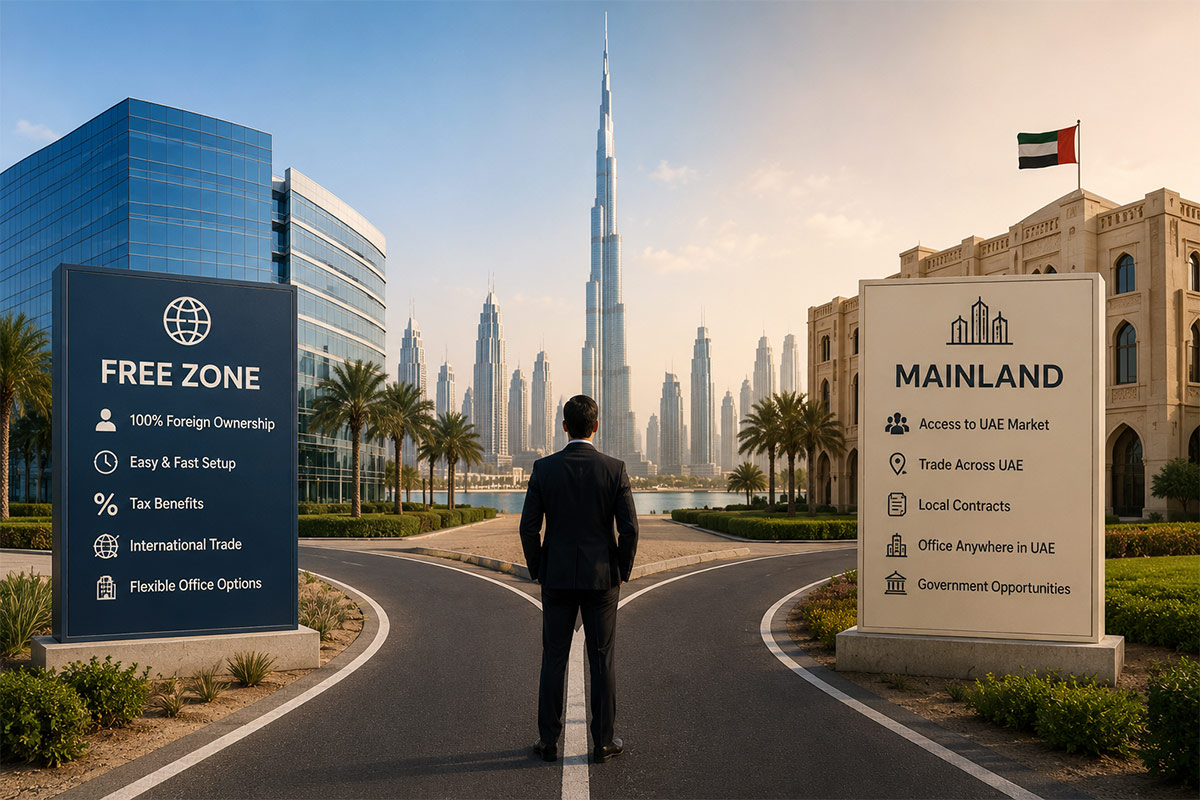
One of the first decisions any entrepreneur faces in Dubai is whether to set up a company in the mainland or in a free zone.
At first, the difference may look technical. In reality, it can affect almost everything: who your customers can be, how you sell inside the UAE, your office requirements, tax position, visa flexibility, banking process, regulatory obligations and long-term growth strategy.
Dubai offers both models because different businesses need different structures. A consultant selling services to international clients may prefer a free zone. A retail company, restaurant, construction firm or local service provider may need a mainland licence. A fintech, media, logistics or commodities company may choose a specialised free zone because of its ecosystem and reputation.
There is no single best answer.
The right structure depends on what the business actually wants to do.
Why the Mainland vs Free Zone Decision Matters
Choosing between Dubai mainland and a free zone is not just about setup cost. It is a strategic decision that shapes how the company can operate, sell, hire, bank, scale and comply with regulations.
A low-cost licence may look attractive at the beginning. But if it does not allow the business to reach its real customers, open the right bank account, hire the right team or trade in the right market, it can become expensive later.
Entrepreneurs should think about the decision through practical questions:
- Where are the customers?
- Will the business sell inside the UAE mainland?
- Is the business mainly international or local?
- Does the company need a physical shop, clinic, restaurant, warehouse or office?
- How many visas will be required?
- Will the company need a UAE bank account quickly?
- Is the activity regulated?
- Does the company need a prestigious sector-specific ecosystem?
- Will the structure still work when the business grows?
The best company setup is not always the cheapest one. It is the one that matches the commercial reality of the business.
What Is a Mainland Company in Dubai?
A mainland company is licensed by the relevant economic authority in the emirate where it is established. In Dubai, mainland businesses are generally licensed through Dubai’s economic authority and can operate across the UAE market, subject to approved activities and sector regulations.
The UAE Ministry of Economy explains that setting up a mainland company involves selecting the business activity, choosing the legal form, registering the trade name, obtaining initial approval and completing licensing procedures.
Historically, many mainland companies required a UAE national shareholder or local sponsor. That has changed significantly. UAE reforms to the Commercial Companies Law now allow up to 100% foreign ownership of mainland companies for many business activities, while strategic-impact sectors may still require special approvals or local ownership conditions.
Why Mainland Companies Are Attractive
Mainland companies are often attractive because they provide broad access to the UAE market. They are usually more practical for businesses that want to work directly with customers, clients, suppliers, landlords, government-related entities or physical locations inside Dubai and the wider UAE.
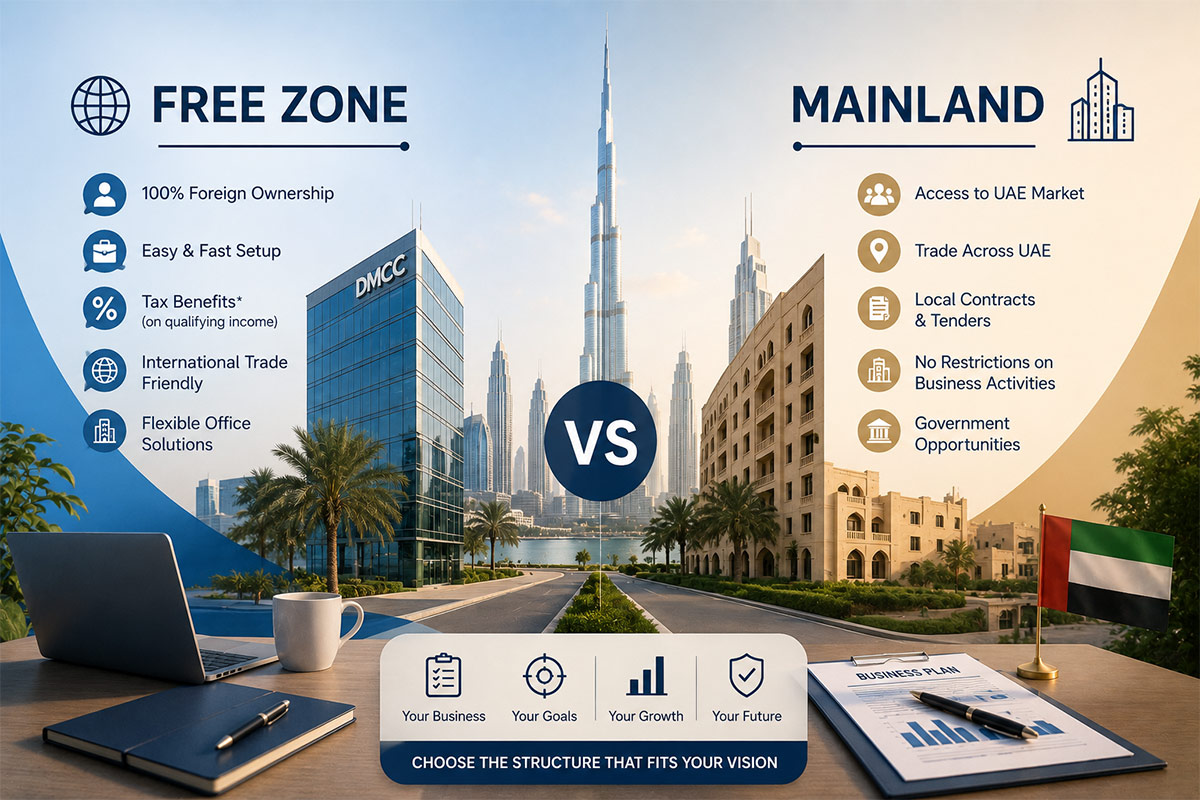
A mainland company may be suitable for:
- Retail shops
- Restaurants and cafés
- Clinics and salons
- Construction companies
- Real estate brokerages
- Local service providers
- Businesses selling directly to UAE residents
- Companies requiring physical commercial premises
- Businesses planning to hire larger local teams
The main advantage is market access. The main responsibility is that the business must comply with the licensing, tax, labour, immigration and sector rules that apply to its activity.
What Is a Free Zone Company in Dubai?
A free zone company is established inside a specific economic zone. Dubai has many free zones, each often designed around a particular business focus, such as technology, media, commodities, finance, healthcare, design, logistics, crypto, e-commerce or professional services.
The UAE Ministry of Economy states that the UAE has more than 40 multidisciplinary free zones where expatriates and foreign investors can have full ownership of companies. Dubai’s Invest in Dubai portal also highlights free zones as business setup options with full foreign ownership and sector-specific opportunities.
Free zones are popular because they often provide fast setup, 100% foreign ownership, specialised ecosystems, business-friendly packages, flexible office options and international credibility.
Examples include:
- DMCC for commodities, trading and international business
- DIFC for finance, legal services, wealth and regulated financial activity
- Dubai Internet City for technology companies
- Dubai Media City for media and communications
- Dubai South for aviation, logistics and trade
- Dubai Silicon Oasis for technology and innovation
- Meydan Free Zone or IFZA for flexible SME structures
Why Free Zone Companies Are Attractive
A free zone company is usually most suitable when the business is international, digital, advisory, export-focused, asset-light or does not need unrestricted direct sales into the UAE mainland market.
A free zone may be suitable for:
- Consultants
- Digital agencies
- E-commerce operators
- Software companies
- Media businesses
- International trading companies
- Holding companies
- Online service providers
- Freelancers and founder-led businesses
- Sector-specific companies that benefit from a free zone ecosystem
The main advantage is efficiency and international positioning. The main limitation is that mainland market access may require additional permissions or structures depending on the activity.
Mainland vs Free Zone: Quick Comparison
| Factor | Mainland Company | Free Zone Company |
|---|---|---|
| Main regulator | Dubai’s economic authority or relevant emirate authority | Specific free zone authority |
| Market access | Broader ability to operate across the UAE, subject to activity approvals | Primarily within the free zone and internationally; mainland activity may need permits or structures |
| Ownership | 100% foreign ownership allowed for many activities | 100% foreign ownership generally available |
| Best for | UAE-facing businesses, shops, restaurants, local services, construction, real estate | International, digital, consulting, trading, fintech, media, innovation and sector-focused businesses |
| Office needs | Often more connected to physical premises, depending on activity | Flexible options such as flexi-desk, shared office or full office, depending on free zone and activity |
| Tax position | Generally subject to UAE corporate tax rules | May access 0% corporate tax on qualifying income if conditions are met |
| Banking | Can be straightforward for UAE-facing businesses with clear substance | Depends on free zone reputation, business model, substance and banking risk |
| Scaling | Often practical for businesses hiring and operating locally | Strong for asset-light, international or sector-specific scaling |
| Cost | Can vary widely by activity, location and office needs | Can be cost-efficient, but premium free zones may be expensive |
| Main risk | Choosing mainland when the business is actually international and could be more efficient in a free zone | Choosing a free zone that does not match the real customer base or activity |
The Biggest Difference: Market Access
The clearest practical difference between a mainland company and a free zone company is market access.
A mainland company can generally trade and provide services directly across Dubai and the wider UAE, subject to its licensed activities and regulatory approvals. This is important for businesses that want to sell to local customers, open a shop, work with government-related entities, serve UAE-based clients directly, or operate physically across the country.
A free zone company, by contrast, is primarily licensed to operate within its free zone and internationally. It can usually do business with clients outside the UAE and often with other free zone companies.
However, if a free zone company wants to sell goods or services directly into the UAE mainland market, it may need a distributor, local agent, branch, dual licence, temporary permit or another compliant structure depending on the activity and emirate. In Dubai, recent frameworks have also created routes for free zone companies to operate on the mainland through branch licences or temporary permits, subject to conditions and eligible activities.
Why Market Access Should Come Before Cost
The choice between mainland and free zone should not start with price. It should start with customers.
If your real customers are restaurants, residents, shops, clinics, landlords, developers, schools or companies operating across the UAE mainland, a mainland licence may be more practical.
If your real customers are international clients, online users, free zone companies or overseas partners, a free zone may be more efficient.
A cheaper licence can become expensive if it blocks the company from reaching its actual market.
Ownership: The Old Difference Has Become Smaller
In the past, ownership was one of the biggest differences between mainland and free zone companies. Free zones were attractive because they allowed 100% foreign ownership, while many mainland companies often required local participation.
Today, the gap is smaller.
The UAE’s foreign ownership reforms allow foreign investors to own 100% of many mainland companies. The UAE government explains that changes to the Commercial Companies Law removed the requirement for 51% Emirati ownership or a local agent for most business activities, while some strategic sectors still require approvals.
This means entrepreneurs should not automatically assume that free zones are the only route to full ownership.
In many cases, a mainland company can also be fully foreign-owned.
What Entrepreneurs Should Compare Instead
Because ownership is no longer the only major difference, entrepreneurs should compare mainland and free zone options based on:
- Business activity
- Customer location
- Market access
- Tax treatment
- Office requirements
- Visa needs
- Banking expectations
- Regulatory obligations
- Sector reputation
- Long-term growth plans
The real question is no longer only, “Can I own 100% of the company?”
The better question is, “Which structure actually supports how this business will operate?”
Tax: Free Zone Does Not Always Mean Zero Tax
Another common misunderstanding is that free zone companies are always tax-free.
This is no longer accurate.
The UAE introduced federal corporate tax, generally applying a 9% rate on taxable business income above the applicable threshold. Free zone companies may still benefit from a 0% corporate tax rate on qualifying income if they meet the conditions to be treated as a Qualifying Free Zone Person. The UAE Federal Tax Authority explains that its Free Zone Person guide outlines the conditions required to benefit from the 0% corporate tax rate, as well as qualifying and excluded activities.
This is extremely important.
A free zone company that sells mostly to mainland UAE clients, fails substance requirements, does not maintain proper records or earns non-qualifying income may not enjoy the full 0% advantage.
Mainland companies, on the other hand, are generally subject to the standard UAE corporate tax rules. They may not have the same potential free zone 0% treatment, but their tax position can be more straightforward if the business is clearly domestic.
Mainland vs Free Zone Tax Position
| Tax Issue | Mainland Company | Free Zone Company |
|---|---|---|
| Corporate tax | Generally subject to standard UAE corporate tax rules | May receive 0% on qualifying income if conditions are met |
| Non-qualifying income | Usually taxed under standard rules | Can be taxed at the standard rate |
| Mainland customer income | Usually part of normal domestic business | May affect qualifying income treatment depending on structure and activity |
| Substance and records | Required for tax and compliance | Especially important for maintaining qualifying free zone status |
| Main misunderstanding | Mainland is always worse for tax | Free zone is always tax-free |
The tax decision should be reviewed carefully with a qualified adviser. The wrong structure can create unexpected tax exposure later.
Office and Physical Presence
Office requirements are another major difference.
Free zones usually offer a range of office options, from flexi-desks and shared offices to dedicated offices and full commercial spaces. This can make them attractive for startups, consultants, digital businesses and international entrepreneurs who want a lower-cost entry point.
Mainland companies may have more traditional office or lease requirements depending on the activity. For retail, restaurants, clinics, salons, warehouses or physical service businesses, the location and commercial premises are often central to the licence.
However, the line is not always rigid.
Some free zones require real offices for regulated or larger activities, while some mainland activities can use flexible office solutions through approved channels.
Which Setup Is Better for Office Flexibility?
A free zone may be more practical if the business:
- Is remote or digital
- Needs only a small team
- Does not serve walk-in customers
- Wants a flexi-desk or shared office
- Works mostly with international clients
- Needs a quick and simple entry structure
Mainland may be more practical if the business:
- Needs a shop, restaurant, clinic or showroom
- Serves local customers directly
- Needs a warehouse or workshop
- Operates across the UAE
- Plans to build a larger physical team
- Requires a visible commercial location
Visas and Hiring
Both mainland and free zone companies can usually sponsor residence visas, but the number of visas depends on several factors.
These may include:
- Office size
- Licence type
- Business activity
- Immigration approvals
- Free zone rules
- Labour approvals
- Company structure
- Employee roles
Free zones often package a certain number of visa allocations with licence and office products. Mainland visa quotas may depend more heavily on office space, labour approvals and the nature of the activity.
Which Is Better for Hiring?
For a small founder-led company, a free zone package may be simple and predictable.
For a business planning to hire many staff, operate physical premises, serve customers across the UAE or build a large local team, mainland may offer more practical flexibility.
The right answer depends on how the company expects to grow.
Banking and Compliance
Opening a UAE bank account is one of the most important practical issues for any company.
Banks usually look beyond the licence type. They want to understand the real business model, source of funds, shareholders, customer base, expected transactions, office presence, contracts and compliance risk.
A mainland licence may sometimes look more straightforward for a UAE-facing business. A reputable free zone, especially one aligned with the company’s sector, can also support credibility.
However, a low-cost free zone licence without real business substance may face more questions from banks.
What Banks Usually Want to Understand
Banks may review:
- Shareholder background
- Source of funds
- Expected transaction volume
- Customer countries
- Supplier countries
- Business activity
- Contracts and invoices
- Office presence
- Website and business profile
- Compliance risk
- Tax registration status
- Economic substance and beneficial ownership information where relevant
Compliance across the UAE has become more serious. Companies should think about corporate tax registration, accounting records, beneficial ownership, economic substance where applicable, anti-money laundering obligations for certain sectors, VAT registration where required and annual licence renewal.
A licence is only the first step. The company also has to look real and credible to banks, clients and regulators.
Which One Is Better for Different Businesses?
There is no universal winner between mainland and free zone companies. The better choice depends on the type of business.
Mainland Is Often Better For
Mainland is often more practical for businesses that directly serve the UAE market or require physical operations.
It may be better for:
- Restaurants
- Retail shops
- Clinics
- Salons
- Construction companies
- Real estate brokerages
- Local service providers
- Maintenance companies
- Businesses selling directly to UAE residents
- Companies working with local contracts or government-related entities
Free Zone Is Often Better For
Free zones may be more efficient for businesses that are international, digital, advisory, export-focused or sector-specific.
They may be better for:
- Consultants
- Digital agencies
- E-commerce businesses
- Media companies
- Software companies
- International trading companies
- Holding companies
- Online service providers
- Freelancers and small founder-led businesses
- Businesses serving clients outside the UAE
Specialised Free Zones Can Add Strategic Value
Some businesses choose a free zone not only for cost or ownership, but for ecosystem value.
For example:
| Business Type | Possible Free Zone Fit | Why |
|---|---|---|
| Finance, funds, asset management, legal services | DIFC | Common law framework, courts, financial ecosystem and international credibility |
| Commodities and international trading | DMCC | Global reputation and sector focus |
| Technology companies | Dubai Internet City or Dubai Silicon Oasis | Tech ecosystem, innovation community and sector positioning |
| Media and communications | Dubai Media City | Media-focused business environment |
| Logistics and aviation | Dubai South | Proximity to logistics, aviation and trade infrastructure |
| Flexible SME structures | IFZA, Meydan Free Zone or similar zones | Entry-level flexibility and founder-friendly packages |
The best structure is the one that matches the commercial reality of the business.
Common Mistakes Entrepreneurs Make
Many entrepreneurs choose their company structure too quickly. The result can be higher costs, banking delays, tax issues or market access problems later.
The most common mistakes include:
- Choosing the cheapest licence without checking whether it allows the intended activity
- Assuming that a free zone company automatically means zero tax
- Forming a free zone company while the real customer base is mainly mainland UAE clients
- Choosing mainland when the business is actually international and could operate more efficiently from a specialised free zone
- Ignoring banking requirements and assuming a licence is enough
- Not planning for scale, staff, visas, office space and future regulatory approvals
- Choosing a free zone with no connection to the company’s sector
- Failing to check whether the activity is regulated
- Underestimating accounting, tax and compliance obligations
A structure that works for one founder and one visa may not work when the business needs ten employees, local contracts, larger offices and regulatory approvals.
Mainland vs Free Zone: Which One Should You Choose?
The simplest way to choose is to start with the business model.
| If Your Business Needs… | Consider |
|---|---|
| Direct access to UAE mainland customers | Mainland |
| A retail shop, restaurant, clinic or physical service location | Mainland |
| Government-related or local contracts | Mainland |
| A large local team operating across the UAE | Mainland |
| International clients and remote service delivery | Free Zone |
| A fast, flexible and cost-efficient setup | Free Zone |
| Sector-specific credibility in finance, commodities, tech or media | Specialised Free Zone |
| Potential 0% tax on qualifying income | Free Zone, subject to conditions |
| A simple domestic operating model | Mainland |
| A premium financial or legal ecosystem | DIFC |
The right answer is not only about what is easier today. It is about what will still work when the business grows.
Final Analysis: Mainland vs Free Zone Is a Strategic Decision
The difference between Dubai mainland and free zone companies is not simply “local versus international” or “expensive versus cheap.” The real difference is strategic.
Mainland gives broader access to the UAE market, stronger suitability for local operations and often more flexibility for businesses dealing directly with UAE customers.
Free zones offer 100% foreign ownership, sector-focused ecosystems, efficient setup options, international positioning and possible 0% corporate tax treatment on qualifying income, but only if the company meets the relevant conditions.
For entrepreneurs, the right question is not:
Which one is better?
The right question is:
Where are my customers, how will I earn revenue, what activity do I need, how many visas will I require, and what structure will still work when the business grows?
In Dubai, choosing the right licence is not a formality.
It is the foundation of the business model.
FAQ About Dubai Mainland vs Free Zone Companies
- What is the main difference between mainland and free zone companies in Dubai?
The main difference is market access. A mainland company can generally operate directly across the UAE market, subject to its licensed activity. A free zone company is primarily licensed to operate within its free zone and internationally, and may need additional structures or permits to sell directly into the mainland market.
- Can foreigners own 100% of a mainland company in Dubai?
Yes, foreign investors can own 100% of many mainland companies in the UAE following reforms to the Commercial Companies Law. However, some strategic or regulated sectors may still require special approvals or local ownership conditions.
- Are free zone companies always tax-free?
No. Free zone companies may benefit from a 0% corporate tax rate on qualifying income if they meet the conditions to be treated as a Qualifying Free Zone Person. Non-qualifying income can be taxed at the standard UAE corporate tax rate.
- Which is cheaper: mainland or free zone company setup?
Free zones may offer lower-cost entry packages, especially for small or remote businesses. However, the cheapest setup is not always the best. If the licence does not match the company’s activity or customer base, it can become more expensive later.
- Can a free zone company do business in Dubai mainland?
A free zone company may need a distributor, agent, branch, dual licence, temporary permit or another compliant structure to do business directly in the Dubai mainland market, depending on the activity and applicable rules.
- Which is better for a consulting business in Dubai?
If the consulting business serves international clients or works remotely, a free zone may be efficient. If the business mainly serves UAE mainland clients directly, mainland may be more practical.
- Which is better for a restaurant or retail shop in Dubai?
Mainland is usually more practical for restaurants, cafés, retail shops, clinics, salons and other businesses that serve local customers from a physical location.