

The UAE’s telecoms regulator has cleared Starlink to run a full public satellite internet network in the country — a major step for Starlink in the UAE rollout, but not the same as the service being ready for every home and business tomorrow.On Friday, 28 August 2026, the Telecommunications and Digital Government Regulatory Authority (TDRA) announced it had granted Starlink Satellite Communications a 10-year General Satellite Services Licence, authorising the company to build, operate and manage a public satellite communications network and sell satellite broadband across the UAE.
The announcement, carried by the UAE Government Media Office, describes the licence as adding “a space-based layer” to the country’s digital infrastructure, sitting alongside the existing fibre-optic and 5G networks operated by du and e&. TDRA said the move is meant to widen connectivity options and strengthen the resilience of the network, and specifically named maritime, aviation, energy, logistics and emergency response as sectors that stand to benefit.
For most residents, the practical questions are simpler: is Starlink actually available yet, what will it cost, and is it worth switching from fibre? Here’s what’s confirmed so far — and what still isn’t.
Starlink in the UAE Licence: What It Actually Allows
What a general satellite services licence means
A General Satellite Services Licence is a different, and bigger, thing than a service approval. It makes Starlink a licensed network operator in its own right — able to build and run its own satellite communications infrastructure inside the UAE, rather than simply being permitted to sell a service that already exists elsewhere. The National reported that TDRA’s deputy director general, Eng. Mohammed Yousif Al Ramsi, said this formalises Starlink as a regulated telecoms provider operating within the UAE’s established security and network frameworks — though he was careful to distinguish this from Starlink becoming a third mobile operator alongside e& and du.
Under the licence, Starlink can serve individuals, businesses and government entities, plus dedicated connectivity for maritime and aviation use. This is part of a broader story about the UAE building out digital infrastructure beyond phone lines and fibre, an effort the country has also been pushing through investment in AI and data infrastructure over the past year.
Licence granted is not service launched
This is not Starlink’s first UAE approval, and that history is exactly why “licensed” and “launched” keep getting confused. TDRA records show the company was granted a narrower 10-year licence back in 2024, but that one covered maritime satellite internet only. In March 2026, TDRA gave further approval that let Starlink’s coverage map show the UAE as active — with an important restriction: the “in-motion on land” feature, which lets a dish stay connected while a vehicle is moving, remained prohibited. Residential and fixed-location plans were advertised from that point at roughly Dh230–Dh300 a month.
Friday’s licence is the step that turns that patchwork of approvals into a formal public network operator status. In practical terms, it’s the regulatory foundation the rollout needed — not necessarily a signal that every UAE address can order and connect this week.
When Can You Actually Get Starlink in the UAE?
Right now, ordering is open. Residents can enter their address on Starlink’s website to check serviceability and pre-order, with Khaleej Times reporting residential pricing at Dh300 a month (Dh230 for the “Residential Lite” tier) and a 30-day trial with unlimited data. But Starlink itself has published a notice on its site saying it “cannot provide an estimated timeframe for service availability” in newly opened markets, as it continues adding capacity to the satellite constellation.
That caveat matters more in the UAE’s two biggest cities than elsewhere. Coverage here tends to be strongest in areas with less competing demand — which is the opposite of Dubai and Abu Dhabi.
What has been confirmed and what has not
Confirmed: TDRA has granted the full licence, Starlink is taking pre-orders through its own website, and pricing has been published (Dh300 standard, Dh230 Residential Lite, roughly Dh248 for business plans). Not yet confirmed: a firm activation date for new residential connections, particularly in Dubai and Abu Dhabi, which some coverage has described as currently listed at capacity on Starlink’s own ordering system. Whether that changes in weeks or months hasn’t been stated publicly by either TDRA or Starlink. [NEEDS VERIFICATION: current capacity status in Dubai/Abu Dhabi should be checked against Starlink’s live availability map before publishing, as this changes frequently.]
How Much Will Starlink Cost in the UAE?
Based on Starlink’s own published UAE pricing, the standard residential kit costs around Dh1,545 (including shipping), with the Residential Lite plan at Dh230 a month and standard Residential at Dh300 a month. Business plans start from roughly Dh248 a month, scaling up with priority data.
Hardware and monthly pricing in neighbouring markets
Starlink’s footprint across the Gulf is uneven, which is worth knowing before assuming UAE pricing is the regional norm.
| Market | Status | Notes |
|---|---|---|
| UAE | Live, full public licence | Residential from Dh230–Dh300/month |
| Qatar, Bahrain, Oman, Jordan | Live | Residential plans generally available |
| Saudi Arabia | Restricted | Approved for maritime and aviation use only as of 2025; no confirmed full consumer rollout |
| Kuwait | Unconfirmed | Appears on Starlink’s coverage map, but no official launch announcement |
Regional monthly prices for markets where Starlink is live cluster in a similar band to the UAE’s roughly, though third-party pricing trackers should be treated as directional rather than exact — always worth confirming on starlink.com for a specific address. [NEEDS VERIFICATION: exact current monthly prices for Qatar, Bahrain and Oman should be checked directly against Starlink’s local ordering pages, as these shift with currency and capacity.]
Why UAE pricing may differ
Starlink’s monthly price in any country is shaped less by the underlying technology and more by local capacity, currency and how much demand a given cell can absorb before the company raises prices to slow sign-ups. A city as dense as Dubai puts real strain on a fixed number of satellites overhead at any one time, which is part of why residents there may see slower onboarding, and potentially different pricing over time, than someone signing up from a lower-density emirate.
Starlink vs du and e&: What Changes for Home Internet
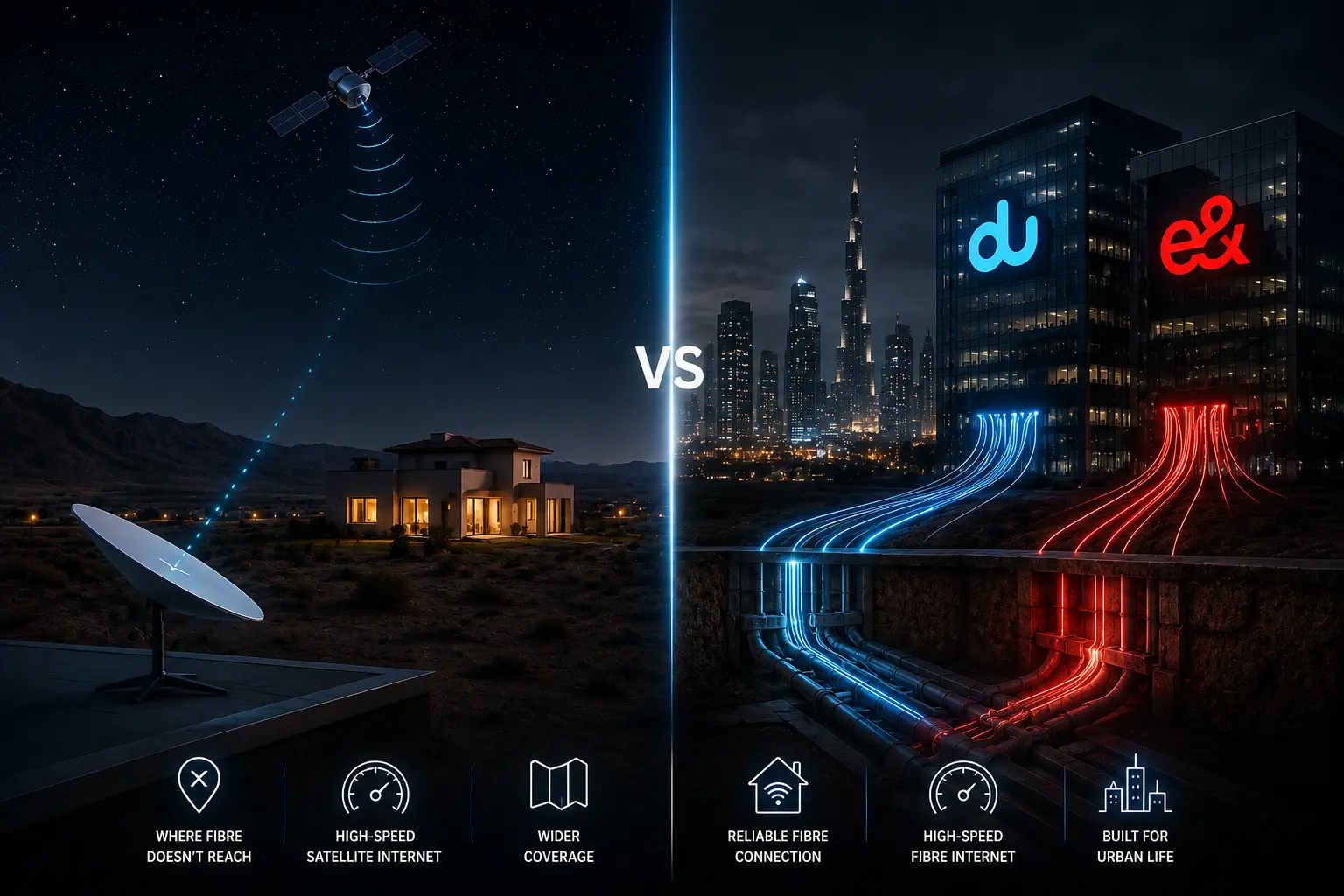
For the vast majority of UAE households, this licence doesn’t replace fibre — it adds an alternative for situations fibre doesn’t reach well.
Speed, latency and data caps compared
| Factor | Starlink Residential | du / e& Fibre |
|---|---|---|
| Typical Download Speed | Around 100–200 Mbps (Weather-dependent) | 250 Mbps to 1 Gbps+ (Consistent) |
| Latency | Roughly 25–50ms | Roughly 5–20ms |
| Data Caps | Unlimited (Priority drops after heavy use) | Unlimited (Standard on most plans) |
| Installation | Self-Install No fibre infrastructure needed | Technician Required Scheduled home visit |
| Contract | No Lock-in | 12-Month Contract |
| Entry Monthly Price | From Dh230 | Dh300–Dh430 (Entry tier pricing) |
Fibre pricing above is drawn from third-party comparison sites rather than du and e&’s own rate cards, so treat it as a general steer rather than a quote — worth a quick check against the operators’ own sites before publishing. [NEEDS VERIFICATION: confirm current du and e& entry-tier fibre pricing directly with the operators.]
Where fibre still wins
Fibre still beats satellite on latency and consistency, which matters most for anything time-sensitive: video calls, competitive online gaming and, increasingly, cloud gaming, where a stable low-latency connection is the difference between a smooth session and a frustrating one. Weather can also affect Starlink’s signal in a way fixed fibre never has to worry about.

Who Starlink Actually Makes Sense For in the UAE
Remote areas, desert camps and marine use
The clearest use case is anywhere terrestrial infrastructure genuinely struggles: desert camps, farms, remote work sites, and boats and yachts operating outside fibre and mobile coverage. This is also where the licence’s maritime and aviation provisions come in directly — Starlink has already been used by UAE-based marine operators under the earlier, narrower maritime licence, and the new licence widens that further.
Why most Dubai apartments will not need it
For an apartment in a well-wired Dubai or Abu Dhabi building, fibre already delivers faster, lower-latency, cheaper-at-scale service with none of the weather sensitivity. Starlink’s real value in a city like Dubai is as a backup connection — genuinely useful during a fibre outage or, as some analysts have pointed out following recent Red Sea undersea cable disruptions, as a redundancy layer for businesses that can’t afford downtime — rather than a primary replacement for most households.
What happens next is whether Starlink’s own capacity in Dubai and Abu Dhabi opens up for new residential orders, and whether TDRA or Starlink issue any further guidance on rollout timing.