

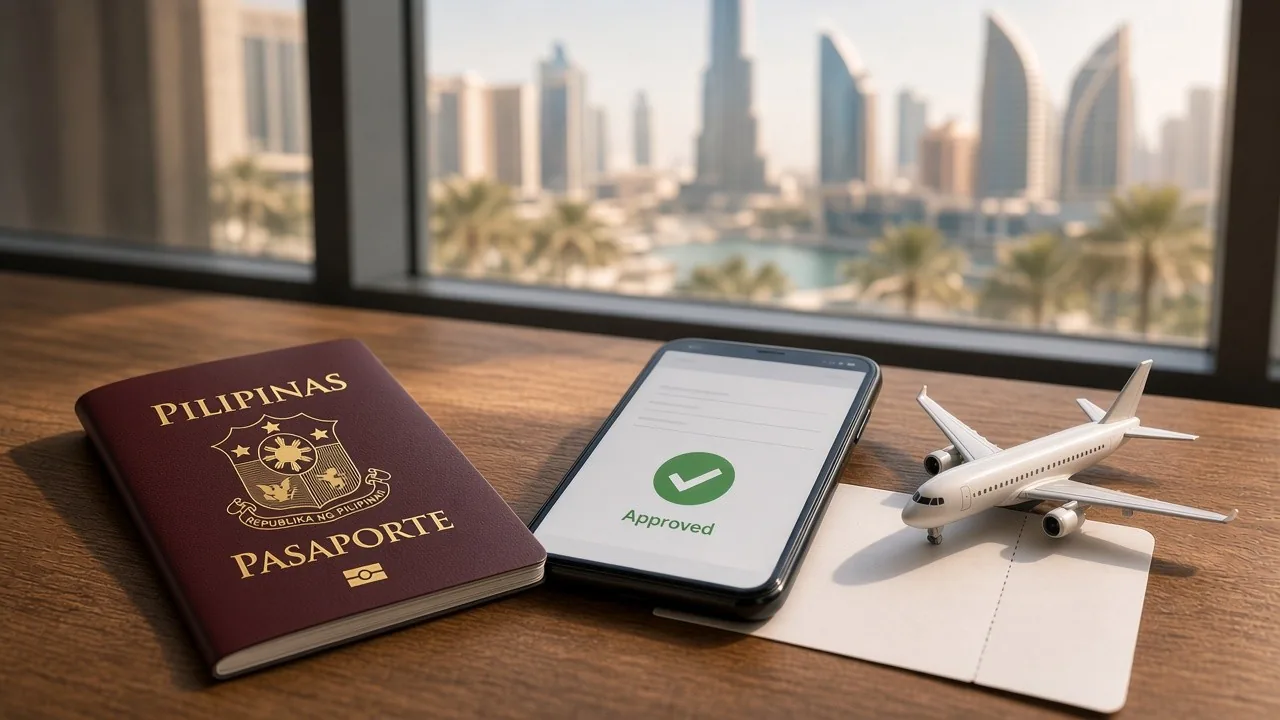
UAE residents who need a visa to visit the Philippines can now apply for a Philippines e-visa through the Philippine Consulate General in Dubai. Ambrosio Brian Enciso III, Consul General of the Republic of the Philippines in Dubai and the Northern Emirates, announced the service at a press briefing on Monday, 26 October, Khaleej Times reported. The Dubai consulate joins 94 other Philippine missions around the world that already process e-visas.
Key points
- A single entry e-visa costs AED 260 and takes 7 to 12 working days.
- Multiple entry e-visas cost AED 420 for six months or AED 580 for one year.
- No sticker goes in your passport. You show the approved e-visa on arrival, on your phone or on paper.
- The e-visa is for short visits. It cannot be used for work, extended or converted to another visa.
Who needs a Philippines e-visa?
Many travellers do not need one. Emiratis, Europeans, Canadians, US citizens and nationals of Southeast Asian countries already have visa-free or visa-on-arrival access. The e-visa is aimed at nationals of at least 37 countries who must get a visa before they travel, including Bangladesh, India, Iran, Iraq, Egypt, Lebanon, Palestine, Pakistan, Sri Lanka, Sudan, Syria, Ukraine and Yemen.
“This is part of the strategy to boost tourism in the Philippines,” Enciso said. He added: “UAE residents are used to convenience when they’re traveling and now it will be easier for them to go to the Philippines.”
How much does the Philippines e-visa cost?
Fees and processing times depend on the type of visa:
| Visa type | Fee | Processing time |
|---|---|---|
| Single entry | AED 260 | 7 to 12 working days |
| Multiple entry, six months | AED 420 | 15 to 40 working days |
| Multiple entry, one year | AED 580 | 15 to 40 working days |
Depending on your nationality, you can stay for 7 to 59 days. The e-visa covers short visits for tourism, business, medical treatment, training, conferences, meetings, workshops and seminars. It is not valid for employment. It cannot be extended, and it cannot be converted to another visa, such as a work or student visa.
How do you apply?
Applications go through the official portal, evisa.gov.ph. You create an account, fill in the form, upload your documents and pay by bank transfer, according to The Filipino Times. The documents include a valid passport, proof that you can cover your costs, your UAE residence documents and a travel itinerary. The consulate may ask for more documents or call you for an interview.
The e-visa does not replace the traditional sticker visa, which is still available if you need a visa that can be extended. Holding a visa does not guarantee entry, because immigration officers at the airport make the final decision.
The Philippine Embassy in Abu Dhabi has issued e-visas since April 2025, according to the Philippine Department of Foreign Affairs, so residents now have two Philippine posts in the UAE that offer the service.
Planning more trips from the UAE?
If your passport and residence visa already let you travel without a visa, see our list of visa-free destinations for UAE residents. The e-visa application asks for proof of UAE residence, and our guide to Dubai visa types explains the main residence options.
Main image: Illustrative image.
For more travel news and guides, see our Travel section.