
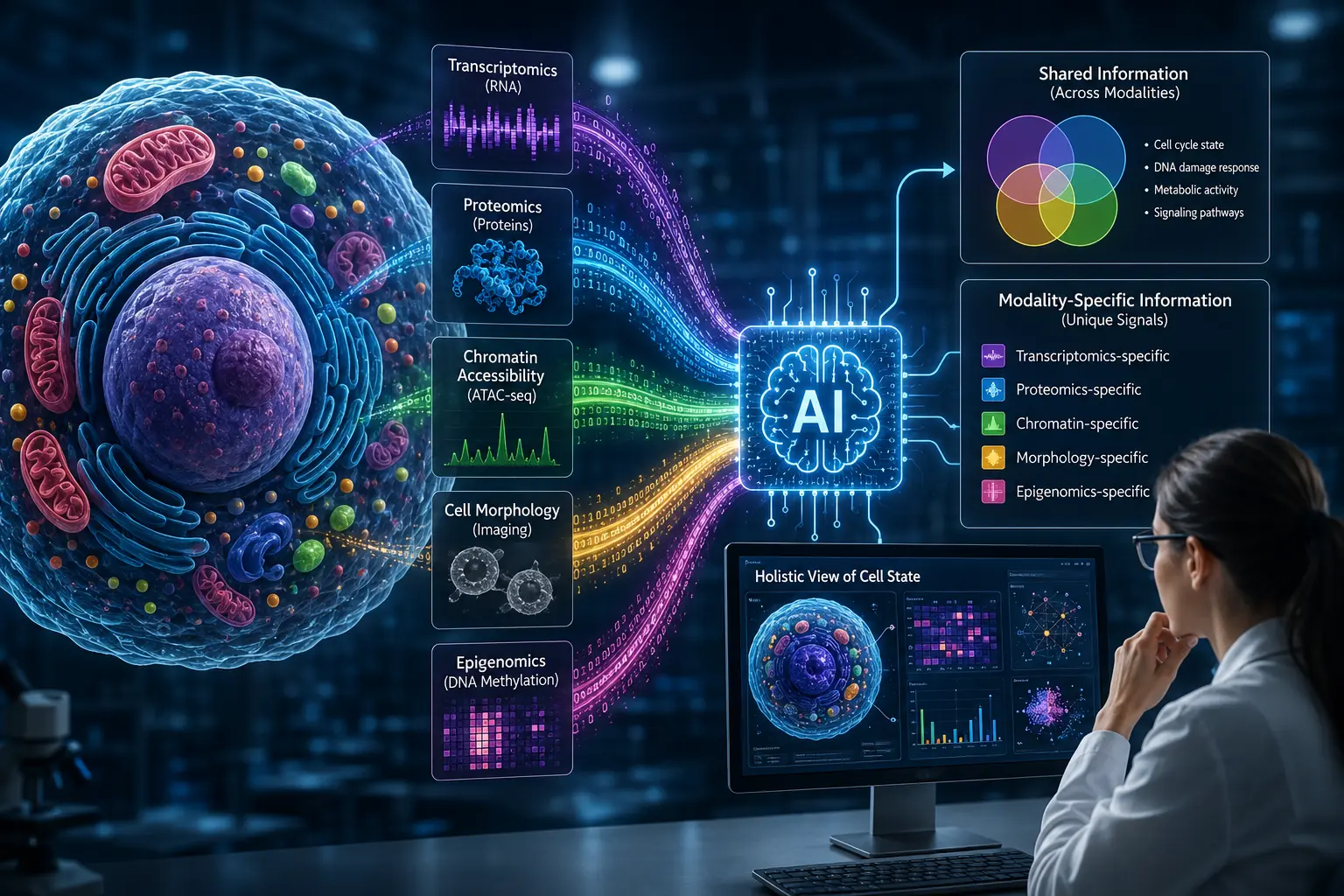
Artificial intelligence could help scientists understand cells in a more complete way, offering a clearer picture of how diseases develop and how treatments may work.
Researchers from the Broad Institute of MIT and Harvard and ETH Zurich/Paul Scherrer Institute have developed an AI-driven framework that can combine different types of cellular measurements while showing which information is shared across those measurements and which information is unique to one specific method. The work could help scientists study cancer, Alzheimer’s disease, diabetes and other complex conditions more effectively.
Why Cell Biology Needs a Bigger Picture
Studying a patient’s cells can reveal important clues about disease. In cancer, for example, measuring gene expression can help researchers understand where the cancer came from and how it may respond to treatment. But a cell is not simple. It contains many layers of biological information. One technique may measure gene activity, another may measure proteins, while another may focus on cell shape or chromatin structure. Each method gives scientists a different view of the same cell.
The challenge is that these measurements are often analysed separately. That makes it harder for scientists to understand how different parts of the cell are connected.
Machine learning can speed up the process, but many existing methods combine all the data together in a way that makes it difficult to know where specific information came from.
How the New AI Framework Works
The new method is designed to solve this problem by separating cellular information into two categories. First, it identifies information that is shared across different measurement methods. Second, it detects information that is unique to one specific type of measurement.
This gives researchers a more organised and complete view of the cell’s state. For example, scientists may use one method to study RNA and another to examine chromatin structure. Some biological signals may appear in both measurements, while others may only appear in one. The AI framework helps identify that difference automatically.
The researchers describe the approach as similar to a Venn diagram for cell data, where overlapping information and unique information can be separated and understood more clearly.
Why This Matters for Disease Research
Understanding where cellular information comes from can be highly valuable in clinical research. If scientists know which measurement method captures a specific disease marker, they can choose the right experiment instead of testing many approaches one by one. This could save time, reduce costs and help researchers design better studies.
In one example, the method was used to identify which type of measurement captured a protein marker linked to DNA damage in cancer patients. This kind of insight can help clinical scientists decide which technique is most useful for tracking a disease-related signal.
The approach could also support research into neurodegenerative diseases such as Alzheimer’s and metabolic diseases such as diabetes, where cellular changes can be complex and difficult to interpret.
A Smarter Way to Plan Experiments
One of the biggest advantages of the new AI framework is that it can help researchers decide which measurements are most important. Scientists cannot measure every possible feature inside every cell. Some methods are expensive, time-consuming or technically difficult. A tool that shows which information is unique and which can be predicted from other measurements could help researchers plan experiments more efficiently.
Instead of collecting every possible dataset, scientists may be able to focus on the most informative measurements and use AI to fill in parts of the broader picture.
Final Thoughts
The new AI-driven method represents an important step toward more holistic cell biology. Rather than simply merging different datasets, it helps researchers understand how different cellular measurements relate to each other. That distinction matters. In biology, knowing what is happening inside a cell is important, but knowing where that information comes from can be just as valuable.
As AI becomes more integrated into biomedical research, tools like this could help scientists uncover disease mechanisms faster, design smarter experiments and better understand how cells respond to treatment.