
Where to Watch Arabic Series Online: Shahid vs Netflix vs OSN+ Compared
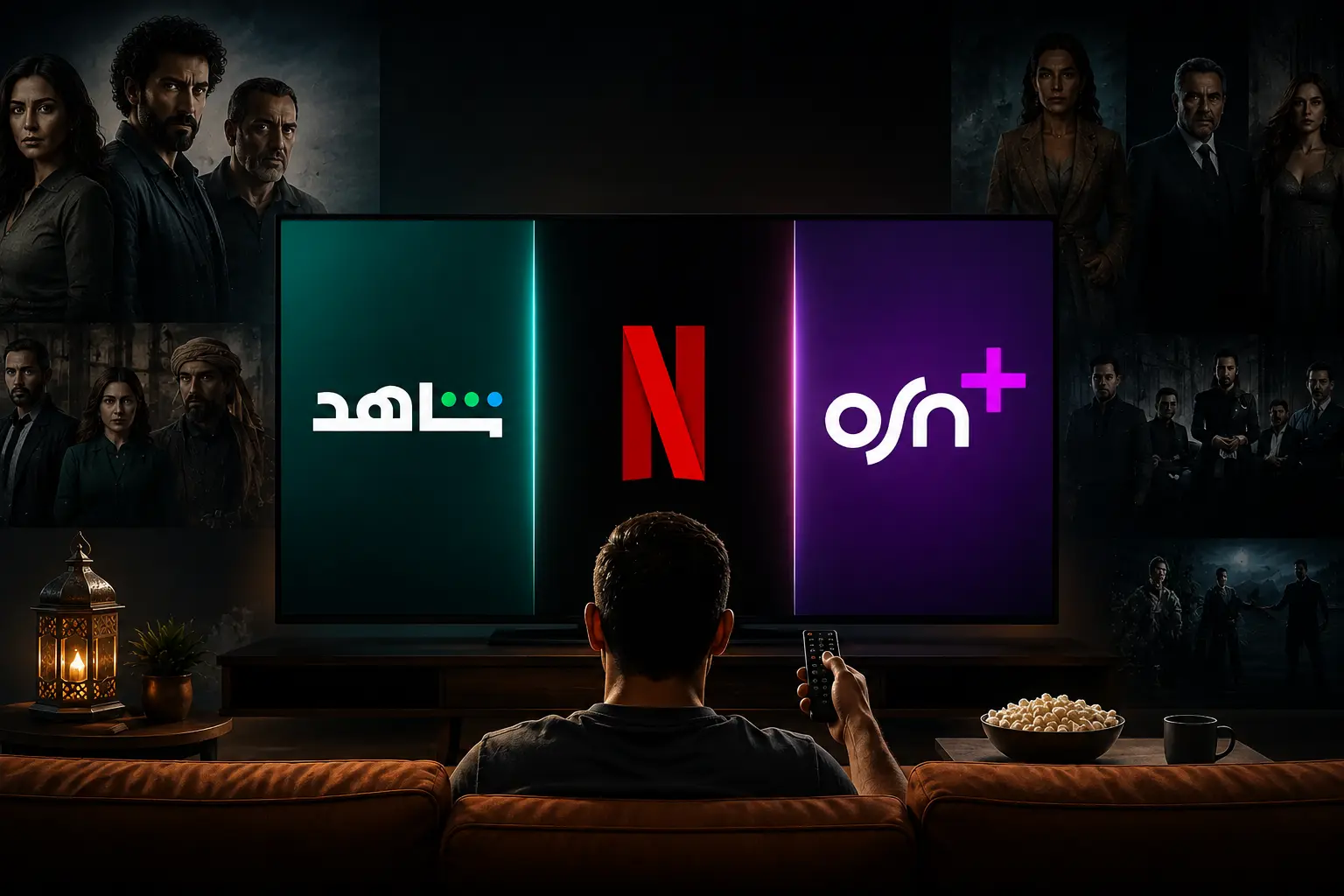
Type “where to watch Arabic series” into Google and you’ll get the same three names back every time: Shahid, Netflix, OSN+. All three are legal, all three are available in the UAE, and all three will happily take your dirhams. What none of the marketing pages will tell you is that they’re not actually competing for the same viewer. Shahid was built as an Arabic platform from day one. Netflix has spent real money trying to catch up. OSN+ isn’t even trying — it’s playing an entirely different game with HBO and Disney+ instead.
That distinction gets lost in most “best streaming service” roundups, which tend to rank all three on the same scorecard as if they’re interchangeable. They’re not. Picking the wrong one means paying AED 40–70 a month for a catalogue that doesn’t actually have what you’re looking for.
Which Platform Has the Deepest Arabic Library
Shahid: the platform Arabic TV was built for
Shahid isn’t close on this front, and it’s not really a fair fight. It’s MBC Group’s flagship streaming service, launched specifically to host Arabic content, and it’s widely regarded as carrying the largest catalogue of Arab film and television anywhere online. That includes decades of Gulf, Egyptian, Levantine and Saudi productions, MBC’s live channel line-up, and a growing run of Shahid Originals — dramas that premiere on the platform first rather than arriving there after airing elsewhere.
The shows that built Shahid’s reputation are the ones that turned into regional appointment viewing — the kind of Ramadan drama or family saga that entire households would organise their evenings around. If your search for “where to watch Arabic series” is really a search for that specific kind of programming, Shahid isn’t one option among three. It’s the option, and everything else is a supplement. We’ve gone deeper on individual titles in our best Arabic series to watch guide if you want a starting watchlist rather than a platform comparison.
Netflix: closing the gap, but not there yet
Netflix’s Arabic push is real, not token. Paranormal became Netflix’s first Arabic Original out of Egypt, adapting Ahmed Khaled Tawfik’s horror novels, and found an audience well beyond the region it was made for. Al Rawabi School for Girls, a Jordanian production about teenage bullying and social hierarchy, did the same thing — global attention for a distinctly local story. For 2026, Netflix’s own MENA announcement lists a fresh slate that includes a Saudi comedy anthology (AlKhallat+), a crime thriller (Chasing Shadows), and a psychological horror series (Obsess), alongside returning regional titles.
That’s a genuine content strategy, not a box being ticked. But it’s still a curated slice sitting inside a much larger, mostly Western catalogue — a handful of standout Arabic titles per year, not the decades-deep, always-updated archive Shahid runs. If you want some excellent Arabic drama alongside your global viewing, Netflix delivers. If you want it as your primary reason to subscribe, it will eventually leave you wanting more.
OSN+: not even trying to compete here
OSN+ deserves a mention in this comparison only because people keep searching for it alongside the other two — not because it’s chasing the same audience. Its entire content strategy rests on two exclusive licensing deals rather than regional production: it’s the sole MENA home for HBO and Max programming, and the regional distributor for Disney+’s full library, including Marvel and Star Wars titles. OSN has publicly confirmed its 2026 slate includes A Knight of the Seven Kingdoms, new seasons of The Pitt and Industry, the long-delayed third season of Euphoria, and the next chapter of House of the Dragon — none of which has anything to do with Arabic-language content.
OSN+ carries some regional programming, but nobody is subscribing to it for that. It answers a completely different question than the one this article started with.
Shahid vs Netflix vs OSN+: UAE Pricing and Content Compared
|
|---|
If price is your main deciding factor, see our Streaming Prices in UAE: What Every Service Costs in AED for a wider, service-by-service comparison.
What Shahid actually costs
Shahid’s base VIP tier runs AED 44.99 a month through UAE telecom billing, unlocking ad-free Arabic Originals, movie premieres timed to cinema release, and two simultaneous streams. Add sport and it climbs to AED 69.99 a month. There’s also a free, ad-supported tier with a thinner catalogue — a reasonable way to sample the platform before committing to VIP, though it won’t get you the newest releases.
If you have decided that Shahid is the right service for you, see our Best Shahid VIP Series: Top Arabic Shows and Subscription Guide.
What Netflix actually costs in the UAE
Netflix runs three dirham-billed tiers here, from AED 35 for Basic up to AED 71 for Premium 4K, with Standard sitting around AED 49 in between — the difference mostly coming down to resolution and how many screens can stream at once. There’s no standard free trial in the UAE any more, which matters if your plan was to sample the Arabic slate for free first; we’ve covered the legal ways around that cost in our guide to watching Netflix for free in the UAE.
What OSN+ actually costs
OSN+’s Standard HD plan is AED 48.99 a month, with Premium 4K at AED 64.99, both billed through UAE telecom partners inclusive of VAT. That sits squarely between Shahid and Netflix’s mid-tier — but remember, you’re not paying for Arabic content depth here. You’re paying for HBO and Disney+ access that neither of the other two platforms can offer.
Bundles Change the Maths
Almost nobody in the UAE actually subscribes to just one of these in isolation, and pricing them as standalone products misses how most households actually pay for them. du and e& both run entertainment bundles that fold Shahid or OSN+ into home internet and mobile plans, sometimes at a discount, sometimes as a free 12-month add-on on qualifying postpaid or home-wireless plans. Before paying full retail for any of the three, it’s worth checking your existing telecom account — the offer may already be sitting there unused.
Shahid itself also sells an Epic Bundle that combines ad-free Shahid with Disney+ and OSN+ access under one GCC-only subscription. For a household that genuinely wants both deep Arabic content and HBO-calibre Western drama, that bundle can work out cheaper than paying for Shahid and OSN+ separately.
Which One Should You Actually Pick?
For a wider comparison that includes Disney+, Prime Video, Apple TV+, STARZPLAY and TOD, see our Best Streaming Services in UAE 2026: Full Comparison.
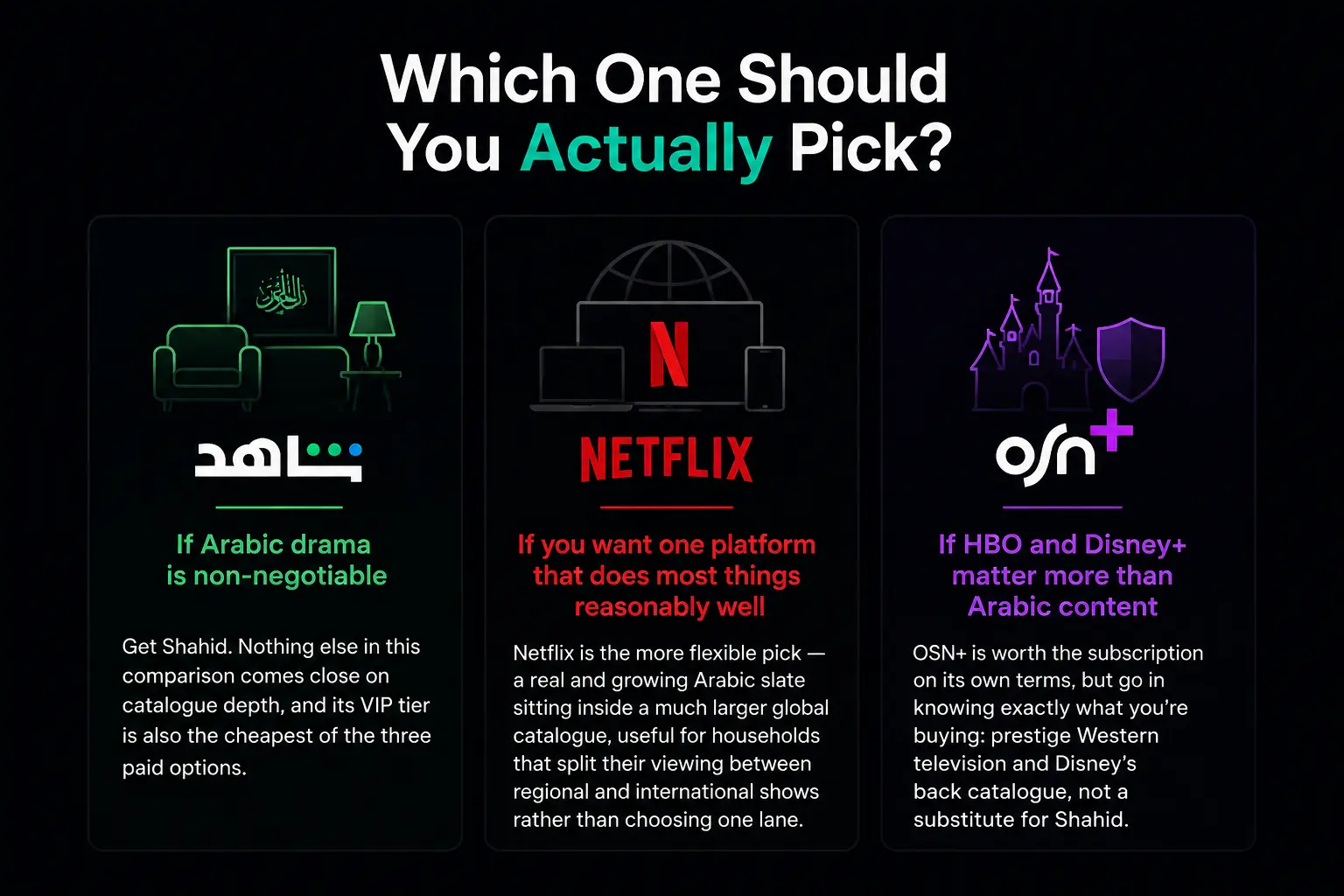
If Arabic drama is non-negotiable
Get Shahid. Nothing else in this comparison comes close on catalogue depth, and its VIP tier is also the cheapest of the three paid options.
If you want one platform that does most things reasonably well
Netflix is the more flexible pick — a real and growing Arabic slate sitting inside a much larger global catalogue, useful for households that split their viewing between regional and international shows rather than choosing one lane.
If HBO and Disney+ matter more than Arabic content
OSN+ is worth the subscription on its own terms, but go in knowing exactly what you’re buying: prestige Western television and Disney’s back catalogue, not a substitute for Shahid.
What’s Still Unsettled
Netflix’s move to acquire Warner Bros., HBO and HBO Max is still working through regulatory review, and it raises a genuine question mark over OSN+’s biggest asset — its exclusive regional rights to HBO content. OSN has publicly stated that its existing licensing deal and 2026 content pipeline haven’t changed and that no disruption is expected in the near term. Whether that holds once the acquisition actually closes is not yet settled, and anyone building a long-term subscription plan around OSN+’s HBO catalogue specifically should keep an eye on how the deal plays out over the coming year.