

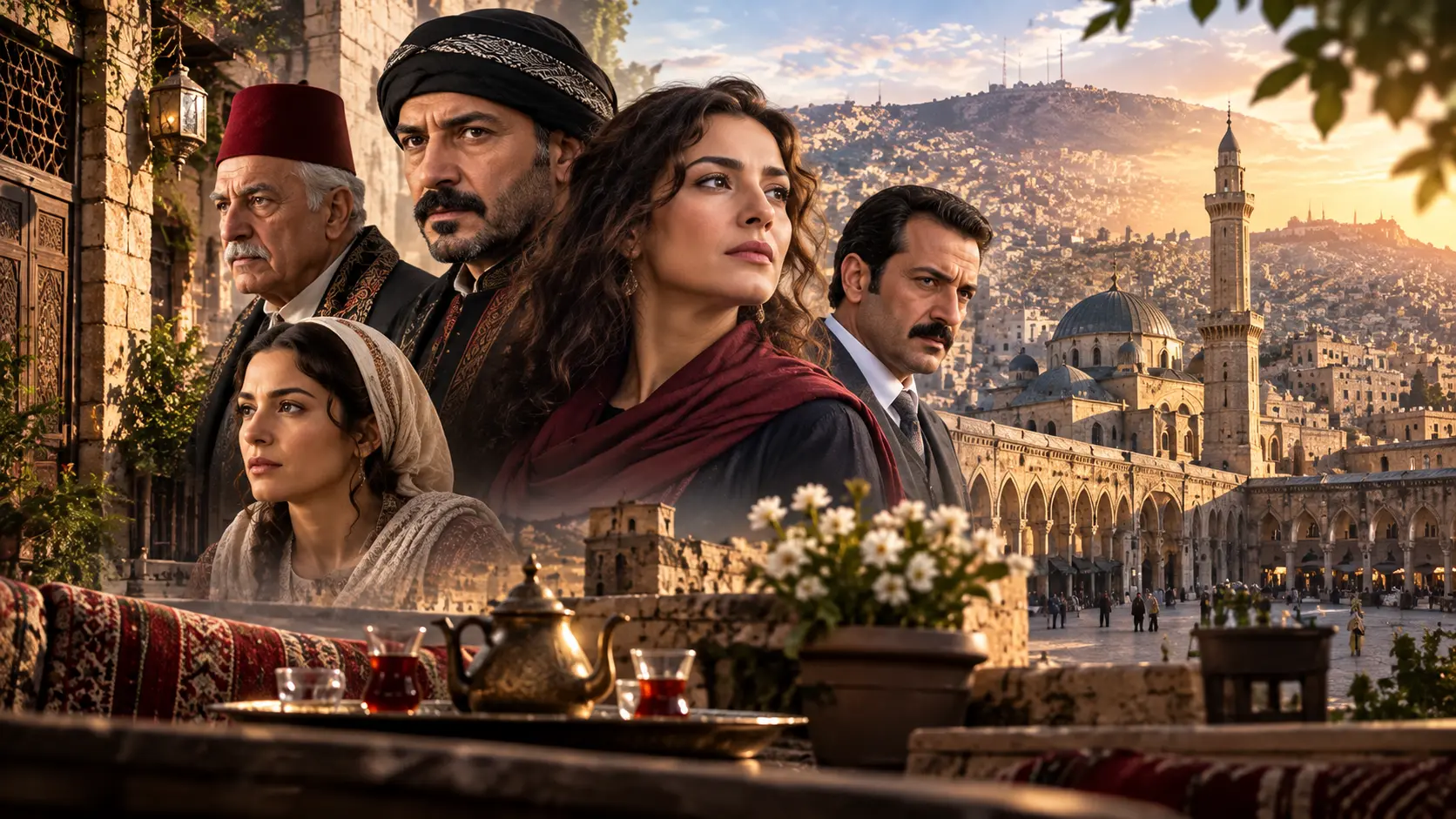
Syrian drama after Assad is still finding its shape, but its first full season already looks different. Ramadan 2026 was the first season written and produced entirely after Bashar al-Assad’s fall in December 2024, and Qantara counted 25 new Syrian dramas in it. Some went straight into the prisons and secrets of the Assad years, while others, led by Taim Hassan’s thriller Mawlana, set out to entertain. This guide covers what changed, which series stood out or caused controversy, where they aired, and the classics the new wave grew out of. For a ranked list of 15 Syrian series with ratings, see our Syrian TV series guide.
Syria has long been one of the Arab world’s main television producers, and its dramas are watched across the Gulf, where many first aired on channels such as MBC, Abu Dhabi TV and Sharjah TV. We rank nothing here by IMDb score, because ratings for older Arabic series rest on small numbers of votes; where we quote one, we say so. For a ratings comparison, see our top 10 Arabic series on IMDb, and for a wider list, DubaiPress’s guide to Arabic series to watch in 2026.
Key takeaways
- Ramadan 2026 was the first Syrian drama season written and produced entirely after Assad’s fall, with about 25 new series, according to Qantara.
- Several revisited the Assad era: Al Khoruj ila Albir (Exit to the Well) on the 2008 Sednaya prison uprising, Al-Qaisar on detention and disappearance, and Eilat Al-Malek (The King’s Family) on the regime’s final months.
- Mawlana, starring Taim Hassan, was the season’s most talked-about series and aired on MBC and Shahid, according to Al Jazeera.
- Script review continued under the new authorities: the Associated Press describes a National Drama Committee as the government body that reviews scripts.
- The new wave builds on landmark series such as Bab Al-Hara (from 2006), Al-Taghriba Al-Filistinia (2004), Dayaa Daayaa (2008-2010) and Zaman Al’ar (2009).

Syrian drama after Assad: the Ramadan 2026 season
Qantara attributed the change to the absence of a censorship apparatus and found the season split between two directions: series that revisit Syrian trauma and series made to entertain. Al Jazeera described it as the first Ramadan season after the fall of the regime, with production companies going back over the years of the former government and their effect on Syrian society. For the wider Ramadan 2026 line-up from across the Arab world, see our guide to Ramadan 2026 series you can still stream.
Dramas about the Assad years
Al Khoruj ila Albir (Exit to the Well) is set around the 2008 uprising at Sednaya prison. It was written by Samer Radwan, who said he finished the script several months before Assad’s fall, and directed by Jordan’s Mohammed Lutfi, with Jamal Suleiman in the lead, according to AFP. AFP reported that scenes were filmed inside Sednaya itself and in a replica built in a disused soap factory north of Beirut. Qantara found viewers divided over the series.
Al-Qaisar: La Makan La Zaman (Caesar: No Place, No Time) is an anthology of ten three-part stories inspired by detention and disappearance in Assad-era prisons. The National reported that its first six episodes aired on the Kuwaiti platform Shasha and that director Safwan Naamo denied reports it had been cancelled. Qantara criticised its structure, and families of the disappeared asked for it to be taken off air.
Eilat Al-Malek (The King’s Family), directed by Mohamad Abdul Aziz, follows a Syrian family through the final months of Assad’s rule, according to AFP. AFP reported that it was filmed at the Mazzeh air base in Damascus, once a detention site run by air force intelligence, and in Assad’s former residence. Al Jazeera lists it on SBC.
Al-Souriyoun Al-Aada (The Syrian Enemies) adapts Fawaz Haddad’s novel, which was banned under Assad for its focus on dark chapters of Syrian history such as the 1982 Hama massacre, according to AP and Al Jazeera. Its director is Allaith Hajjo, who also made Dayaa Daayaa. In February, AP reported that production had been delayed and that the series would probably air after Ramadan.
Entertainment and Mawlana
Mawlana, a thriller with dark comedy about a fugitive taken for a saviour in a border village, was the season’s most talked-about series. Samer Al-Barqawi directed it, and it stars Taim Hassan, Nour Ali, Fares Al-Helou and Mona Wassef, with Lubna Haddad credited for the story, according to ElCinema. Qantara also names Bi khams Arwah, about a garbage collector who learns he is a millionaire’s illegitimate son. Rasha Sharbatji, who directed Zaman Al’ar, came back with Matbakh Al-Madina (The City’s Kitchen), a social drama set in a Damascus restaurant.
How much freedom?
Qantara linked the new season to the end of censorship, yet script review has not gone away. The Associated Press describes a National Drama Committee as the government body that reviews scripts, and AFP reported that the information ministry still reads them, although Maan Sakbani, who wrote The King’s Family, called its comments on his series very minor.
Landmark Syrian series behind the new wave
Two directors from the 2026 season, Rasha Sharbatji and Allaith Hajjo, also made series in the table below. It lists six titles in chronological order, from period drama to comedy to Mawlana, with years and facts from Wikipedia, TheTVDB, Qantara and ElCinema.
| Series | Why it stands out |
|---|---|
| Al-Khawali 2000 Ottoman-era period drama | Set in the late 1890s and early 1900s, mainly in the Shaghour neighbourhood; follows a man sentenced to death who escapes and joins a resistance-like group. |
| Al-Taghriba Al-Filistinia 2004 Historical drama | Written by Walid Saif and directed by Hatem Ali; follows a poor Palestinian family from 1933 to 1968 across 31 episodes. |
| Bab Al-Hara 2006 onward Damascus period drama | Set in a Damascus neighbourhood in the French-mandate era; 13 seasons and 434 episodes. |
| Dayaa Daayaa 2008-2010 Village comedy | Two seasons and 57 episodes on Abu Dhabi TV, following two friends and their village. |
| Zaman Al’ar 2009 Social drama | Written by Hassan Sami Yusuf, directed by Rasha Sharbatji; stars Sulafa Memar and Bassam Kousa, on honour and shame in Syrian society. |
| Mawlana 2026 Thriller with dark comedy | Directed by Samer Al-Barqawi and starring Taim Hassan; 30 episodes, aired during Ramadan 2026. |
Al-Taghriba Al-Filistinia is often cited as a high point of Syrian television. Wikipedia notes that critics credit it with portraying pre-1948 Palestinian life without idealising it, that Khaled Taja won Best Actor in a Second Role at the 2005 Cairo Festival for Radio and Television, and that Shahid removed it in 2020 over copyright before restoring it after public protest. A historian, Mustafa Kabha, noted some historical errors.
Dayaa Daayaa remains the most familiar Syrian comedy. IMDb shows it at 9.4 out of 10 from only about 1,200 votes when we checked, which points to a devoted fan base more than a broad verdict. The 2012 epic Omar, directed by Syria’s Hatem Ali, is often mentioned alongside these classic Syrian dramas; IMDb lists it as a Gulf and Moroccan co-production, so we have not counted it as a Syrian series here. Zaman Al’ar centres on a woman who enters a secret customary marriage, and the story explores the social cost for women, according to Wikipedia.
Shami period drama and Bab Al-Hara
Shami (Damascene) historical drama means serials set in old Damascus neighbourhoods, often during Ottoman or French-mandate rule, and broadcast mainly in Ramadan. Bab Al-Hara is the genre’s defining example: it was written by Marwan Qawooq and Kamal Mara, directed by Bassam Al-Mulla and Muhammad Zuhair Rajab, and its second-season finale reportedly drew more than 50 million viewers, according to Wikipedia. The National lists Ahl Al Raya (2008), Al Daboor (2010) and Al Zaeem (2011) with it. For anyone new to the style, Bab Al-Hara is the place to start.
The genre has critics. Wikipedia reports that some critics and actors said Bab Al-Hara exaggerated the power of neighbourhood leaders and the oppression of women, and misrepresented parts of the era. A proposal to film it in Dubai drew protests from Syrians who felt it would lose the show’s authenticity. Its first five seasons were filmed at Al Shamiya, a purpose-built television village; The National reported in January 2025 that after Assad’s fall, people returned to find it reduced to debris, and called it a microcosm of what Syria and its culture endured.
Where to watch Syrian series
Shahid, MBC’s streaming service, has Bab Al-Hara pages for several seasons and a page for Al-Taghriba Al-Filistinia that offers the first episode in HD. Neither page says whether a subscription is needed or in which countries the series is available; our Shahid VIP guide covers the subscription itself.
Among the 2026 series, Al Jazeera lists Mawlana and Matbakh Al-Madina on MBC and Shahid, Exit to the Well on Syria TV’s Al-Thania channel and The King’s Family on SBC, while The National reported that Al-Qaisar’s first episodes streamed on Shasha. ElCinema also lists Mawlana on MBC 1 and MBC Iraq. Al Jazeera places Saadet Al-Majnoon on Al-Thania, and The National lists it on Tod alongside Ana W Hiya W Haya. Shams Al Aseel and Al Yateem aired on Sharjah TV, and Bayt El Ahlam, set in Damascus, on Viu, according to The National. We found no official streaming page for Dayaa Daayaa or Zaman Al’ar.
Explore more film and TV guides in our Movies section.