
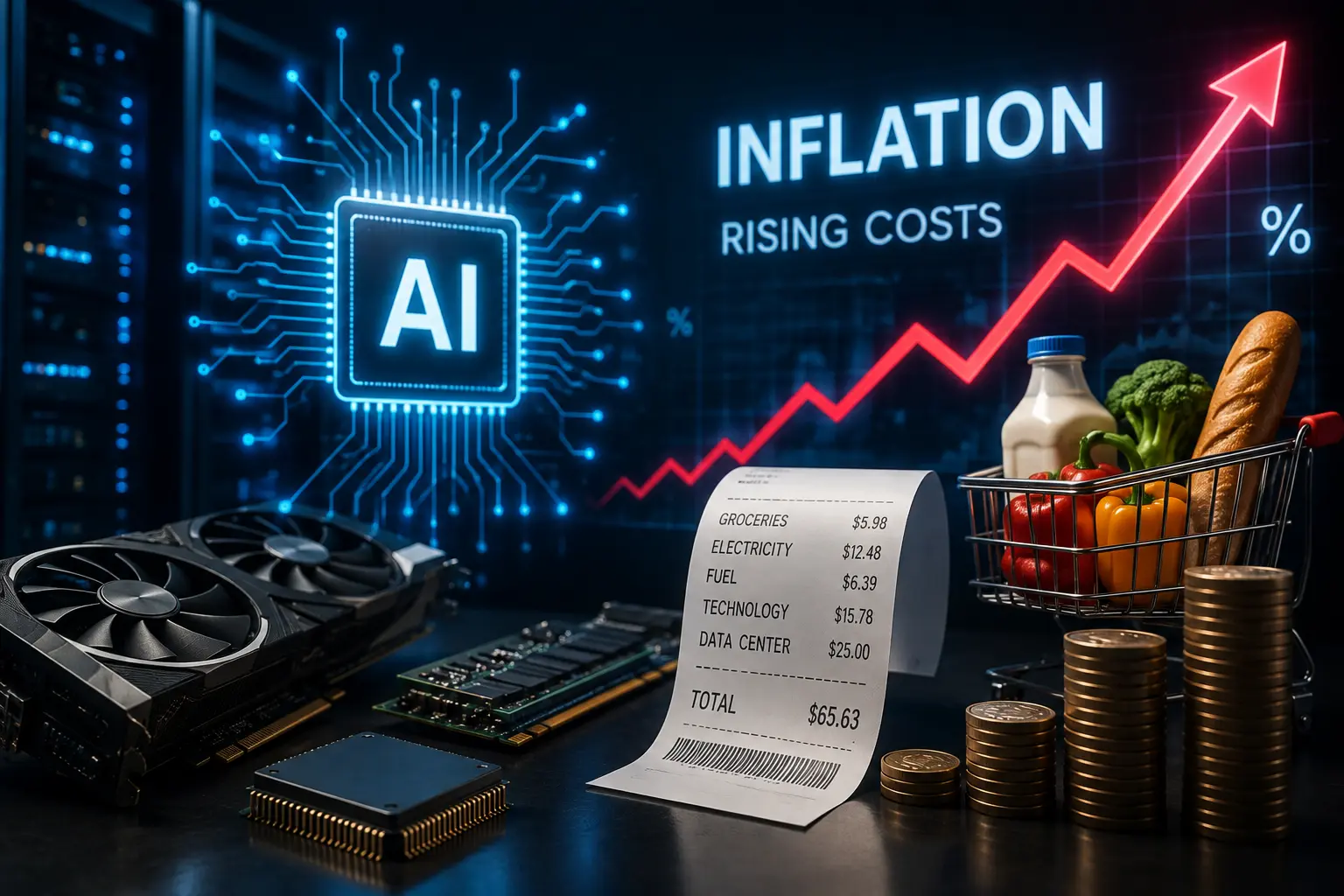
AI inflation is becoming a growing concern as artificial intelligence investment pushes up costs across the economy. Artificial intelligence was expected to become one of the biggest forces reducing costs and increasing productivity around the world. However, the rapid expansion of AI
The massive investment required to build AI infrastructure is putting pressure on several parts of the economy, including electricity markets, semiconductor production, construction materials and technology products.
According to CNN, the AI boom has pushed companies to invest hundreds of billions of dollars in new infrastructure, with AI-related spending estimated at around $750 billion in 2026. While AI could eventually improve productivity and lower costs, economists say the short-term impact is creating new inflationary pressure.
The result is a surprising situation: a technology designed to make businesses more efficient is currently making some parts of everyday life more expensive.
How AI Inflation Is Pushing Prices Higher?
The main reason behind AI-related inflation is the enormous infrastructure required to operate advanced AI systems. Unlike traditional software, modern AI models require thousands of powerful computers, specialized chips and massive data centers that consume huge amounts of electricity.
Companies such as Microsoft, Amazon, Google and Meta have invested heavily in expanding AI capabilities, creating unprecedented demand for computing power and related resources.
This demand is affecting prices in several important areas:
- Electricity
- Computer chips
- Memory products
- Data center construction
- Software subscriptions
- Technology equipment
Economists say these pressures may continue as companies race to build the infrastructure needed for the next generation of AI services.
Electricity Costs Rise Due to AI Data Centers
One of the clearest examples of AI-driven inflation is the growing demand for electricity. AI data centers require enormous amounts of energy to operate advanced computer systems. As more companies build these facilities, electricity demand is rising faster than supply in some areas.
According to economists cited by CNN, data centers can compete with households and businesses for available electricity capacity, pushing wholesale energy prices higher.
The pressure is especially noticeable in regions where large technology companies are rapidly expanding their AI infrastructure.
The combination of:
- AI data centers
- Aging electricity infrastructure
- Increasing electrification
- Limited energy supply
has created concerns that electricity costs could remain elevated.
AI Is Changing the Price of Computers and Electronics
For decades, technology products were one of the few categories that consistently became cheaper over time.
Consumers usually received more powerful computers and devices at similar or lower prices because technological progress improved efficiency.
However, the AI boom has changed that trend.
The demand for advanced chips and high-performance memory has increased dramatically, especially for data centers that support AI models.
Manufacturers are prioritizing production of expensive AI-focused components, reducing available supply for some consumer products.
As a result, prices for certain computers and electronics are facing upward pressure instead of the traditional decline seen in previous years.
Software Prices Also Feel the AI Effect
AI is also changing the cost of software. Many companies are adding AI assistants and automation features to their existing products, but those upgrades often come with higher subscription prices.
For example, Microsoft increased prices for some Office 365 plans after adding its AI-powered Copilot features.
The logic behind these increases is that AI tools provide additional capabilities, but for consumers and businesses, the result is higher monthly costs.
This creates a new debate: will AI eventually reduce expenses through efficiency, or will companies continue passing AI development costs to customers?
Construction Costs Increase as Data Centers Expand
The AI boom is not only affecting technology companies. Building new data centers requires massive construction projects involving:
- Steel
- Copper
- Electrical equipment
- Cooling systems
- Skilled workers
The rapid expansion of AI infrastructure has increased demand for these resources. Construction companies are facing higher costs, while technology firms compete for specialized workers who can design and operate advanced facilities.
This creates another channel through which AI investment can influence broader inflation.
The Federal Reserve Is Watching AI Closely
The Federal Reserve has traditionally viewed technology as a force that reduces inflation by improving productivity. However, policymakers are now paying closer attention to the possibility that AI could create short-term inflation risks.
The concern is that massive AI investment may increase demand faster than supply can respond. Federal Reserve officials have noted that strong demand for AI infrastructure could maintain upward pressure on technology prices and electricity costs. If inflation remains higher for longer, the Fed could face a more difficult decision about interest rates.
Is AI Really Bad for the Economy?
Despite the current inflation concerns, economists emphasize that AI is not necessarily negative for the economy. The long-term benefits could be significant.
AI has the potential to:
- Increase worker productivity
- Reduce business costs
- Improve healthcare and research
- Automate repetitive tasks
- Create new industries
The challenge is timing. The costs of building AI infrastructure are appearing immediately, while the productivity benefits may take years to fully develop.
This creates a temporary imbalance where society pays the cost before receiving the full economic benefits.
AI Inflation Impact at a Glance
| Area | Impact of AI Boom |
|---|---|
| Electricity | Higher demand from data centers |
| Computer chips | Increased demand and supply pressure |
| Electronics | Rising production costs |
| Software | More expensive AI-powered subscriptions |
| Construction | Higher demand for materials and workers |
| Inflation | Estimated small but noticeable increase |
The Bigger Economic Question
The debate around AI inflation represents a larger question about technological revolutions. Historically, major innovations often create disruption before producing widespread benefits. The internet, automation and personal computers all required huge investments before transforming the economy. AI may follow a similar path.
In the short term, businesses and consumers may face higher costs as companies compete for computing power and energy. In the long term, however, AI could reduce costs by making companies more efficient and increasing productivity.
Conclusion: AI Creates Short-Term Pressure, Long-Term Potential
The AI revolution is creating an unusual economic situation. A technology expected to make the world cheaper and more efficient is currently contributing to higher costs in areas such as electricity, chips and technology products.
The inflation impact remains relatively limited compared with larger economic forces, but policymakers are monitoring the trend closely.
The biggest question is whether AI’s future productivity gains will eventually outweigh the inflationary pressure created by its rapid expansion.
For now, artificial intelligence is proving that even technologies designed to save money can become expensive before they begin delivering their full promise.