
Maritime infrastructure is one of the most critical , and most overlooked , components of global security. From commercial shipping lanes to naval operations, maritime cyber physical systems quietly power global trade and national defense. Yet as digitalization accelerates, these systems are becoming increasingly vulnerable to cyber threats.
At the intersection of artificial intelligence, cybersecurity, and policy stands Strahinja (Strajo) Janjusevic a researcher in MIT’s Technology and Policy Program (TPP) , whose work focuses on strengthening maritime cybersecurity using AI driven solutions grounded in real world policy frameworks.
His journey from Montenegro to the U.S. Naval Academy and now to MIT reflects more than academic achievement. It represents a cross continental perspective on how emerging technologies can protect critical infrastructure while shaping responsible national security policy.
From Montenegro to MIT: A Global Perspective on Cybersecurity
Originally from Montenegro, a small Balkan nation with a strong strategic position in European geopolitics, Janjusevic’s academic path began through a highly selective program allowing allied countries to send students to the U.S. Naval Academy in Annapolis, Maryland.
There, he earned a dual bachelor’s degree in cyber operations and computer science. His undergraduate years exposed him to high level cybersecurity operations through collaboration with the U.S. military and the National Security Agency. This experience sharpened his understanding of operational cybersecurity and critical infrastructure defense.
He also gained industry exposure through internships at Microsoft , where he developed tools for cloud incident response , and NASA, where he worked on solar data visualization systems.
Yet despite these accomplishments, he recognized a knowledge gap: the growing intersection between artificial intelligence and cybersecurity. That realization led him to MIT’s Technology and Policy Program, hosted by the Institute for Data, Systems, and Society (IDSS).
Unlike purely technical programs, TPP combines rigorous engineering with policy analysis , a dual lens increasingly necessary in AI cybersecurity.
The Growing Threat to Maritime Cyber Physical Systems
Maritime systems today are complex cyber physical ecosystems. Large legacy vessels, in particular, rely on interconnected navigation systems, GPS inputs, onboard networks, and automated control mechanisms. A successful cyberattack against these systems could disrupt global trade routes, compromise national security, or even escalate geopolitical tensions.
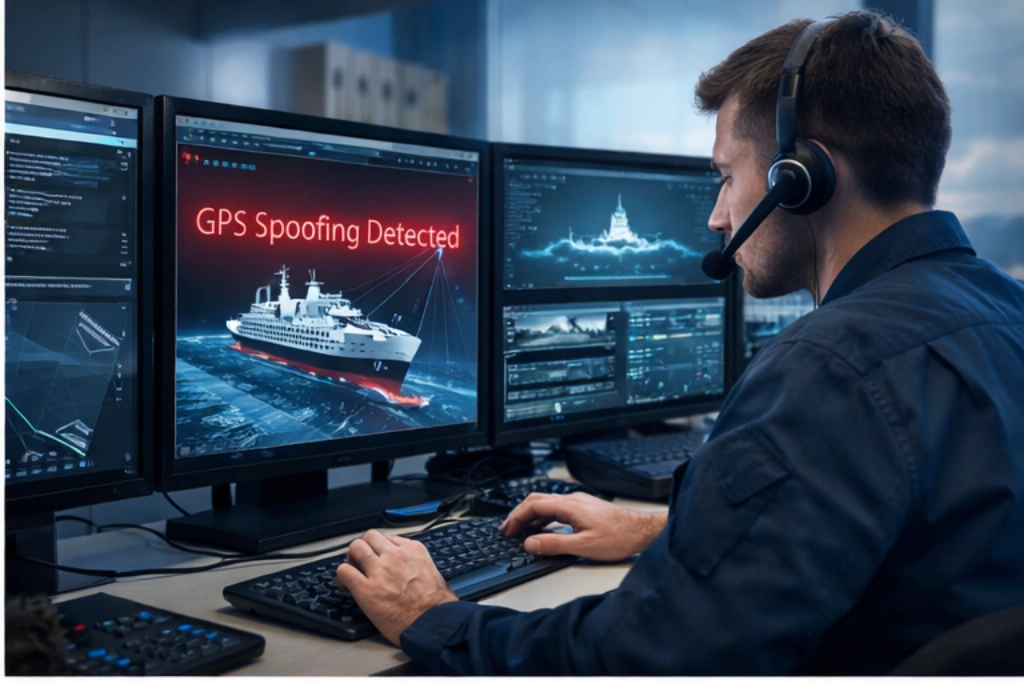
One of the most concerning threats is GPS spoofing , a technique where malicious actors manipulate navigation signals to mislead ships about their true location. Such attacks have already occurred in contested waters, luring vessels off course without triggering immediate detection.
Unlike traditional IT breaches, maritime cybersecurity incidents affect physical assets in real time. This makes cyber physical security fundamentally different , and significantly more dangerous.
Janjusevic’s research directly addresses this emerging risk.
Using AI to Detect GPS Spoofing in Maritime Infrastructure
At the core of his thesis is a hybrid AI framework designed to detect malicious GPS spoofing attacks in maritime navigation systems.
The model combines:
- Deep learning techniques (specifically LSTM autoencoders)
- Physics based vessel trajectory modeling
- Environmental dynamics forecasting (wind, sea state, physical constraints)
Here’s how it works:
The internal LSTM autoencoder analyzes signal integrity patterns to identify anomalies in reported GPS data. Simultaneously, a physics-based forecaster predicts where the vessel should realistically be, based on environmental forces and trajectory constraints.
By comparing these two outputs , reported position versus physics-consistent prediction , the system can distinguish between:
- Natural sensor noise
- Technical malfunctions
- Intentional spoofing attacks
This layered approach is crucial. A purely machine learning model may overfit to known attack patterns. A purely physics-based model may struggle with complex real world variability. Together, they create a resilient maritime cybersecurity solution.
Importantly, the system is designed to support , not replace , human operators. It provides verified navigation data that allows watch standers to differentiate between benign glitches and strategic cyberattacks.
That human in the loop philosophy reflects a broader principle in AI security: augmentation over automation.
Bridging AI Innovation and Cybersecurity Policy
One of the most distinctive elements of Janjusevic’s work is its policy dimension.
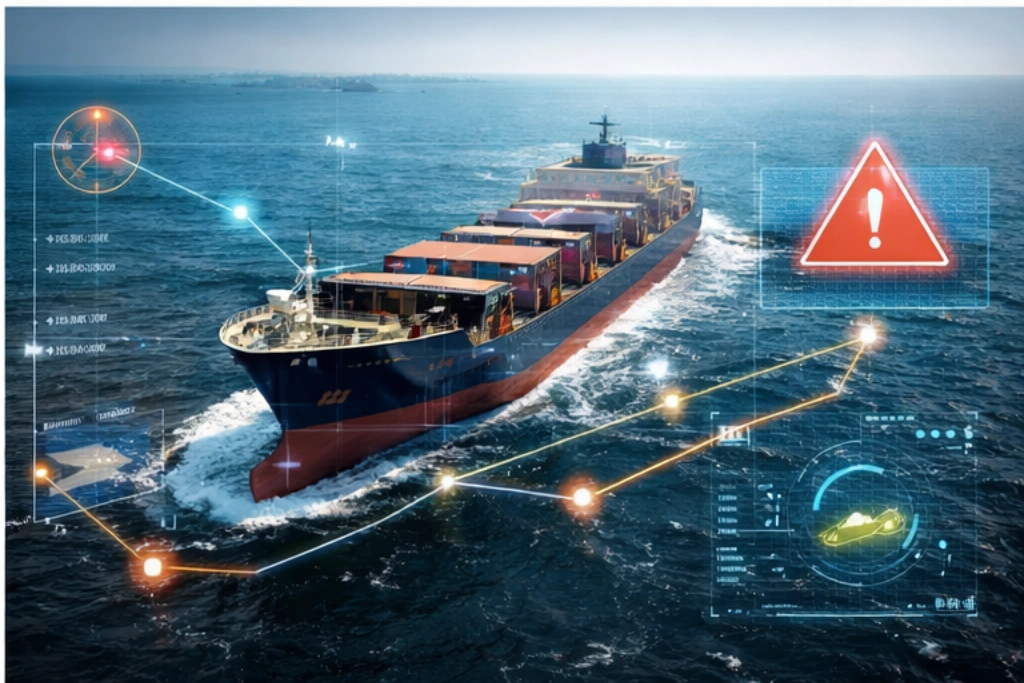
In AI cybersecurity, technological capability often outpaces regulatory adaptation. Emerging tools can create both defensive and offensive advantages , sometimes simultaneously.
Through MIT’s Maritime Consortium , a collaboration among academia, industry, and regulatory agencies , Janjusevic contributes to discussions that extend beyond algorithms. The consortium works to develop:
- Industry standards for maritime cyber defense
- Policy frameworks for AI deployment
- Cross border collaboration in maritime security
The consortium includes international participation, including members from Singapore and South Korea, reinforcing the global nature of maritime cybersecurity challenges.
In this context, cybersecurity is not merely a technical problem , it is a geopolitical one.
Industry Experience: Understanding the Risks of Agentic AI
In addition to his academic research, Janjusevic interned with Vectra AI’s Network Detection team, where he explored the security implications of emerging AI agents and the Model Context Protocol (MCP) , an evolving standard for AI agent communication.
His research demonstrated how MCP and AI agents could be repurposed for autonomous hacking operations and advanced command and control structures.
The findings were presented in the preprint:
“Hiding in the AI Traffic: Abusing MCP for LLM Powered Agentic Red Teaming.”
This work highlights a critical paradox in AI cybersecurity:
The same systems built for intelligent automation can be weaponized for autonomous cyberattacks.
Understanding these risks from both industry and academic perspectives allowed him to refine anomaly detection models in his maritime research. It also reinforced a central truth: securing AI systems requires anticipating how adversaries might creatively misuse them.
The Importance of Policy in AI Cybersecurity
AI-powered cyber defense systems introduce several policy questions:
- Who is accountable for AI driven security decisions?
- How should maritime AI systems be certified?
- What standards should govern cross-border cyber incident reporting?
- How do we balance innovation with national security concerns?
Given the speed of AI development, regulatory frameworks often lag behind technical capability. In critical sectors like maritime infrastructure, that lag can translate into real world risk.
Janjusevic argues that policy is not an afterthought , it is an essential design constraint.
Embedding policy awareness into system design ensures that AI cybersecurity tools are not only technically robust but legally deployable and internationally aligned.
Leadership and International Collaboration
Beyond research, Janjusevic actively contributes to international security dialogue. He is helping organize two major conferences:
- The Harvard European Conference
- The Technology and National Security Conference (a Harvard MIT collaboration)
Both events convene policymakers, diplomats, industry leaders, and academic researchers to address pressing national security and AI challenges.
His long term goal is clear: to serve as a bridge between the United States and Montenegro , and more broadly between Europe and the U.S. in the fields of AI, cybersecurity, and national security strategy.
That cross border vision aligns with the inherently global nature of maritime security. Shipping routes, naval operations, and supply chains do not recognize political boundaries. Neither do cyber threats.
The Future of Maritime Cybersecurity
As global shipping becomes increasingly digitized, maritime cybersecurity will only grow in importance. Legacy vessels are being retrofitted with modern digital systems, creating hybrid infrastructures that combine old hardware with new software , often without fully integrated security architecture.
AI offers powerful tools to detect anomalies, forecast threats, and strengthen resilience. However, AI alone is not enough.
Effective maritime cyber defense requires:
- Hybrid technical models (machine learning + physics based validation)
- Human centered system design
- International policy coordination
- Cross sector collaboration
Janjusevic’s research represents a forward looking model of what cybersecurity leadership should look like: technically sophisticated, policy aware, and globally engaged.
In an era where AI can both defend and destabilize, securing maritime cyber-physical systems demands more than code. It requires strategy.
And increasingly, it requires professionals who understand that technology and policy are not separate domains , but interdependent forces shaping the future of national security.