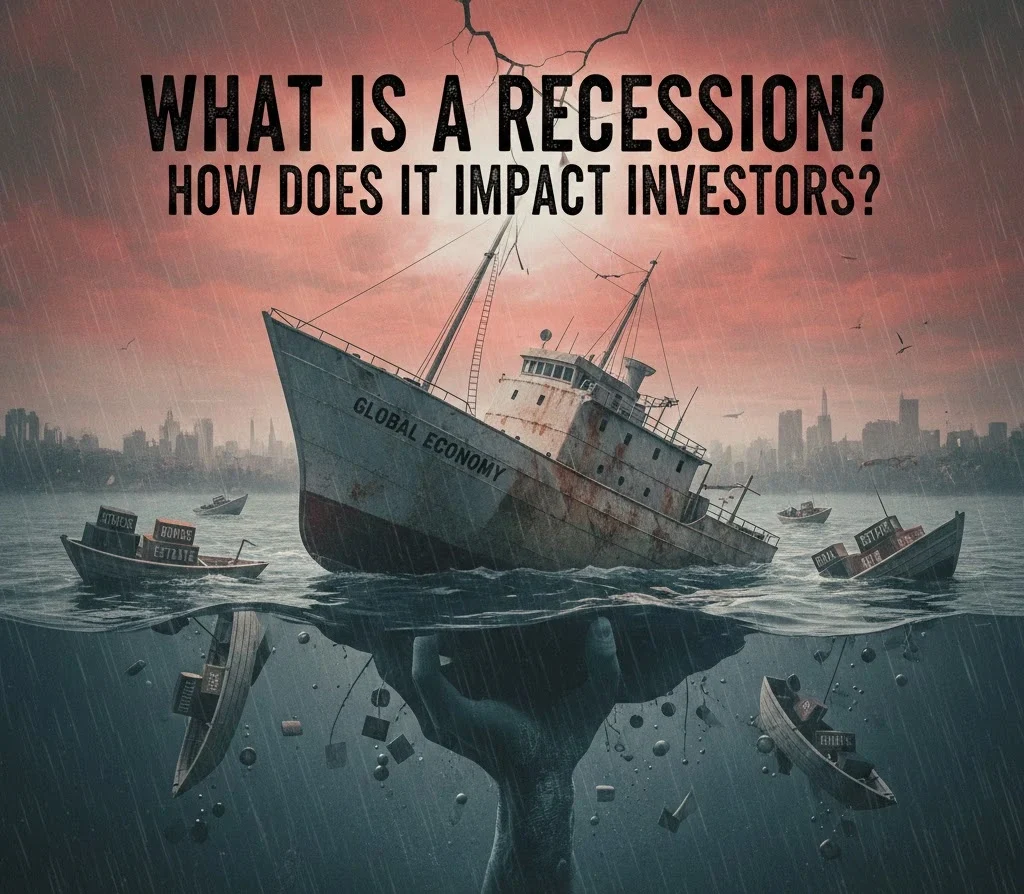
Understanding the meaning of the recession is essential for investors, business owners, policymakers, and individuals trying to make informed financial decisions. Economic growth naturally moves in cycles. Periods of expansion, rising employment, and strong corporate profits are often followed by phases of contraction. A recession represents one of those contractionary periods, a measurable slowdown in economic activity that can influence markets, asset prices, and investor behavior.
But what does recession mean in practical terms? Beyond textbook definitions, a recession affects earnings, credit conditions, risk appetite, and long-term investment outcomes. For investors, recognizing early signs and understanding the broader implications can make the difference between reacting emotionally and responding strategically.
Recession Meaning: A Clear and Practical Definition
The formal recession meaning refers to a significant decline in economic activity that lasts for an extended period, typically visible across multiple areas of the economy. While many people simplify the definition as two consecutive quarters of negative Gross Domestic Product (GDP) growth, that description is incomplete.
In the United States, the National Bureau of Economic Research(NBER) is responsible for officially declaring recessions. Rather than relying solely on GDP, the NBER examines a broad range of indicators, including:
- Employment and unemployment rates
- Industrial production
- Real personal income
- Wholesale and retail sales
- Business investment trends
Therefore, when asking what recession means, the answer involves widespread economic contraction across industries rather than just a temporary dip in output.
In simple language, a recession is a period when economic activity slows down enough to reduce corporate profits, increase unemployment, weaken consumer confidence, and restrict overall growth.
Why Do Recessions Happen?
To fully grasp the meaning, it is important to understand the mechanisms that trigger economic slowdowns. Recessions rarely emerge randomly; they often follow economic imbalances or external shocks.
1. Tight Monetary Policy
Central banks such as the Federal Reserve adjust interest rates to manage inflation and economic stability. When inflation rises too quickly, interest rates are often increased to slow borrowing and spending. However, aggressive rate hikes can reduce business investment and consumer demand, increasing recession risk.
2. Asset Bubbles Bursting
When asset prices, such as housing or equities, become excessively inflated, they may eventually correct sharply. The collapse of such bubbles can destabilize financial systems and trigger economic contraction.
3. Credit Contraction
Recessions often follow periods of excessive lending. When banks tighten credit standards, borrowing declines, slowing business activity and consumer purchases.
4. External Shocks
Pandemics, geopolitical conflicts, and global supply chain disruptions can also accelerate economic downturns.
Understanding what a recession means requires recognizing that recessions are often the result of necessary economic corrections after unsustainable growth phases.
How Recessions Impact Investors
The impact of a recession varies depending on asset class, investment strategy, and time horizon. However, several consistent patterns appear during downturns.
1. Increased Market Volatility
During a recession, stock markets frequently experience sharp price swings. Major indices such as the S&P 500 historically decline during economic contractions due to falling corporate earnings and reduced investor confidence.
Volatility increases because markets attempt to price in future uncertainty. Investors often react to:
- Lower earnings forecasts
- Reduced growth expectations
- Policy uncertainty
- Rising unemployment
For investors, understanding the meaning means anticipating volatility rather than being surprised by it.
2. Declining Corporate Earnings
Recessions typically reduce consumer spending and business investment. As demand weakens:
- Revenue growth slows
- Profit margins compress
- Dividends may be cut
- Expansion plans are postponed
Stock valuations often fall in response to declining earnings expectations.
From an investor’s perspective, what does recession mean? It often translates into short-term earnings pressure across sectors.
3. Sector Rotation and Defensive Positioning
Not all sectors react equally during a recession. Defensive sectors such as:
- Healthcare
- Utilities
- Consumer staples
tend to perform more steadily because demand for essential goods remains relatively stable.
In contrast, cyclical sectors such as technology, luxury goods, and industrial manufacturing may experience larger declines.
Understanding the recession’s meaning helps investors reposition portfolios according to risk tolerance and economic outlook.
4. Bond Market Dynamics
Government bonds often attract capital during economic downturns. As investors seek stability, demand for bonds increases, which can lower yields.
If central banks cut interest rates to stimulate growth, bond prices may rise further. This dynamic creates opportunities for fixed-income investors.
5. Impact on Real Estate and Alternative Assets
Real estate markets may experience slower price growth or temporary declines during recessions, particularly in speculative segments. However, long-term fundamentals often remain intact.
Gold and other alternative assets sometimes gain popularity during recessionary periods due to their perceived safe-haven status.
Psychological Effects on Investors
The recession’s meaning extends beyond data; it significantly affects investor psychology.
Recessions often trigger:
- Fear-driven selling
- Increased cash hoarding
- Short-term thinking
- Overreaction to negative news
Behavioral finance research shows that many investors sell assets near market bottoms due to panic. Historically, markets recover before economic indicators fully improve. Those who exit prematurely may miss early-stage recoveries.
Understanding what a recession means from a cyclical perspective helps investors maintain discipline.
Historical Recession Case Studies
Examining past downturns provides clarity on the recession’s meaning in practice.
The 2008 Global Financial Crisis
Triggered by housing market instability and excessive leverage, global markets declined sharply. However, coordinated monetary policy responses eventually stabilized economies, and markets recovered over subsequent years.
The 2020 Pandemic Recession
The global shutdown caused a rapid economic contraction. Despite severe short-term declines, markets rebounded quickly due to stimulus measures and policy intervention.
These examples demonstrate that recessions, while painful, are generally temporary phases within broader economic cycles.
Long-Term Investment Perspective
Historically, financial markets trend upward over extended periods despite recurring recessions. Economic cycles typically follow this pattern:
- Expansion
- Peak
- Contraction (Recession)
- Recovery
Investors who understand the meaning of the recession often focus on:
- Diversification
- Long-term horizon
- Asset rebalancing
- Consistent investing
Rather than attempting to time downturns precisely, many experienced investors use recessions as opportunities to accumulate high-quality assets at discounted prices.
Opportunities During a Recession
Although recessions generate uncertainty, they can also create strategic openings:
- Lower stock valuations
- Reduced competition for investments
- Attractive dividend yields
- Potential for innovation acceleration
When asking what a recession means from an opportunity standpoint, it often represents a phase of market reset and long-term positioning.
Risk Management During Economic Contraction
Prudent investors manage recession exposure by:
- Maintaining liquidity
- Diversifying across asset classes
- Avoiding excessive leverage
- Rebalancing periodically
The recession’s meaning does not imply abandoning investment strategies; it suggests adapting them to changing economic conditions.
Frequently Asked Questions
What does recession mean in simple terms?
A recession refers to a sustained period of economic decline characterized by falling output, rising unemployment, and reduced business activity.
How long does a recession typically last?
Recessions can last from several months to a few years, depending on severity and policy responses.
Do stock markets always fall during recessions?
Markets often decline before or during recessions, but recoveries may begin before economic data fully improves.
Is a recession the same as a depression?
No. A depression is significantly more severe and prolonged than a typical recession.
Should investors change strategy during a recession?
Adjustments may be appropriate depending on risk tolerance, but long-term investors often remain disciplined and diversified.
Conclusion
The recession represents a natural phase of economic contraction within broader business cycles. Understanding what the recession means equips investors with clarity rather than fear. While recessions can create volatility, declining earnings, and market uncertainty, they are not permanent economic collapses.
For disciplined investors, recessions often serve as periods of recalibration times to reassess risk, rebalance portfolios, and position for recovery. By recognizing the cyclical nature of economic systems, investors can navigate downturns strategically rather than react emotionally.