
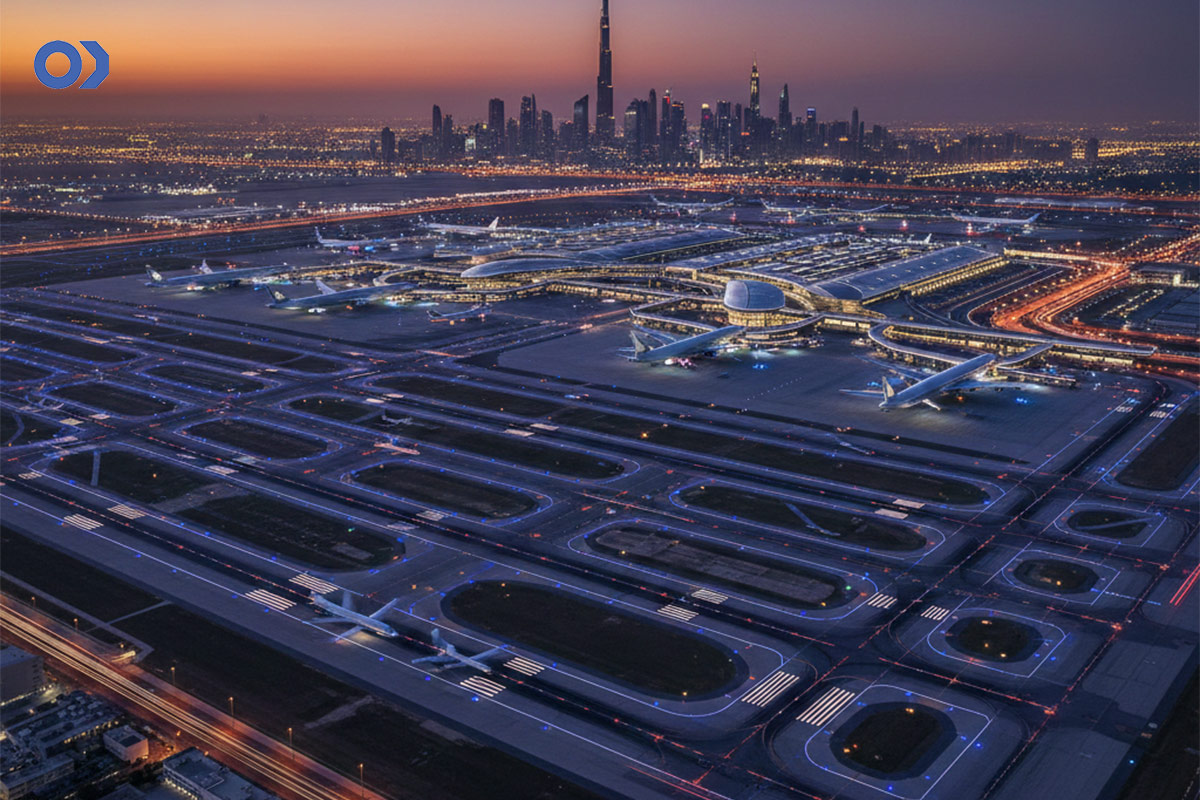
We already talked about Dubai as a global transit hub but the aviation industry is one of the most powerful pillars of the United Arab Emirates’ economic model. Over the past four decades, Dubai has deliberately positioned itself as a global aviation super-hub connecting East and West. Today, the UAE is home to some of the world’s most influential airlines and one of the busiest international airports on Earth with a new mega-airport under development that is set to redefine global aviation capacity.
The Strategic Importance of Aviation in Dubai’s Economy
The UAE Aviation Industry is not simply a transport sector it functions as a central economic engine. Economic impact studies estimate that aviation contributes approximately 27% of Dubai’s GDP when including tourism, trade, and supply chain effects. This level of dependency is among the highest globally and reflects a long-term strategic decision: Dubai chose connectivity over natural resource reliance. The city’s growth model is built around mobility, transit flows, and international integration.
Emirates Airline: The Flagship Powerhouse
The UAE Aviation Industry represents the core of Dubai’s aviation ecosystem. It is the largest airline in the Middle East, one of the largest long-haul carriers globally, and reported record profitability in the 2024–2025 financial year. Operating more than 150 destinations across six continents, Emirates anchors Dubai International Airport’s traffic structure.
At DXB, Emirates alone handles roughly 50–60% of total passenger traffic. This dominance is rare in global aviation and demonstrates the deep integration between the airline and the city’s economic framework. Dubai’s aviation strategy is built around a flagship carrier model, similar to historical hub systems like Singapore Airlines in Singapore or Turkish Airlines in Istanbul — but on a larger scale.

Flydubai: The Regional Connector
Flydubai was established not to compete with Emirates but to complement it. The airline operates under a low-cost / hybrid model and serves more than 130 destinations across Europe, Asia, and Africa. It generates significant feeder traffic into Emirates’ long-haul network, strengthening hub connectivity.
At DXB, Flydubai accounts for roughly 13% of passenger traffic but represents a larger share of aircraft movements due to its shorter routes. Together, Emirates and Flydubai operate a coordinated dual-carrier hub system that maximizes efficiency and global reach.
Other Airlines Operating in the UAE
Beyond Dubai-based carriers, the UAE aviation landscape includes major national and international players. Etihad Airways in Abu Dhabi continues to expand rapidly with fleet growth and new route development. Air Arabia, based in Sharjah, operates as a major low-cost carrier in the region, while Wizz Air Abu Dhabi adds further competitive dynamics.
Dubai International Airport itself hosts more than 100 airlines flying to over 270 destinations worldwide, reinforcing its status as one of the most globally connected airports.
Dubai International Airport (DXB): The Current Global Leader
Dubai International Airport has remained the world’s busiest airport for international passengers for years. In 2025, it handled more than 95 million passengers — a record level. However, DXB is approaching its physical capacity limits. This constraint has triggered the next strategic phase in Dubai’s aviation evolution.
The Future: Al Maktoum International Airport (DWC)
Dubai is constructing what is expected to become the largest airport in the world. The Al Maktoum International Airport project involves an investment of approximately AED 128 billion (around $35 billion) and is designed to handle up to 260 million passengers annually. The plan includes five parallel runways and approximately 400 aircraft gates.
The airport is intended to eventually replace DXB as Dubai’s primary aviation hub. This is not incremental expansion it represents a structural shift in capacity and ambition.

Strategic Vision Behind the New Airport
The development of DWC reflects a forward-looking economic philosophy rather than a reactive infrastructure upgrade. Dubai is preparing for long-term population growth, sustained tourism expansion, and continued dominance in global aviation connectivity. The new mega-airport will integrate passenger traffic, cargo logistics, and industrial activity within the Dubai South economic zone, creating a unified aviation-logistics ecosystem.
Officials anticipate that the transition from DXB to DWC will accelerate around 2032 as capacity constraints intensify.
Division Between the Two Airports
In the current phase, DXB remains the primary passenger hub, while DWC handles cargo, charter operations, and gradual expansion. During the 2030s, Emirates and Flydubai are expected to shift operations to DWC, with DXB eventually closing or transforming. Ultimately, DWC will function as Dubai’s single mega-hub airport.
Global Records the New Airport Is Expected to Break
When completed, Al Maktoum International Airport is projected to become:
• The largest airport in the world by passenger capacity
• The largest aviation infrastructure project globally
• The biggest integrated aviation-logistics hub
• The largest cargo airport worldwide
This scale has no direct precedent in aviation history.
Economic Impact and Business Opportunities
The aviation sector already supports hundreds of thousands of jobs and generates billions in economic activity. Future expansion is expected to stimulate tourism growth, trade and logistics demand, real estate development — particularly in Dubai South — and broader service-sector expansion.
For entrepreneurs and investors, aviation growth creates opportunities across hospitality, e-commerce logistics, real estate, marketing and digital services, and trade finance. Aviation expansion in Dubai has historically produced multiplier effects across nearly every major industry.
10-Year Outlook (2025–2035)
Looking ahead, several trends are likely to shape the next decade. Global passenger growth is expected to continue, the Middle East’s aviation dominance is projected to expand, and technology integration including AI, automation, and biometrics will accelerate operational efficiency. Larger aircraft fleets and transit tourism growth will further reinforce Dubai’s hub model.
Dubai is expected to remain among the top three global aviation hubs alongside London, Singapore, and Istanbul.
Strategic Conclusion
Dubai’s aviation success is the result of deliberate state strategy, sustained infrastructure investment, and deep airline-city integration. The development of the new mega-airport is not merely about capacity it represents Dubai’s ambition to dominate global aviation connectivity for the next half-century.
For businesses, investors, and professionals, understanding the aviation sector is essential because airport expansion directly translates into broader economic opportunity across tourism, trade, logistics, technology, and real estate.