
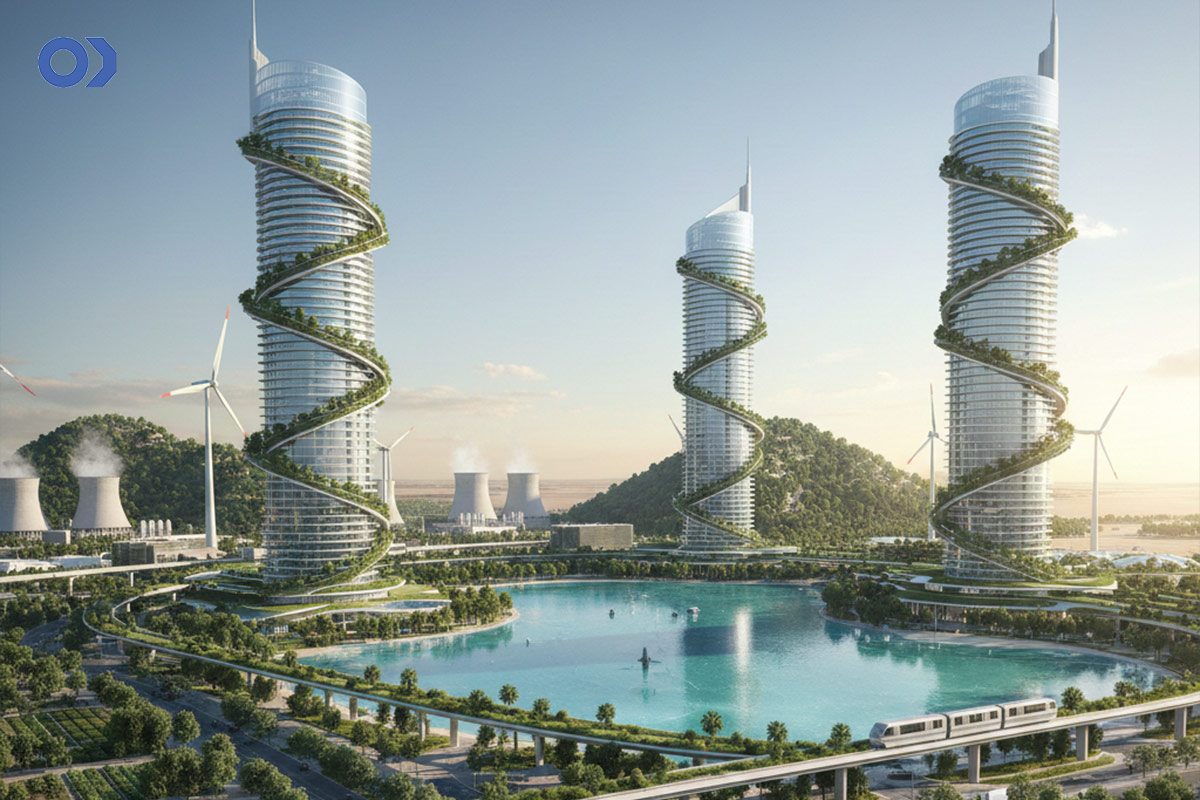
Sustainable development means a city grows without exhausting its resources or damaging long-term health, equity, and resilience. A practical global reference is SDG 11: cities should be inclusive, safe, resilient, and sustainable covering housing, transport, planning, air quality, and waste. Dubai’s sustainability story is best judged by measurable systems (energy, water, buildings, mobility, waste) and human outcomes (health, affordability, fairness). What follows is a structured, benchmark-style assessment grounded in systems performance rather than slogans.
1) Dubai’s Sustainability Roadmap: Official Targets and Direction
Dubai’s sustainability framework is defined through long-term strategies tied to energy transition, urban planning, and infrastructure investment. The credibility of any sustainability claim depends on formal targets, institutional alignment, and measurable outputs.
Clean Energy and Net-Zero Direction
Dubai’s Clean Energy Strategy 2050 set a headline target to supply 75% of Dubai’s energy from clean sources by 2050, supported by interim milestones. Later communications linked to the Net Zero Carbon Emissions Strategy 2050 increasingly frame the objective as 100% of energy production capacity from clean sources by 2050. This shift suggests movement from a “share-of-supply” target toward a broader system-transformation narrative. The remaining question is transparent accounting and delivery mechanisms.
The Flagship Asset: Mohammed bin Rashid Al Maktoum Solar Park
The clearest infrastructure signal of sustainability progress is the solar park. DEWA reports:
- 3,860 MW installed capacity achieved
- Planned expansion beyond 8,000 MW by 2030
- Clean energy exceeding 21.5% of total DEWA capacity
- Target of 36% by 2030
- Emissions reductions exceeding 8.5 million tonnes annually
This project represents Dubai’s strongest measurable evidence of energy transition progress.
2) Environmental Performance: Where Dubai Is Strong and Where It’s Constrained
Environmental sustainability is multidimensional. It includes supply-side energy, demand-side efficiency, land use, construction regulation, and air quality management.

A) Energy efficiency (often overlooked, hugely important)
Dubai’s Demand Side Management (DSM) strategy targets 30% reduction in energy and water consumption by 2030.
In hot-climate cities, demand reduction (efficient cooling, retrofits, smart grids) can be as important as building renewables.
B) Cooling: a major lever in Gulf sustainability
Dubai regulates district cooling and the regulator notes district cooling delivers more than 20% of the city’s cooling needs a big efficiency lever if managed well.
C) Urban form & green space: Dubai 2040 Urban Master Plan
The Dubai 2040 Urban Master Plan frames “sustainable urban development” and includes clear land-use intentions like doubling green and leisure areas/public parks, and setting nature reserves and rural natural areas at 60% of the emirate’s total area.
This is a meaningful sustainability signal because land use drives transport emissions, heat stress, and quality of life.
D) Buildings: rules matter more than slogans
Dubai’s green building regulations are positioned as mandatory for new buildings and are tied into Dubai’s DSM program.
In practice, the real test is enforcement + retrofits (existing building stock usually dominates emissions).
E) Air quality: the stress test many cities try to ignore
Dubai’s air quality can be impacted by dust and emissions. IQAir cites an average PM2.5 concentration of 33.5 µg/m³ in 2024, above WHO guideline levels.
Sustainable development requires not only energy transition, but also better urban mobility, construction dust control, and industrial emissions management.
3) Social Sustainability: The Hardest Dimension to Measure
Infrastructure can be measured. Social sustainability is more complex. Dubai’s planning documents, including Dubai 2040, emphasize wellbeing and quality of life. However, sustainable development also includes:
- Labor conditions
- Fairness
- Safety
- Access to remedies
Human Rights Watch’s 2026 UAE chapter alleges ongoing risks for migrant workers (wage disputes, recruitment fees, passport retention, heat protection limits), while acknowledging reforms. Official UAE channels describe labor protections and regulatory frameworks. The decisive factor is enforcement and accessible dispute resolution.
Bottom line: Dubai’s sustainability performance is strongest in infrastructure and planning; social sustainability remains the area of greatest external scrutiny.

4) Comparison: How Dubai Stacks Up Globally
Rather than ranking cities, comparing sustainability models reveals structural differences.
Middle East Benchmarks
- Abu Dhabi: Estidama framework built on four pillars (environmental, economic, cultural, social) with the Pearl Rating System across development lifecycles.
- Riyadh: Green Riyadh program targeting 7.5 million trees and expanded per-capita green space to address heat and livability.
- Doha (Qatar): Qatar National Vision 2030 structured around four pillars including environmental sustainability.
Europe Benchmarks
- Copenhagen: Known for aggressive decarbonization planning and carbon-neutral ambition frameworks such as CPH 2025.
- Amsterdam: Prominent circular economy narrative with a 2050 circularity ambition.
US & Canada Benchmarks
- New York City: Local Law 97 caps emissions from large buildings and enforces compliance—an example of regulation-driven decarbonization.
- Vancouver: Targets a 50% carbon reduction by 2030 and carbon neutrality by 2050, explicitly linking climate action to equity.
Dubai’s model emphasizes infrastructure buildout and strategic positioning rather than regulation-first enforcement.
5) So… Is Dubai Doing Sustainable Development?
The evaluation must separate progress from perfection.
Where Dubai Is Advancing
- Clean-energy buildout via large-scale solar infrastructure
- Formal demand-side efficiency targets
- Strategic urban planning with green-space expansion
- Institutional alignment across utilities and planning bodies
Where Structural Gaps Remain
- Air quality pressure
- High per-capita emissions context (World Bank: UAE at 18.3 tCO2e per capita in 2024 excluding LULUCF)
- Social sustainability concerns raised in independent reports
Verdict
Dubai is neither pure greenwashing nor fully sustainable. It is best described as pursuing fast sustainability-by-infrastructure. The next phase will require stronger measurable outcomes in:
- Mobility mode shift
- Circular economy implementation
- Air quality management
- Social protection enforcement
Quick FAQ
- Is Dubai aiming for net zero?
Dubai’s strategies reference a net-zero-by-2050 direction connected to energy, water, transport, buildings, and waste roadmaps.
- What is Dubai’s clean energy target?
75% clean energy by 2050 (Clean Energy Strategy 2050); later messaging emphasizes 100% clean energy production capacity by 2050.
- What is Dubai’s strongest sustainability proof-point?
The scale and expansion trajectory of the Mohammed bin Rashid Al Maktoum Solar Park.
- What is Dubai’s biggest sustainability challenge?
Cooling demand, transport emissions, air quality, and social sustainability scrutiny.