

At first glance, the United Arab Emirates appears to operate as a single economic success story a rapidly growing country attracting global capital, entrepreneurs, and high-net-worth individuals. Yet beneath this unified national framework lies a more sophisticated reality.
When examining the Abu Dhabi vs Dubai economy, it becomes clear that Abu Dhabi and Dubai represent two distinct economic philosophies operating in parallel within the same state. Understanding this distinction is essential for investors, businesses, and policymakers seeking to engage with the region effectively.
Economic Foundations of the Abu Dhabi vs Dubai Economy
The divergence in the Abu Dhabi vs Dubai economy begins with economic foundations.
Abu Dhabi controls approximately 90% of the UAE’s oil reserves and manages some of the largest sovereign wealth funds in the world, including the Abu Dhabi Investment Authority (ADIA), Mubadala Investment Company, and ADQ. Combined sovereign assets are widely estimated to exceed $1.5 trillion, placing Abu Dhabi among the most influential state investors globally. This capital base provides Abu Dhabi with long-term financial security and the ability to deploy investments strategically across industries and continents.
Dubai, by contrast, derives less than 1% of its GDP from oil. Its economy is built instead on trade, logistics, aviation, tourism, financial services, and real estate. Rather than relying on natural resources, Dubai has positioned itself as a global commercial platform a hub where capital, talent, and markets intersect. Dubai monetizes economic activity rather than resource ownership.
These structural differences have produced two distinct strategic models within the broader Abu Dhabi vs Dubai economy dynamic. Abu Dhabi functions like a sovereign institutional investor: long-term, capital-intensive, and state-anchored. Dubai functions like a global entrepreneurial marketplace: agile, service-oriented, and opportunity-driven. A useful way to understand the contrast in the Abu Dhabi vs Dubai economy is this:
Abu Dhabi monetizes capital.
Dubai monetizes movement.
Abu Dhabi generates wealth primarily through sovereign investment returns, hydrocarbons, industrial assets, and state enterprises. Dubai generates wealth through transaction volume trade flows, tourism spending, financial services, logistics throughput, and real estate development.
Structural Indicators in the Abu Dhabi vs Dubai Economy
Several economic indicators highlight the difference between the two emirates:
Abu Dhabi sovereign assets: estimated $1.5+ trillion
Dubai oil contribution to GDP: less than 1%
UAE expatriate population: approximately 88% nationally and over 90% in Dubai
UAE personal income tax: 0%
UAE corporate tax: 9% above profit threshold
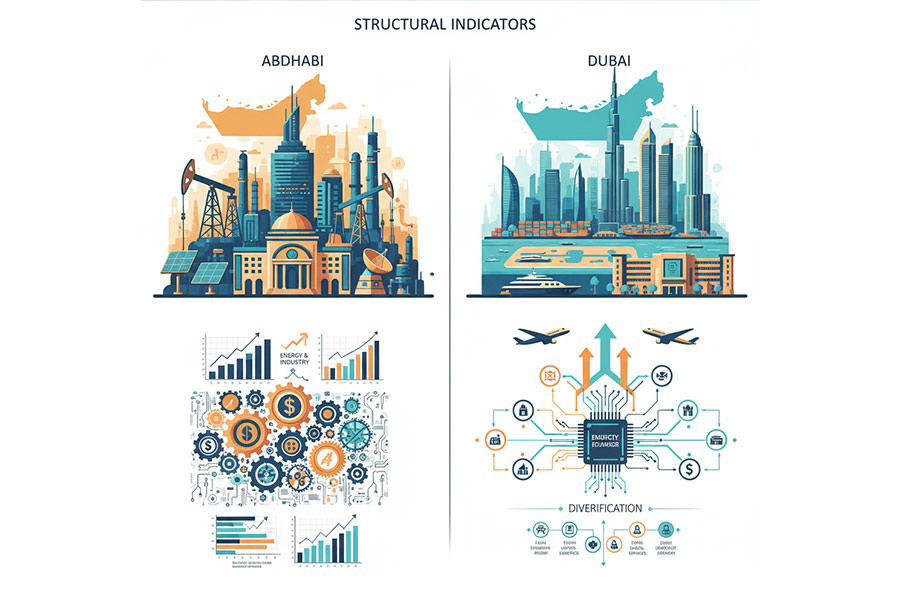
While both emirates benefit from the same national tax environment, their internal economic engines differ significantly a defining characteristic of the Abu Dhabi vs Dubai economy structure.
Investor Origins: Institutional vs Entrepreneurial Capital in the Abu Dhabi vs Dubai Economy
Abu Dhabi attracts primarily institutional capital, sovereign partnerships, pension funds, and ultra-long-horizon investors. Major investment relationships historically involve the United States, the United Kingdom, China, Japan, South Korea, and leading European economies. Investment sectors often include infrastructure, energy transition, advanced technology, semiconductors, aerospace, healthcare, and large industrial platforms.
The Abu Dhabi investor mindset is typically characterized by:
• Long-term capital preservation
• Strategic geopolitical positioning
• Sovereign co-investment partnerships
• Risk management and stability
• Industrial scale deployment
• National economic resilience
Dubai attracts a markedly different investor demographic within the Abu Dhabi vs Dubai economy framework.
Its ecosystem draws entrepreneurs, family offices, private investors, real estate buyers, hedge-fund managers, digital asset founders, traders, and globally mobile professionals. Investor origins are geographically diverse, including Europe, Russia and CIS countries, India, Pakistan, Iran, Africa, Southeast Asia, and increasingly North America.
The Dubai investor mindset often prioritizes:
• Speed and opportunity
• Liquidity and return on investment
• Tax efficiency
• Lifestyle and mobility
• Regulatory flexibility
• Market timing
Another useful distinction in the Abu Dhabi vs Dubai economy lies in capital time horizons.
Abu Dhabi capital often thinks in decades.
Dubai capital often thinks in years sometimes even months.
This difference does not imply lower sophistication in Dubai; rather, it reflects entrepreneurial capital psychology versus sovereign capital psychology.
Government Strategy and Policy Orientation
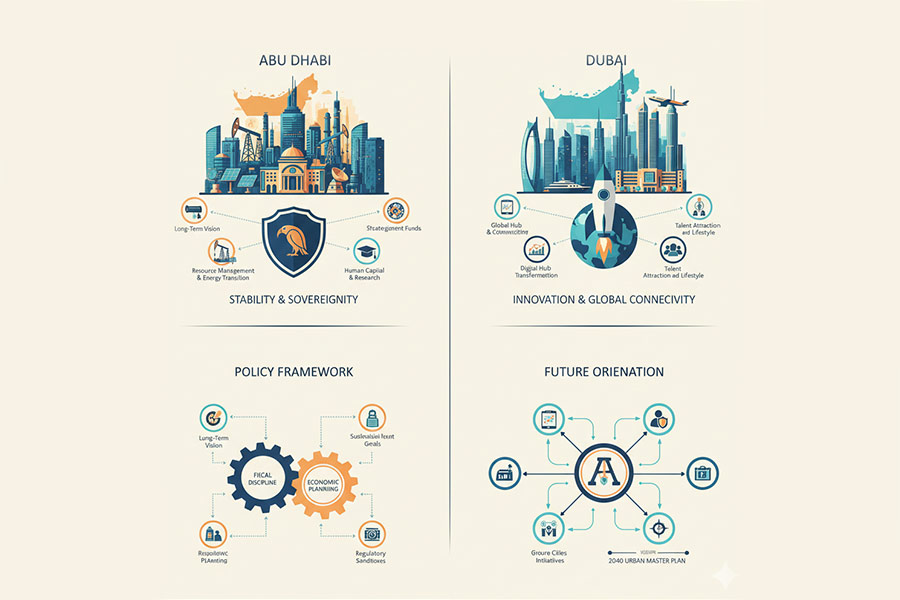
Abu Dhabi’s development agenda focuses heavily on economic diversification beyond oil through industrial policy, advanced manufacturing, artificial intelligence, clean energy, and strategic technology investment. Programs such as Abu Dhabi Economic Vision 2030 emphasize productivity, technological leadership, and long-term national economic security.
Dubai’s strategy emphasizes competitiveness, connectivity, and economic velocity. Policies prioritize free zones, foreign ownership incentives, residency programs, digital economy growth, tourism expansion, and business friendliness. Dubai aims to maximize its role as a global node — a place where capital, talent, and ideas converge.
Together, these approaches reinforce the dual-structure nature of the Abu Dhabi vs Dubai economy.
Demographics and Institutional Environment
Dubai’s population is one of the most internationally diverse in the world, with expatriates forming roughly 90% of residents. This creates a fluid, commercially oriented environment similar to global hubs such as Singapore or Hong Kong.
Abu Dhabi, while also international, maintains a stronger institutional and governmental presence due to its role as the political capital and center of sovereign wealth management. Government entities play a more visible role in economic planning and investment allocation — another structural contrast within the Abu Dhabi vs Dubai economy.
The Strategic Balance of the Abu Dhabi vs Dubai Economy
Importantly, Abu Dhabi and Dubai are not competing models. They are complementary components of a single national system.
Abu Dhabi provides financial gravity sovereign capital depth, geopolitical credibility, and long-term investment capacity.
Dubai provides economic velocity market dynamism, global connectivity, and entrepreneurial energy.
Together, they form a hybrid economic structure rarely seen elsewhere: a nation combining state-capital strength with private-sector agility.
The Future Outlook of the Abu Dhabi vs Dubai Economy
The future trajectory of the UAE may depend precisely on maintaining this balance. As global capital becomes more mobile and technological disruption accelerates, the ability to combine stability with flexibility may become the country’s greatest competitive advantage.
If Abu Dhabi represents strategic patience, Dubai represents adaptive speed.
Modern economic success increasingly requires both dimensions of the Abu Dhabi vs Dubai economy.